As a young lawyer in the Reagan administration, Chief Justice John Roberts fought tooth and nail to oppose the 1982 reauthorization of the Voting Rights Act, which amended the law by requiring courts to look at the discriminatory results of a district map or election law and not just the discriminatory intent. He lost that battle as the reauthorization passed on a wide bipartisan vote.
But he won the war.
Forty-four years later, Roberts joined the majority opinion written by Justice Samuel Alito in Louisiana v. Callais that last week effectively overturned that 1982 reauthorization by requiring voting rights advocates to prove racially discriminatory intent when challenging a district map. The decision now makes it impossible to bring Voting Rights Act challenges to any district map drawn by a state legislature, and presages the greatest rollback of Black political representation since the dawn of Jim Crow.

Southern states are already moving fast to eliminate Black-held congressional seats previously protected by the Voting Rights Act. In the bare week since the decision was released, Florida and Tennessee enacted new maps eliminating Black-majority districts, while Louisiana, Alabama, Mississippi and South Carolina are taking steps to do the same.
The Road to Callais
The road to Callais and the death of the Voting Rights Act was paved by a series of decisions from the Republican-appointed justices that now reveal themselves as disingenuous efforts to pull the wool over the eyes of the public as the Roberts Court continued its march to roll back hard-won rights.
To understand the court’s disingenuousness, let’s start with Alito’s majority opinion in Callais. The decision found that a Black-majority congressional district was an illegal racial gerrymander, in that it had used race as a consideration in trying to account for the racial impact of voting maps. It held that challenges to district maps brought under Section 2 of the Voting Rights Act cannot succeed unless they show intentional racial discrimination, above partisan considerations, by the state map drawers.
This stopped short of finding the law technically unconstitutional, but, in overriding the 1982 amendment, completely neutered it. After all, in the South, the party affiliation of voters falls along racial lines: Black voters predominantly vote for Democrats and white voters for Republicans. The decision allows white Republicans to now eliminate districts electing Black Democrats by merely stating their partisan motive.
Roberts' Long History
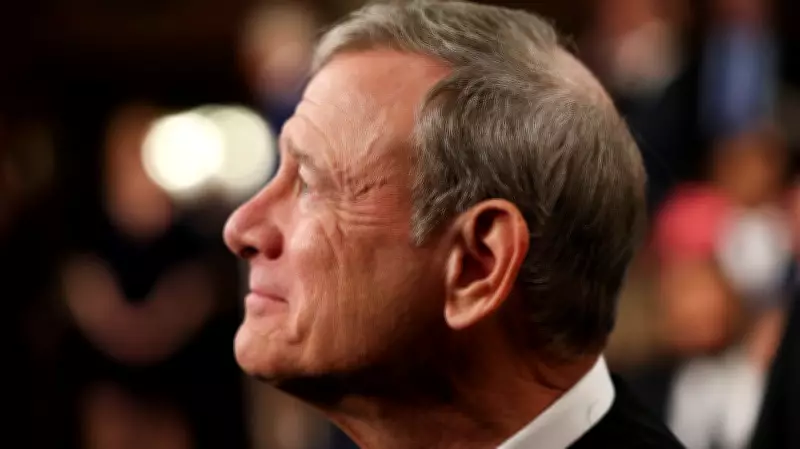
Chief Justice John Roberts' efforts to kill the Voting Rights Act stretch back to the early 1980s. He finally succeeded in Louisiana v. Callais.
The setup, though, was the court’s 2019 decision in Rucho v. Common Cause, which held that federal courts cannot hear cases challenging a district map on the grounds of partisan gerrymandering. In Rucho, Roberts and the court’s Republican-appointed justices held that partisan gerrymandering was a nonjusticiable political question, and that they had no authority to block it, even if the results were undemocratic. But Roberts did go out of his way to note that the decision “does not condone excessive partisan gerrymandering,” in an apparent warning to legislators not to actually aim for undemocratic results.
“Excessive partisanship in districting leads to results that reasonably seem unjust. But the fact that such gerrymandering is ‘incompatible with democratic principles,’ does not mean that the solution lies with the federal judiciary,” Roberts wrote, quoting a previous court decision.
Fast-forward seven years, and this warning now appears wholly disingenuous. In Callais, the court effectively encouraged states to engage in partisan gerrymandering if “that achieves all the State’s objectives,” as Alito wrote.
“[I]n considering the constitutionality of a districting scheme, courts must treat partisan advantage like any other race-neutral aim: a constitutionally permissible criterion that States may rely on as desired,” Alito wrote.
Rather than the court not condoning it, partisan gerrymandering now acts as a “permissible” act to uproot civil rights protections and roll back Black political representation to near nothing in the South.

Section 2: From 'Permanent' to 'Dead Letter'
This is how Alito turns Section 2 of the Voting Rights Act inside-out. But Section 2 was not supposed to be made into a “dead letter,” as Justice Elena Kagan called it in her Callais dissent. Indeed, back in 2013, Roberts assured the public it was “permanent” in his opinion in Shelby County v. Holder.
In that case, Roberts gutted Section 5 of the Voting Rights Act, the provision requiring states with a history of racial discrimination to get preclearance from the Department of Justice for election changes. The ruling declared the preclearance formula was no longer applicable, and anyway, Section 5 wasn’t needed because Section 2, which prohibited racial discrimination in voting, would make up any difference. By stating that Section 2 was “permanent” and “applies nationwide,” Roberts sought to ease concerns that Black and Latino voters would no longer have avenues to protect their rights. With Section 2 now eviscerated, Roberts’ comforting assertion appears to have only been temporary.
Double Standards and the Purcell Principle
The court’s disingenuousness continues today as it considers the mad dash by Republican states to do President Donald Trump’s bidding and redraw their maps ahead of the 2026 midterms or to rapidly eliminate Black-majority districts following Callais.
Just one day before the court issued its decision in Callais, it released a brief order allowing Texas to move forward with the mid-decade redistricting map Trump had pushed, a map that heavily favored Republicans, by reversing a district court decision that found the map was drawn with an intent to discriminate based on race. This is the exact criterion that Alito outlined in Callais as necessary for a Section 2 case to succeed. But this was not even referenced when the court summarily reversed the lower-court decision, over the dissent of the three liberal justices.
This wasn’t the first decision the court had issued regarding the Texas map. On Dec. 4 last year, the court’s conservatives put a hold on a November lower court decision that had blocked Texas’ map, passed by the state legislature in August. The conservative justices argued that the lower court had “improperly inserted itself into an active primary campaign, causing much confusion and upsetting the delicate federal-state balance in elections.” The Texas primary was still three months away, and the candidate filing deadline had not even passed yet. Here, the court applied the “Purcell principle,” a doctrine invented by the current court that argues against courts changing election rules too close to an election.
But this principle has not been applied equally. Just look at how the court deployed the Purcell principle in Alabama in 2022, as opposed to how it is now ignoring it following the decision in Callais.
In February 2022, as the court heard arguments in Merrill v. Milligan, where a lower court found that Alabama must draw a second Black-majority seat under the Voting Rights Act, the conservative justices ordered that the state must continue to use its preexisting map, without that second Black-majority seat, for the upcoming midterm election. The court ultimately upheld the lower court’s decision, meaning that Alabama used an illegal map for the 2022 election — a boon for Republicans, who won control of the House that year by a mere five seats. In a concurring opinion on the order to use the old map, Justice Brett Kavanaugh laid out his explanation for the Purcell principle.
“When an election is close at hand, the rules of the road must be clear and settled,” Kavanaugh wrote. “Late judicial tinkering with election laws can lead to disruption and to unanticipated and unfair consequences for candidates, political parties, and voters, among others. It is one thing for a State on its own to toy with its election laws close to a State’s elections. But it is quite another thing for a federal court to swoop in and re-do a State’s election laws in the period close to an election.”
Alabama’s primary elections were seven weeks away when that decision came down in 2022.
Now look at what is happening following Callais. The ruling was handed down less than three weeks before Louisiana’s primary election, set for May 16: Absentee, overseas and military ballots were already sent out to voters. Around 42,000 Louisianans had already cast votes. Yet, Louisiana Republicans decided to cancel the election to draw a new map eliminating one or two Black-majority districts in the state following the court’s decision.
The court’s conservatives even stepped in to help Louisiana Republicans by waiving the normal procedure of waiting 32 days to send a certified copy of the decision to the lower court that originally heard the case, instead finalizing it immediately. This means that Louisiana Republicans now have a judicial order stating that the current map is illegal and that a new map must be put in place. Instead of pausing the decision’s impact for fear of “unanticipated and unfair consequences” amid an ongoing election, the court’s conservatives sped it up to help Republicans redraw maps ahead of the midterms.
In a fiery dissent from the court’s decision to expedite delivery of the Callais decision to the lower court, Justice Ketanji Brown Jackson accused the majority of “seeming to endorse Louisiana’s efforts to change its congressional map during this primary election, before the pending lawsuits have a chance to play out.”
She specifically called out the double standard. “There is also the so-called Purcell principle, which we invoked only five months ago to chide a federal district court for ‘improperly insert[ing] itself into an active primary campaign,’” Jackson wrote, in reference to the Texas case.
In previous dissents, Jackson referred to the court’s decisions favoring the Trump administration as “Calvinball jurisprudence.” This likened the conservatives’ deference to Trump to the fictional game invented in the comic strip “Calvin & Hobbes” where “there are no rules,” as Jackson wrote, except those made up by the players as they play.
But the Roberts Court’s line of elections cases leading up to Callais is different. They aren’t just making it up as they go along, but engaging in a smarmy and disingenuous project that hid their objectives behind promises that Section 2 of the Voting Rights Act was “permanent” and that partisan gerrymandering would not be condoned.
There’s a word for this: Bullshit.