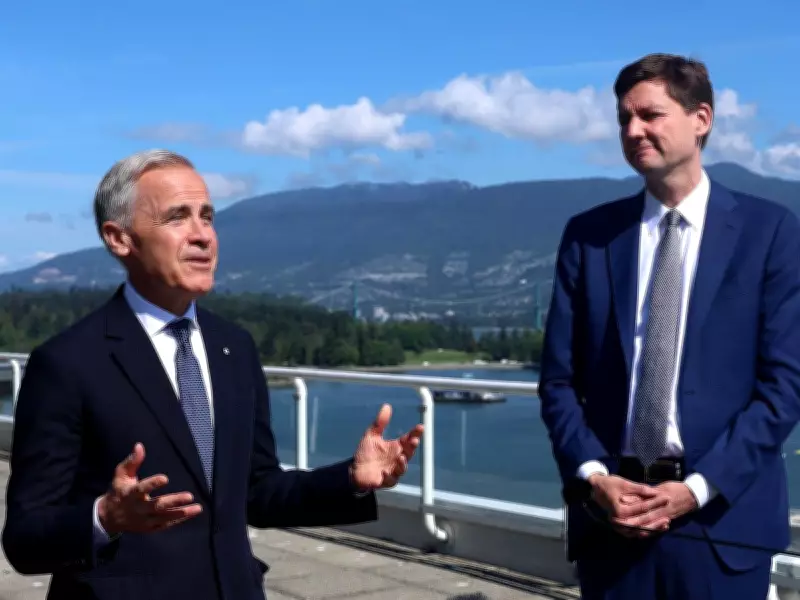
Prime Minister Mark Carney sought to ease tensions over pipeline development in British Columbia during a fireside chat with the Greater Vancouver Board of Trade on Wednesday, promising to make the province a cornerstone of his national economic agenda. The event preceded a high-stakes meeting with Premier David Eby to discuss B.C.'s priorities within Carney's 'build Canada' strategy.
Carney's Message to B.C. Business Leaders
Speaking to a full house of approximately 700 executives and business leaders, Carney emphasized the province's importance in his push for economic independence. YVR CEO Tamara Vrooman described the event as 'the hottest ticket in town, next to the resale of FIFA.' Carney received a standing ovation and reiterated that B.C. 'is in a position of strength' in Canada's energy transition, with much to gain from his goal to double non-U.S. trade within a decade. This includes increasing electricity generation and expanding shipments through the Port of Vancouver.
'To some degree, the vision for B.C., yes, there's the obvious areas — energy, critical minerals, tech,' Carney said during the chat with Board of Trade CEO Bridgitte Andersen. 'But it's also where B.C. wants to take it. What we're trying to accomplish ... is we don't want to hear what people are against, we want to hear what you're for. And if you're for something, let's give full credit to B.C. ... more than one third of the 22 projects and strategies being fast-tracked under the nation-building approach are from British Columbia.'

Pipeline Tensions and Economic Benefits
The meeting with Eby was anticipated as a potential showdown over Alberta's ambitions for a new bitumen pipeline to the West Coast. Eby had previously criticized the project as jumping the queue and 'rewarding bad behaviour' of Alberta's separatist movement. Carney acknowledged opposition in B.C. and among First Nations but stressed that advancing the pipeline 'requires that British Columbians should share substantial economic and financial benefits' and ensure Indigenous consultation and economic benefits.
Eby, however, struck a diplomatic tone before the meeting, declaring that 'there is no doubt in my mind that the Prime Minister is a friend to British Columbia.' He said the goal was to cement an agreement to negotiate B.C.'s priorities in the national strategy, adding that B.C. 'can really deliver for all Canadians.' Yet, he noted that 'an important part of friendship is telling each other the truth, and part of the truth for British Columbia is that the development work we're doing, developing our economy, has to go hand in hand with environmental protection for the next generation.' This includes upholding the North Coast moratorium on oil tanker traffic and 'protecting our pristine North Coast.'
Looking Ahead
Eby expressed hope for 'a fair share for British Columbia of federal investment that the Prime Minister has committed to for this country, and a fair share of enthusiasm for the projects that we're bringing forward.' The meeting at the government's Vancouver cabinet office aimed to solidify B.C.'s role in the national strategy, with both leaders emphasizing collaboration and mutual benefit.