

NYC Snowball Attack on Police Sparks Debate Over Law Enforcement and Political Rhetoric
A brutal cold snap has paralyzed New York City and much of the East Coast, freezing streets and sidewalks while apparently chilling any remaining sense of civic restraint. In Washington Square Park, what began as winter weather escalated into a disturbing confrontation that has raised serious questions about public attitudes toward law enforcement.
Violent Confrontation During Winter Storm
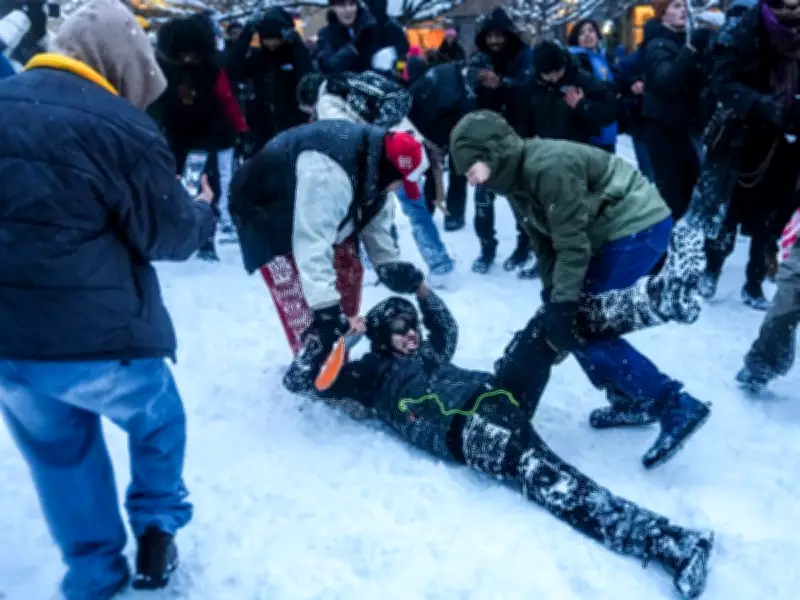
Video evidence reveals a group of adults deliberately hurling snowballs and other objects at responding officers from the New York City Police Department. This was not playful winter roughhousing but rather a coordinated assault involving grown men and women—some masked, others standing brazenly in the open—all apparently confident that consequences would be minimal as they pelted officers arriving on scene.
New York City Police Commissioner Jessica Tisch responded swiftly to the incident, labeling the conduct as "disgraceful" and "criminal" while confirming that detectives have launched a thorough investigation. The city's largest police union, the Patrolmen's Benevolent Association, issued an even sharper warning, noting that officers required medical treatment for injuries sustained during the assault.

The Problem of Confidence and Consequences
The fundamental issue highlighted by this incident centers on confidence—the apparent belief among perpetrators that attacking police officers carries minimal consequences. Assaulting law enforcement personnel is not a prank or political theater but rather a serious crime that demands appropriate legal response. Every individual captured on video throwing objects at officers should be identified, arrested, and charged accordingly according to legal experts.
"Attack a cop, go to jail" represents not a radical slogan but rather the bare minimum required to maintain a functioning urban society. When segments of the public begin treating police officers as legitimate targets rather than protectors of public safety, the very foundations of civic order come under threat.
Political Rhetoric's Role in Shaping Attitudes
Public attitudes toward law enforcement do not develop in isolation but are significantly shaped by the rhetoric of elected officials. When political figures spend years portraying police as inherently suspect or malign, it should surprise no one when certain segments of the public begin treating officers as acceptable targets for hostility.
Consider New York City Mayor Zohran Mamdani, who long before taking office established himself as a sharp critic of policing practices. Words matter profoundly in this context, as does tone. The cumulative effect of constant denunciation creates cultural erosion—an environment where hostility toward police feels permissible and even fashionable among certain groups.
Historical Context and Current Implications
This incident echoes broader national patterns that have emerged over the past decade. Following the unrest in Ferguson, Missouri in 2014, national rhetoric surrounding policing shifted dramatically. The 2020 wave of anti-police protests accelerated this transformation, with calls to "reimagine" or defund police departments moving from activist slogans into serious policy debates and, in some cases, actual governance decisions.
The result in numerous major cities has been confusion about fundamental principles. Law remains only as effective as its consistent enforcement, and order is not automatic but must be actively maintained. When elected leaders send mixed signals about whether officers deserve institutional backing, the public inevitably receives and internalizes that message.
Cold Weather Crisis Adds Complexity
The current cold emergency adds another layer of complexity to this debate. As temperatures plunged dangerously low, the administration highlighted the deployment of more than five hundred outreach workers across New York's five boroughs to connect homeless residents with essential services. The mayor suggested that several recent deaths appeared related to overdoses rather than direct exposure to extreme cold.

However, this distinction raises its own troubling question: Why are so many vulnerable individuals still sleeping on city streets during life-threatening weather conditions? In extreme weather situations, municipalities possess both the authority and, many would argue, the moral obligation to compel vulnerable people into protective shelter. Allowing individuals to remain outdoors—whether they ultimately succumb to cold temperatures or drug overdoses—reflects specific policy choices with potentially fatal consequences.
Testing the Limits of Urban Order
A city that tolerates mobs throwing projectiles at police officers during a blizzard is a municipality flirting with something darker than mere rowdy misbehavior. Such incidents represent tests of the very limits of civic order itself. New Yorkers traditionally pride themselves on resilience, but genuine resilience requires clear rules consistently enforced.
Rules demand enforcement—consistently, unapologetically, and from the top down through the chain of command. If political and civic leaders fail to draw this line clearly and maintain it without compromise, the public will inevitably continue testing boundaries with potentially dangerous consequences for urban safety and social cohesion.
Governance carries profound consequences, as does political rhetoric. The Washington Square Park incident serves as a stark reminder that words and policies shape public behavior in ways that extend far beyond theoretical debates into the realm of physical safety and social stability.





