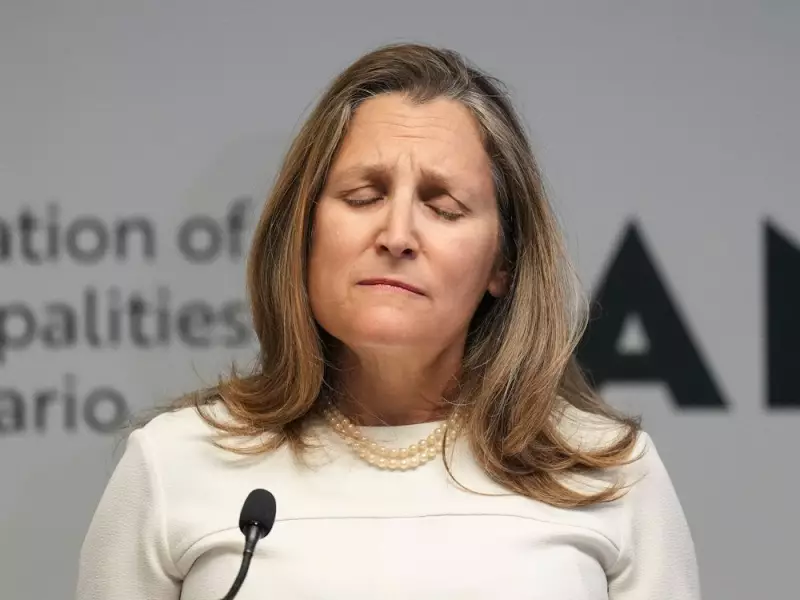
An unusual situation involving a high-profile Canadian politician has exposed a surprising gap in the nation's parliamentary rules. It is technically legal for a sitting Member of Parliament to accept employment from a foreign government, a fact highlighted by former Deputy Prime Minister Chrystia Freeland's recent appointment as an advisor to Ukrainian President Volodymyr Zelenskyy.
The Freeland Controversy and the Absence of Rules
In early January 2026, Ukrainian President Volodymyr Zelenskyy announced the appointment of Chrystia Freeland as an "Advisor on Economic Development." At the time, Freeland was already in Ukraine serving as a special envoy appointed by Prime Minister Mark Carney. Although she had resigned from the federal cabinet in mid-2025, she remained the MP for the Toronto riding of University-Rosedale and had voted in the House of Commons as recently as December 11, 2025.
The appointment sparked immediate criticism from opposition MPs. Roman Baber, the Conservative MP for York Centre, labeled it a "blatant conflict of interest." Michael Chong, the Conservative foreign affairs critic, stated firmly that "one cannot be a Canadian MP and an advisor to a foreign government."

However, these criticisms were based on perceived ethical breaches, not legal ones. Freeland announced she would step down from the special envoy role immediately and resign as an MP in "the coming weeks," but she did not break any explicit Canadian law or parliamentary rule by accepting the foreign advisory position while still holding her seat.
What the Law Actually Says (and Doesn't Say)
The legal framework governing who can serve as an MP in Canada is remarkably permissive regarding foreign allegiances. The Canada Elections Act sets only basic requirements: a candidate must be a Canadian citizen, at least 18 years old, and not incarcerated. It explicitly bars members of provincial legislative assemblies but is silent on employment by foreign governments or even service in foreign parliaments.
This stands in stark contrast to the rules for the Senate. Canada's founding document, the 1867 British North America Act, stipulates that a senator can be removed for making any "Declaration or Acknowledgement of Allegiance, Obedience, or Adherence to a Foreign Power." No such prohibition was extended to members of the elected House of Commons.
Furthermore, the Conflict of Interest Act, which imposes post-employment "cooling off" periods on parliamentarians dealing with certain businesses, does not apply to foreign governments. This creates a scenario where, theoretically, a sitting MP could even take a side job as a foreign head of state without violating Canadian statute.
Broader Implications and International Comparisons
The Freeland case has ignited a debate about the adequacy of Canada's ethical safeguards for its elected officials. The incident reveals that the country's laws are built on an assumption of propriety rather than explicit prohibition, a model that may be outdated in an era of complex global entanglements.
The article notes that some of Canada's peer nations address potential conflicts from foreign ties through controls on dual citizenship or more stringent parliamentary codes of conduct. The Canadian framework, however, leaves the matter largely to political convention and public scrutiny.
Freeland's involvement in passing the Liberal government's 2025 budget, which included significant civil and military aid for Ukraine, further underscores the potential for perceived conflicts, even if no legal line was crossed. The episode raises fundamental questions about loyalty, transparency, and whether Canada's parliamentary rules require modernization to address the realities of 21st-century geopolitics.