Montreal Demonstrators Rally in Support of U.S.-Israel Military Actions in Iran
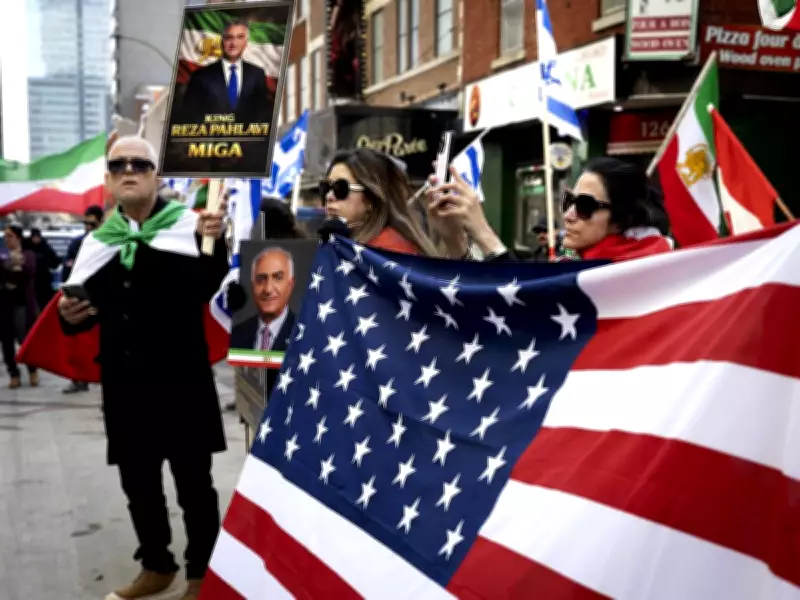
Approximately fifty demonstrators assembled outside the United States consulate in downtown Montreal on Wednesday, March 4, 2026, expressing strong support for recent military strikes conducted by the United States and Israel against Iran. The gathering featured participants waving American and Israeli flags alongside the historic lion-emblazoned flag of pre-revolutionary Iran.
Voices from the Protest: Gratitude and Calls for Change
The crowd chanted "President Trump, thank you" and danced to the Village People's 1978 hit YMCA, a song frequently associated with former U.S. President Donald Trump's political rallies. One prominent sign displayed portraits of Trump, Israeli Prime Minister Benjamin Netanyahu, and Reza Pahlavi, the son of Iran's last Shah, whom some hope could lead a future Iranian government.
Mahbod Nazeri, a protester who immigrated to Montreal from Iran seven years ago, articulated the central message of the demonstration. "The war isn't against Iran. It's for Iran," Nazeri stated, despite acknowledging the tragic human cost of the conflict. He described the military action as necessary for Iran's future, using the metaphor: "To make peace, you first need to cut off the snake's head," referring to the current Iranian leadership.

Personal Perspectives and Political Analysis
Nazeri revealed that his parents remain in Iran and support the strikes, even telling him "Bomb us." Another demonstrator, Melody Tabatabaian, born in Montreal to Iranian parents, wore a Make Iran Great Again cap and expressed deep appreciation for Trump and Netanyahu's actions. She characterized the U.S. and Israeli militaries as a "people's army" providing essential external help against what she called a "terrorist regime."
Tabatabaian referenced a severe government crackdown in January that reportedly killed at least 7,000 protesters in Iran, with human rights groups suggesting the actual number was likely higher. "It's the first time that an administration picked the people of Iran over the regime and finally took action," she remarked, though Nazeri noted that while American and Israeli interests typically come first, they now recognize greater benefits in collaborating with the Iranian people.
Contrasting Views and Critical Voices
Not all perspectives at the event were uniformly supportive. Nimâ Machouf, a Montreal epidemiologist and former NDP candidate with Iranian heritage, described the pro-war protests as "very sad." While expressing hope for democratic change in Iran, Machouf warned that the war risks replacing one dictatorship with another and questioned American motives.
"If what comes after is a democratic solution, we'll be able to consider it a positive," Machouf said. "But do you think that the Americans are spending billions of dollars in public money to help Iran achieve a democratic government?" She suggested U.S. interests lie more in controlling Iran's substantial oil and gas reserves than in liberating its people, drawing parallels to the 2003 invasion of Iraq.
The Human Cost and Ongoing Debate
The demonstration occurred on the fifth day of the U.S.-Israeli military campaign, which has resulted in significant casualties. Reports indicate at least 1,100 deaths in Iran, including Supreme Leader Ayatollah Ali Khamenei. A particularly tragic incident involved a strike on a girls' school that killed at least 168 pupils according to Iran's semi-official Tasnim News Agency.
Machouf acknowledged widespread Western antipathy toward the Iranian government and admitted feeling "very happy" upon hearing of Khamenei's death. However, she maintained that "this war is unjust" despite public pressure to support it. Nazeri countered by distinguishing Iran from other conflict zones, asserting: "Iran is not Afghanistan. Iran is not Iraq. Because the Iranian people know what they want."
The Montreal protest highlights the complex and divided responses within the Iranian diaspora community to international military intervention, reflecting broader global debates about sovereignty, democracy, and the ethics of foreign policy actions.