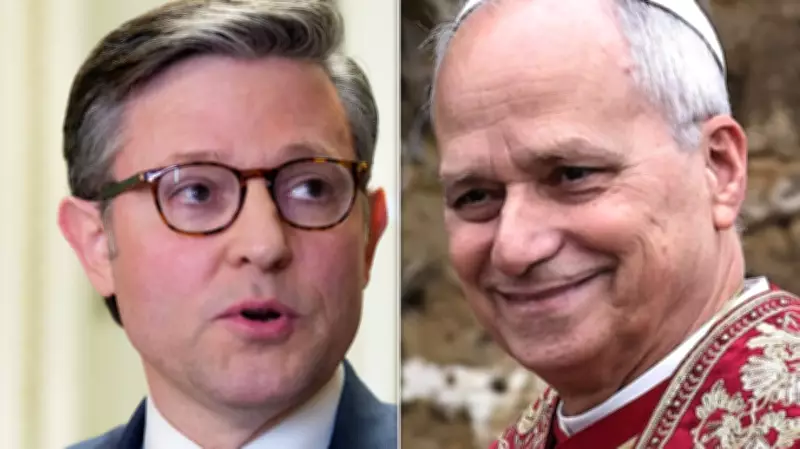
House Speaker's Scriptural Justification for Immigration Stance Draws Widespread Criticism
House Speaker Mike Johnson, a Republican from Louisiana, has ignited a significant controversy by attempting to use biblical scripture to defend the Trump administration's hardline immigration agenda. The Southern Baptist politician faced immediate backlash on social media platforms, where critics mockingly accused him of trying to "out-Bible the Pope" in his theological arguments.
The Scriptural Exchange That Sparked the Debate
The controversy began when Johnson was questioned by Migrant Insider editor Pablo Manríquez about Pope Leo's recent citation of Matthew 25:35. The current leader of the Roman Catholic Church had referenced the biblical passage, which states "For I was hungry and you gave me something to eat, I was thirsty and you gave me something to drink, I was a stranger and you invited me in," while urging "deep reflection" on how migrants are treated in the United States.
When asked how he would respond to Pope Leo using scripture, Johnson initially quipped, "So you want me to give you a theological dissertation?" before proceeding to outline his position. He later expanded his arguments in a detailed 1,300-word post on the social media platform X, formerly known as Twitter.

Johnson's Biblical Case for Border Security
In his response, Speaker Johnson made several key arguments rooted in his interpretation of biblical teachings:
- Sovereign borders as biblical principle: Johnson asserted that "sovereign borders are biblical and right and just," arguing this position stems from love for citizens rather than hatred toward outsiders.
- Assimilation expectations: The House Speaker claimed the Bible welcomes immigration but teaches that "assimilation is expected and anticipated and proper." He emphasized that newcomers should not seek to change a nation's laws or society.
- Government's role in maintaining order: Johnson argued that scripture requires civil authorities "to maintain order," a responsibility he accused the Biden-Harris administration of neglecting regarding border security.
Johnson elaborated further, stating, "We should love our neighbor as ourselves, as individuals, but as a civil authority and the government has to maintain the law and that is biblical and it's right and it's just."
Widespread Criticism and Accusations of Hypocrisy
The response to Johnson's biblical defense was swift and overwhelmingly critical across social media platforms. Critics leveled several accusations against the House Speaker:
- Cherry-picking scripture: Many commentators accused Johnson of selectively choosing biblical passages while ignoring others that emphasize compassion for strangers and refugees.
- Hypocrisy charges: Several critics pointed to what they perceived as contradictions between Johnson's interpretation and broader Christian teachings about welcoming the stranger.
- Questioning theological authority: Some users questioned Johnson's qualifications to make theological arguments, particularly when contradicting the leader of the Roman Catholic Church.
- Political weaponization of faith: Numerous responses suggested Johnson was twisting religious teachings to justify predetermined political positions.
One particularly pointed criticism came from a user who wrote, "Watching a politician try to out-Bible the Pope to defend mass deportations is wild. You can dress it up in scripture all you want, but twisting faith to fit policy like this just feels dishonest and cynical."
Broader Implications for Political Discourse
This incident highlights the ongoing tension between religious interpretation and political policy in American discourse. The exchange demonstrates how biblical references continue to play a significant role in political arguments, particularly regarding emotionally charged issues like immigration.

The controversy also raises questions about the appropriate use of religious authority in political debates and how different interpretations of shared scriptures can lead to dramatically different policy conclusions. As the debate continues online, it reflects broader societal divisions regarding immigration policy and the role of faith in public life.
Johnson's detailed scriptural defense and the vigorous response it generated suggest that these theological-political intersections will likely remain contentious as immigration policy debates continue to evolve in the coming political cycles.