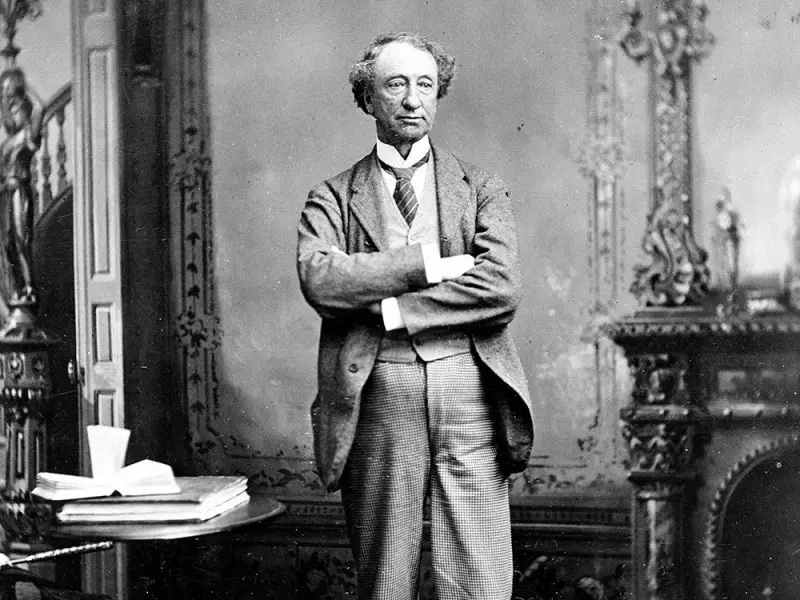
Sir John A. Macdonald, Canada's first prime minister, is experiencing a notable resurgence in public discourse, coinciding with what would have been his 211th birthday. This revival is not merely symbolic, marked by the return of his statue to Queen's Park and the revival of the Prime Ministers Path in Wilmot, Ontario, but also ideological.
The 'Build Canada' Ethos Returns
A new civic movement, embracing a 'Build Canada' ethos, is gaining traction. This perspective argues that Canada's identity extends beyond politeness and apologies; it is fundamentally about the hard work of constructing and reinforcing a nation. The philosophy champions values such as 'growth is good,' 'bold beats safe,' and the celebration of success.
This shift in perspective is often catalyzed by existential threats. Whether personal crises or geopolitical instability—such as the potential for a protectionist and unpredictable American presidency—such moments force a nation to re-evaluate its history. The question evolves from 'how should we judge our past leaders?' to 'what can we learn from them?'

Parallels Between Macdonald's and Carney's Challenges
The challenges confronting Prime Minister Mark Carney's government bear a striking resemblance to those Sir John A. Macdonald navigated in the 19th century. The core issues remain: the urgent need to build national infrastructure, respond to a protectionist and sometimes threatening United States, stitch together a cohesive east-west economy, and manage deep-seated regional rivalries that threaten national unity.
No project exemplifies this more than the Canadian Pacific Railway (CPR). It was a monumental, audacious undertaking to lay steel tracks across a continent, traversing impassable mountains long before significant settlement. Its primary purpose was political and national: to link British Columbia—a province that logically could have joined the United States after the 1867 Alaska Purchase—with the eastern provinces, thereby creating the physical backbone of a transcontinental nation.
Nation-Building Over Pure Business Cases
Critics of the CPR, much like modern detractors of major infrastructure projects like pipelines, argued there was no viable 'business case.' Private investors were reluctant, and those who did participate preferred a route south through the United States for greater profitability. Macdonald's government had to actively lure capital with substantial incentives, prioritizing national vision over immediate market logic.
The project was not without severe cost and controversy. It led to the Pacific Scandal of 1873, which forced Macdonald's government to resign. However, he returned to power in 1878 with a renewed mandate. Following a depression and debates over free trade, he implemented his famous National Policy. This comprehensive plan focused on protective tariffs to shield Canadian industry, aggressive immigration to populate the West, and the relentless push for railway expansion—all designed to forge a strong, independent national economy from coast to coast.
The legacy of Macdonald's era, with its blend of bold vision, political pragmatism, and acceptance of necessary compromise, is being re-examined as a potential guidebook. As Canada confronts 21st-century tests of sovereignty, economic resilience, and unity, the foundational struggles of its first prime minister offer not just historical judgment, but potentially, actionable lessons.