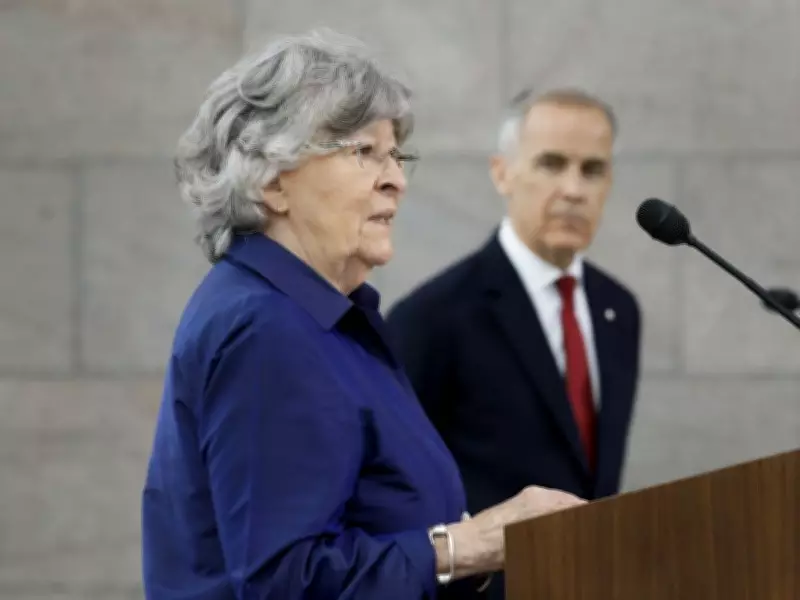
With every Governor General appointment comes an opportunity. In July 2021, Prime Minister Justin Trudeau used it to smooth over an Indigenous relations maelstrom that began swirling in May of that year, when a B.C. First Nation announced that it found 215 “graves” (later corrected to “potential graves”) at the site of the old Kamloops residential school. It’s no coincidence that he settled on the appointment of Mary Simon, a half-Inuk woman, to symbolize his reconciliation efforts and show the community that they had a stake in Canada’s highest offices, too.
In 2026 — and billions of reconciliatory dollars later — it’s not the Indigenous who are most unhappy within Confederation but Western Canadians. Between one-fifth and one-third of Albertans favour separation, and the numbers out of Saskatchewan are close. And that’s just the crest of the alienation wave: many more federalist Albertans are frustrated with how they’re treated by Ottawa. Which is why the appointment of a Governor General from out west should have been a top priority.
Instead, we’re getting Louise Arbour, the most Laurentian of Laurentian elites, whose resume entries range from Canadian Supreme Court judge to United Nations Eurocrat. At a time like this, especially considering how office appointments have served as olive branches to communities in pain in the past, naming Arbour to the role is profoundly alienating to Western Canada.

The last time the region had the pride of putting forth a Governor General was more than 20 years ago, when Ray Hnatyshyn of Saskatchewan held the post. A lawyer, former member of Parliament, and former attorney general of Prime Minister Brian Mulroney, he certainly had the practical understanding of the role upon his swearing-in in 1990. He was in office until 1995, serving alongside Mulroney as well as Prime Ministers Kim Campbell and Jean Chrétien.
Subsequent Governors General originally came from New Brunswick, Hong Kong, Haiti, Ontario and, twice, Quebec. Of course, representation shouldn’t be the only criterion that determines who should fill the post. In fact, in an ideal world, the Governor General would be selected based on their commitment to service to the Crown, and their constitutional knowledge of the role, which is why we previously recommended appointing someone from the military leadership.
Alas, the reality is representation does figure into the appointment, particularly with Liberals, so given the length of the drought since there was a Governor General from the West, it deserved extra consideration.
That shouldn’t have been hard for the Liberals to give, seeing how they are the experts in breaking the population down into statistics and increasingly granular sub-categories that come with new entitlements to group privileges as a matter of achieving equity. Liberals have expanded bilingualism requirements throughout public offices and the judiciary to the point of locking out the best candidates from the West (Arbour, of course, is bilingual). Racial and gender expectations have dominated the conversation when it comes to appointments, hires and promotions. It’s their guiding principle.