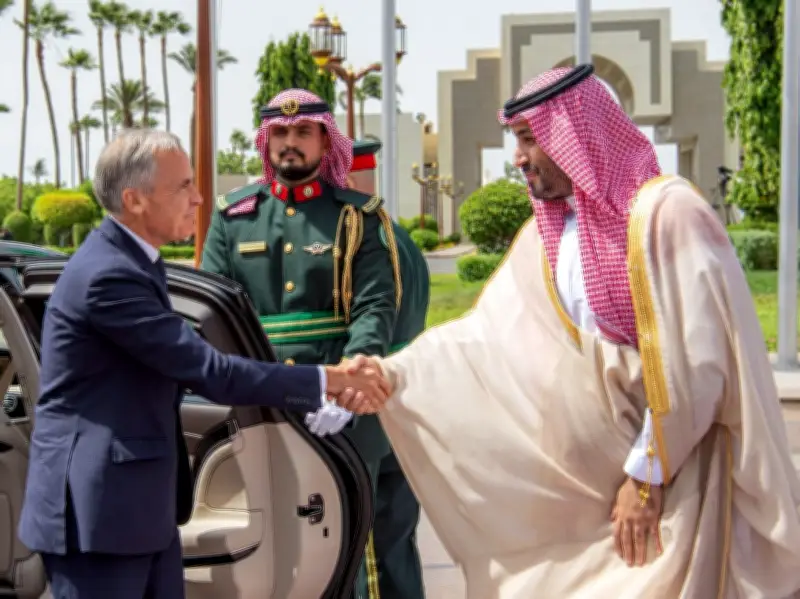
On Thursday, Prime Minister Mark Carney stood in Jeddah, Saudi Arabia, and declared that lecturing other countries is ineffective, a statement that marks a significant shift from the foreign policy of his predecessor, Justin Trudeau. However, critics are pointing out that Carney's pragmatic approach appears to stop at the U.S. border, as he continues to organize opposition to Donald Trump.
Carney's Saudi Comments Mark a Policy Shift
Speaking at Al-Salam Royal Palace during an official visit, Carney responded to a question about doing business with countries where Canada holds different views on human rights. “Lecturing countries from afar is an ineffective strategy. It’s satisfying, but it’s ineffective,” Carney said, according to a handout picture released by the Saudi Ministry of Media.
The comments are notable given that in 2018, the Trudeau government's public criticism of Saudi Arabia over the arrest of activist Samar Badawi led to a diplomatic rupture. Canada's ambassador was expelled, the Saudi ambassador was recalled, trade halted, and Saudi students studying in Canada were told to return home. Neither Samar nor her brother Raif Badawi were Canadian citizens at the time, though Raif's wife and children had fled to Canada and later became citizens.

Trudeau's Moralizing Foreign Policy Came at a Cost
The Trudeau government's tendency to lecture other nations also damaged relations with India. In 2020, Trudeau voiced support for farmers protesting in India, many of whom were Sikhs from Punjab. In an online video, Trudeau said, “Canada will always be there to defend the right of peaceful protest. We believe in the importance of dialogue.” Yet less than two years later, his government used police on horseback and froze bank accounts to quell a domestic protest he opposed.
Carney has since repaired relations with India and is now mending ties with Saudi Arabia. This pragmatic approach—taking the world as it is—has been welcomed by many. But critics argue that Carney fails to apply the same logic to the United States under Donald Trump.
Carney's Anti-Trump Stance Undermines Pragmatism
According to a two-part report from the Wall Street Journal published this week, Carney has spent months lobbying European officials to organize against Trump. Using his British cellphone number, he regularly texts leaders, checks in, and pushes for a middle-power vision he outlined at the World Economic Forum in Davos in January. In one text to British Prime Minister Keir Starmer, Carney wrote: “We don’t have a relationship to keep!” In another conversation, he told European leaders: “The old America isn’t coming back.”
While Carney's points about diversifying away from U.S. reliance have merit, his approach risks needlessly irritating a key trade and defence partner. “Carney can accept Turkey and Saudi Arabia as they are and do business with them, so he should try doing the same with the U.S.,” the article states.
Carney's inability to apply his own pragmatic philosophy to Trump—oscillating between sycophantic praise in person and behind-the-scenes opposition—undermines his credibility on foreign policy. As Canada remains deeply dependent on the U.S. for trade and security, many argue that a more consistent, less confrontational approach would serve the country better.