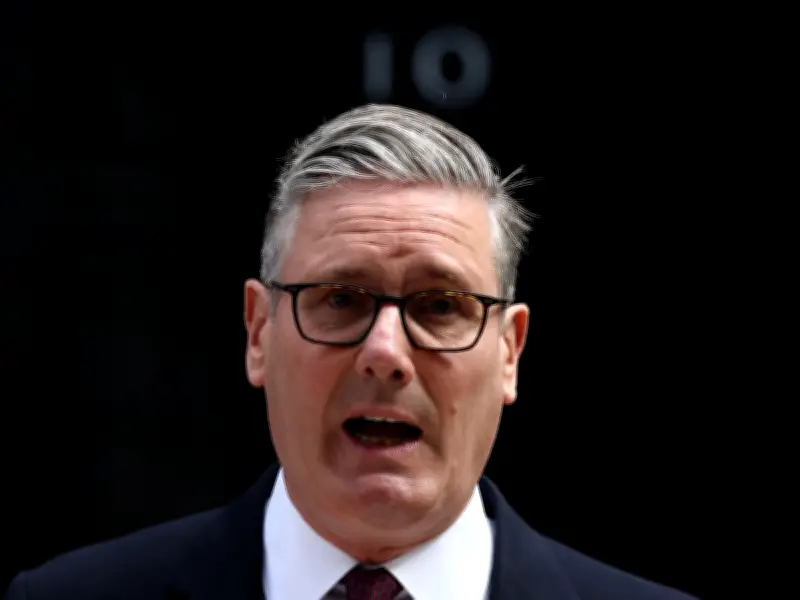
Keir Starmer announced his resignation as Britain's prime minister from the steps of 10 Downing Street on Monday, but his remarks were overshadowed by “Ode to Joy,” the official European Union anthem, blasted from nearby loudspeakers by a Remainer activist. Britain is now on course for its seventh prime minister since it voted to leave the European Union 10 years ago, as the country cycles through leaders amid deepening crises.
Starmer's Forced Exit and Trump's Disclosure
Starmer was in control of neither the music, nor the timing of his resignation, having been all but forced out of office by a Labour party that had long soured on his premiership. The announcement itself was also not his to control: U.S. President Donald Trump disclosed Starmer’s resignation the day before he did, summing up the lopsided relationship between the two executives. Trump posted on social media on Sunday, “Keir Starmer will resign as Prime Minister of the United Kingdom. He failed badly on two very important subjects – IMMIGRATION AND ENERGY (OPEN NORTH SEA OIL!).”
That may prove to be one of the more sympathetic epitaphs to Starmer’s tenure, which failed on far more counts than those two, partly as a result of a political system with stasis baked into its core. That system, which upholds legalism as an end in itself, procedure for its own sake, and a generalized sticklerism over effective governance, could find no more consummate avatar than the outgoing prime minister — who does not dream, have a favourite book or film, or possess a hinterland beyond a pedestrian, played-up enthusiasm for football and the occasional pint. He was an unremarkable man who felt the need to thrust himself to the centre of an exceptional time.

Britain's Historic Juncture and Starmer's Hollow Leadership
Britain is at an historic juncture: it has undergone profound demographic change, with more than five million migrants arriving in as many years; the economy is plausibly heading for insolvency; the last three summers have seen rioting along ethnic lines; and Reform, Nigel Farage’s new political party, is the favourite to head the next government. The country has cycled through leaders, sanguinely hoping one of them would be up to the task of carving a path through this confluence of crises and potentially seismic political developments. Starmer is the latest reminder that such hopes have so far been in vain.
Starmer promised change and was swept into office two years ago in a least-worst-option general election, the result of which was rooted in antipathy towards a Tory party that squandered 14 years in power, rather than enthusiasm for Labour or its wooden leader. He enjoyed the briefest of honeymoons — three weeks of vibes-based praise from the mainstream press — before reality set in.
Broken Promises and Policy U-Turns
Starmer jettisoned his campaign promises, announcing policies as if the opposite pledges had never been committed to paper. He attempted modest reforms, to welfare and other expenditures, only to U-turn on virtually every major decision. One week, he declared women could have penises. When fashion dictated, he changed his mind. Another week saw him designate Britain as an “island of strangers.” Then, weeks later, he confessed to not having read the speech in advance, and disowned the phrase. Starmer the leader proved as elusive and hollow as Starmer the man: defined, fleetingly, by his last volte-face.