Conservative MP's Washington Mission Sparks Partisan Debate Over Canada-US Relations
In a political climate often marked by division, Conservative MP Jamil Jivani's recent trip to Washington, D.C. has ignited a contentious debate about what constitutes genuine national interest versus partisan posturing. The Industry Minister Mélanie Joly's dismissive response to Jivani's diplomatic efforts reveals a troubling inflexibility that could hinder Canada's position in crucial trade negotiations with the United States.
A Conservative's Unconventional Approach to Bilateral Relations
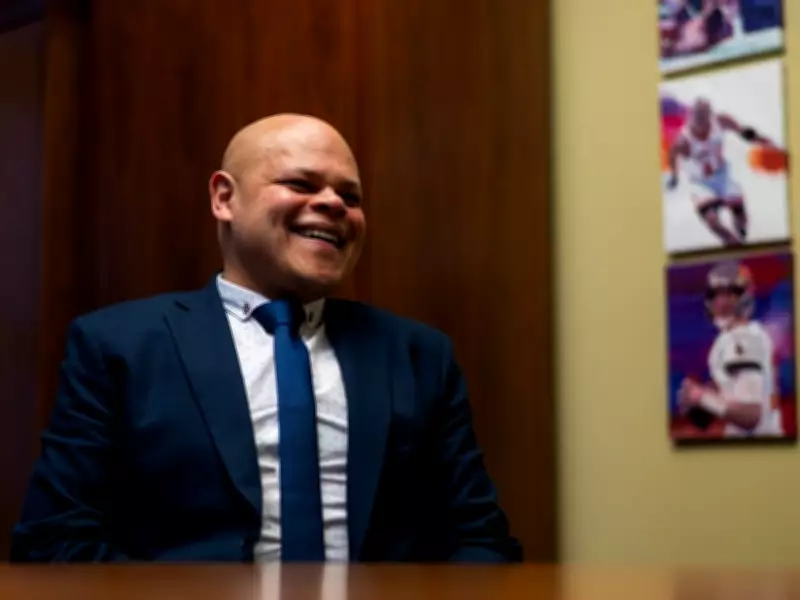
Jamil Jivani, photographed in his Ottawa office earlier this year, made a surprising announcement via social media platform X that he intended to visit the White House. His stated purpose was remarkably straightforward: to "help Prime Minister Mark Carney be successful in negotiating a trade deal with the United States." For a Conservative MP to offer assistance to a Liberal government might seem counterintuitive in today's polarized political environment, but Jivani framed it as a matter of urgent national importance.
"The reality is that this is so important to the Canadian economy, and to our future as an independent, self-reliant nation, that Conservatives and Liberals don't need to fight over this at all," Jivani explained. "In fact, we need to work together." He emphasized that Canada's economy remains "perpetually in a state of uncertainty" until these critical trade matters are resolved, expressing particular concern about recent agreements allowing more Chinese electric vehicles into the Canadian market while the domestic auto industry faces significant challenges.

Liberal Response: Skepticism Over Strategic Value
When questioned by CTV's Vassy Kapelos about whether Jivani had requested or received a briefing before his Washington trip, Industry Minister Mélanie Joly responded with what appeared to be dismissive skepticism. With an attitude bordering on revulsion, Joly shook her head and pointedly questioned Jivani's priorities: "Why is he just embracing the Trump administration that is putting tariffs on them? Why is he basically not denouncing the U.S. auto tariffs?"
Kapelos pressed further, asking whether Jivani could genuinely help the government through his Washington connections. Joly's response revealed a fundamental misunderstanding of negotiation dynamics: "I'm not in his heart nor in his mind. I'm just looking at what he says and what are the facts." She noted that Jivani only began discussing General Motors layoffs after she publicly criticized him for not addressing the issue, concluding "it talks for itself."
The Missed Opportunity for Bipartisan Cooperation
What makes Joly's response particularly troubling is what it reveals about the Liberal government's approach to international negotiations. Jivani possesses a valuable asset that any government should want to leverage: a genuine friendship with U.S. Vice-President J.D. Vance. In the complex world of international diplomacy, personal relationships often prove more valuable than formal channels, yet Joly seemed unwilling to recognize this strategic advantage.
Prime Minister Mark Carney echoed similar sentiments, telling reporters that while the Liberals maintain extensive White House contacts, Jivani was nonetheless given a briefing by Intergovernmental Affairs Minister Dominic Leblanc. This acknowledgment suggests some recognition of Jivani's potential value, yet the overall Liberal response remains characterized by skepticism rather than strategic embrace.
The Broader Implications for Canadian Diplomacy
The fundamental question raised by this episode transcends partisan politics: when a political opponent offers to help advance national interests, should that offer be rejected on ideological grounds or embraced for potential mutual benefit? Jivani's Washington mission represents more than just a single MP's initiative; it tests whether Canadian politicians can prioritize national interest over partisan advantage.

Successful trade negotiations require flexibility, creativity, and the willingness to utilize every available resource. By dismissing Jivani's efforts as politically motivated rather than evaluating their potential strategic value, Liberal ministers may be undermining Canada's position in crucial negotiations. As the Canadian auto industry faces unprecedented challenges and the broader economy navigates uncertainty, the ability to forge bipartisan approaches to international relations becomes increasingly vital.
Ultimately, Jivani's Washington trip highlights a persistent tension in Canadian politics between partisan loyalty and national interest. His argument that "Conservatives and Liberals don't need to fight over this" challenges the conventional wisdom of opposition politics, suggesting that some issues are too important for partisan division. Whether this perspective gains traction or remains an outlier will significantly influence Canada's approach to future international negotiations and domestic political cooperation.