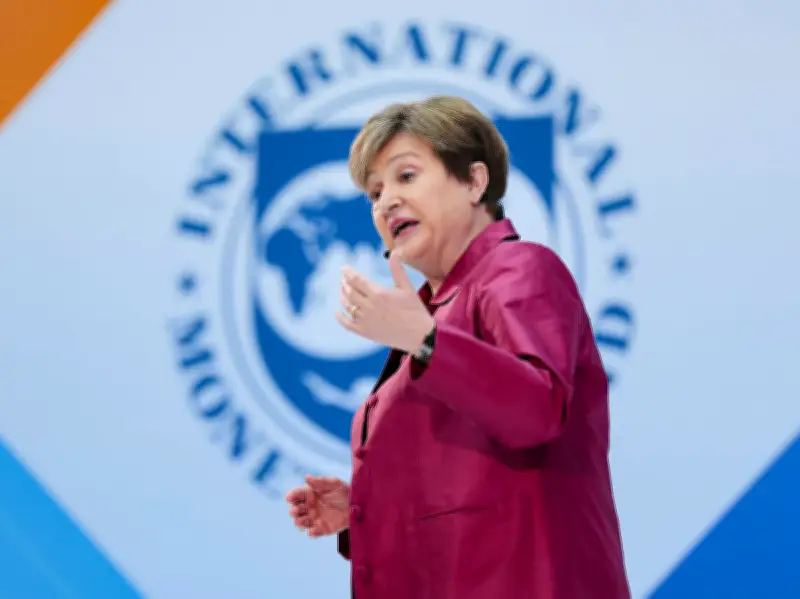
International Monetary Fund Managing Director Kristalina Georgieva has issued a stark warning that the global community is not adequately prepared for the escalating series of economic shocks. Speaking on Bloomberg's podcast 'Leaders with Francine Lacqua,' Georgieva emphasized that the world must build more resilient foundations to withstand the increasing frequency of crises.
IMF's Lending Capacity and Leadership
The IMF currently possesses a lending capacity of nearly US$1 trillion. Georgieva, who has led the Washington-based institution since 2019, has navigated through multiple global crises, including the COVID-19 pandemic, the war in Ukraine, trade tariff turmoil, and the ongoing conflict in the Middle East. Her primary objective, as she described, is to maintain unity among the IMF's 191 member nations for the collective benefit of the global economy.
“I am worried that we are not completely internalizing yet that this is how the world is going to be,” Georgieva stated. “We are not going to get to a place where shocks are gone.” She stressed that the IMF's most effective tool is its objective analysis of global economic conditions.

Artificial Intelligence and Inequality
One significant transformation underway is the proliferation of artificial intelligence and its potential impact on labor markets and local economies. Georgieva acknowledged that institutions, including the IMF, failed to recognize the inequalities arising from globalization, and she is determined to prevent a similar oversight with AI.
“We collectively, including the fund, did not appreciate the backlash against globalization that came from the fact that, yes, the world economy is doing better as a whole, but many communities were hollowed out because their jobs disappeared and there was not enough attention to them,” she said. “I’ll tell you what I’m very keen not to see repeated is the same with artificial intelligence.”
Global Economic Outlook and Russia Assessment
The IMF is set to update its global economic outlook in July, following a downgrade in April due to the Middle East conflict. The fund also conducts annual economic reviews of member countries as part of its surveillance mandate.
Regarding Russia, the IMF announced in 2024 that it would resume its annual economic review, known as Article IV, for the first time since the war in Ukraine began. This decision faced criticism from several European Union countries, who argued that engaging Russia economically would legitimize efforts to evade sanctions. Georgieva noted that the review was delayed due to the ongoing conflict and Russia's reluctance to provide data on trade and imports. “At some point we will have the regular assessment restarted,” she said, without specifying a timeline.
The IMF has provided substantial financial support to Ukraine since Russia's invasion, including programs totaling US$15.6 billion in 2023 and US$8.1 billion this year, tied to key reforms.