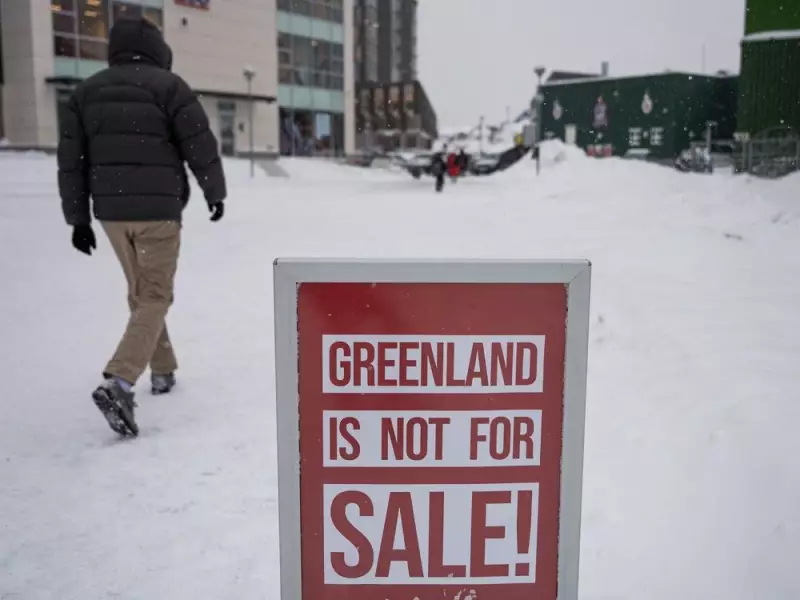
Danish Lawmaker's Controversial Remarks Interrupted in European Parliament
During a heated debate in the European Parliament this week, Danish politician Anders Vistisen delivered a blunt message to former U.S. President Donald Trump regarding his persistent campaign to acquire Greenland. "Let me put this in words you might understand," Vistisen declared during discussions about European Union responses to sovereignty threats. "Mr. President, f—k off."
The lawmaker's speech was abruptly cut short by parliamentary vice president Nicolae Stefanuta, who immediately intervened. "I am sorry, this is against our rules," Stefanuta stated firmly. "We have clear rules about cuss words and language that is inappropriate in this room. It is unacceptable, even if you might have strong political feelings about this."
History of Confrontational Language Toward Trump
This incident marks the second time Vistisen has employed such explicit language toward Trump in parliamentary settings. Almost exactly one year earlier, on January 13, 2025, the Danish MP delivered similar remarks after Trump first suggested acquiring Greenland early in his second presidential term.

"Dear President Trump, listen very carefully," Vistisen asserted at that time. "Greenland has been part of the Danish kingdom for 800 years. It is an integrated country. It is not for sale." He concluded with the same profane directive that would later get him interrupted in 2026.
While Vistisen wasn't stopped during his 2025 remarks, Stefanuta did issue a warning afterward. "The term you used is not allowed in this house and there will be consequences," the Romanian politician cautioned. "Regardless of what we think of Mr. Trump, it is not possible to use such language." The specific reprimands Vistisen may have faced remain unclear.
Greenland's Government Prepares for Potential Conflict
Meanwhile, Greenland's leadership is taking tangible steps to prepare for what Prime Minister Jens-Frederik Nielsen describes as a possible military invasion scenario, however unlikely. Speaking at a press conference in Nuuk, Greenland's capital, Nielsen emphasized the need for preparedness.
"It's not likely there will be a military conflict, but it can't be ruled out," the Prime Minister stated frankly. "We need to be ready for all scenarios."
Task Force Formation and Emergency Preparedness
Greenland's government is establishing a comprehensive task force with representatives from all relevant local authorities to help citizens prepare for potential disruptions. The initiative includes:
- Developing new emergency guidelines for the population
- Recommending households maintain five days' worth of food supplies
- Coordinating responses across government agencies
- Addressing infrastructure and logistical concerns
Finance Minister Mute B. Egede echoed the Prime Minister's concerns, noting that Greenland faces "a lot of pressure" and must prepare accordingly.
Geopolitical Context and Military Developments
The tensions stem from Trump's repeated assertions that the United States needs to own Greenland for security reasons. The former president recently posted an AI-generated image depicting himself planting a U.S. flag on the Arctic island, further escalating concerns.
Greenland, with its population of approximately 57,000 people, maintains self-governance over most domestic matters while remaining part of the Kingdom of Denmark, which handles defense and foreign policy. In response to growing tensions, Denmark has recently deployed additional troops to Greenland to bolster Arctic defenses.
NATO Involvement and International Ramifications
Security measures have expanded significantly in recent days. Denmark and seven other NATO countries deployed officers to Greenland as part of Operation Arctic Endurance, with plans to potentially extend military exercises year-round according to Greenlandic media reports.

Trump responded to these developments by threatening new tariffs against the eight NATO allies involved, effective February 1, further straining transatlantic relations. The situation highlights the complex intersection of Arctic sovereignty, international diplomacy, and domestic preparedness in an increasingly tense geopolitical landscape.