President Donald Trump's military campaign against Iran has driven up oil prices and inflation, while significantly damaging his approval rating and lasting much longer than initially anticipated. Despite these setbacks, Republican lawmakers in Congress expressed support on Thursday for further escalation of the conflict if the president deems it necessary.
Trump's Threats and Republican Backing
After two days of renewed hostilities, Trump wrote on his website Thursday morning that the U.S. would attack Iran "VERY HARD TONIGHT" and could soon seize an island off the Iranian coast crucial to the country's oil production. However, by Thursday afternoon, Trump announced he had canceled the strikes, again citing positive developments in negotiations.
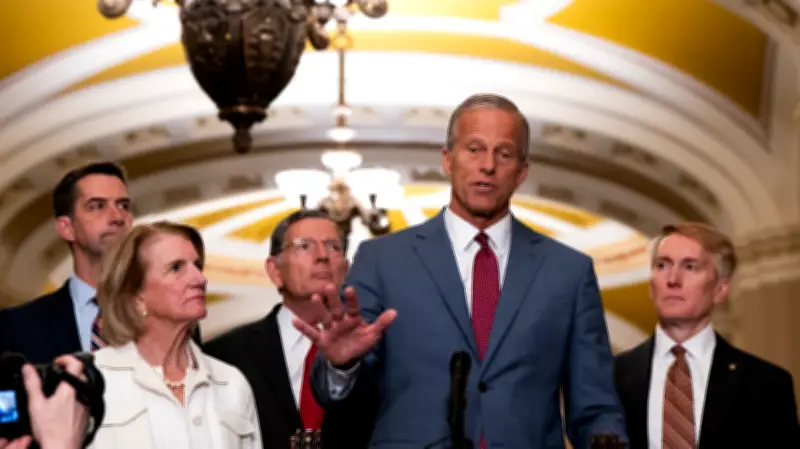
Before Trump's apparent reversal, Senator Roger Wicker (R-Miss.), chair of the Senate Armed Services Committee, told reporters he supported the president being "much more aggressive"—a sentiment echoed by several other senators. Senator Roger Marshall (R-Kan.) stated, "I certainly think it’s the time for us to stand behind the president. I think it’s time to stand with our military, and really, we can’t allow Iran to have nuclear weapons."

Economic Fallout and Public Disapproval
Republican support for escalating the war comes a day after the Bureau of Labor Statistics reported that inflation had surged to 4.2% in May, a level unseen since the Biden administration. The price increase was directly linked to the Iran conflict, which has pushed up oil costs. The American public has grown increasingly opposed to the war, with voters disapproving by a 21-point margin that has widened since spring, according to a survey aggregator.
Uncertain Objectives and Prolonged Conflict
Trump stated in March, early in the conflict, that it might last only four or five weeks. Three months later, there is no clear metric for success beyond reopening the Strait of Hormuz—which Iran closed as a result of the war—and halting Iran's nuclear program, which Trump claimed last year he had already obliterated. Senator Chuck Grassley (R-Iowa) remarked, "The progress has been delayed because the Iranians are doing the usual thing, not negotiating in good faith. Delay, delay, delay."
Senator Todd Young (R-Ind.) said, "I think it’s necessary for the president to apply more pressure and get more leverage within negotiation. It appears that’s what he’s attempting to do."
Minority Opposition Within the GOP
Despite broad support, there is some opposition to the war from within the president's party. Both the House and Senate have passed symbolic resolutions to end the war, thanks to votes from a handful of Republicans. Senators Rand Paul (Ky.), Lisa Murkowski (Alaska), Susan Collins (Maine), and Bill Cassidy (La.) have voted to advance an antiwar resolution. While more Republicans might join as Democrats continue to force war votes, it is unlikely there would be enough support to override a presidential veto soon.
Senator Murkowski said the war "doesn’t appear to be going in the right direction." When asked if she trusted Trump's latest claim that a deal is imminent—a claim he has made 38 times before, according to CNN's tally—she replied, "I think you know the answer to that question."
Senator Josh Hawley (R-Mo.), who has voted against resolutions to end the war but cautioned in March against deploying ground troops and expressed hope for a "swift end" to the conflict, was reluctant to comment on Trump's fresh threats. "I don’t have a reaction, to be honest, because I imagine some of that is—maybe all of it—is directed towards Iran, you know, to say this is what we could do, but I just, I don’t know," Hawley told reporters Thursday.