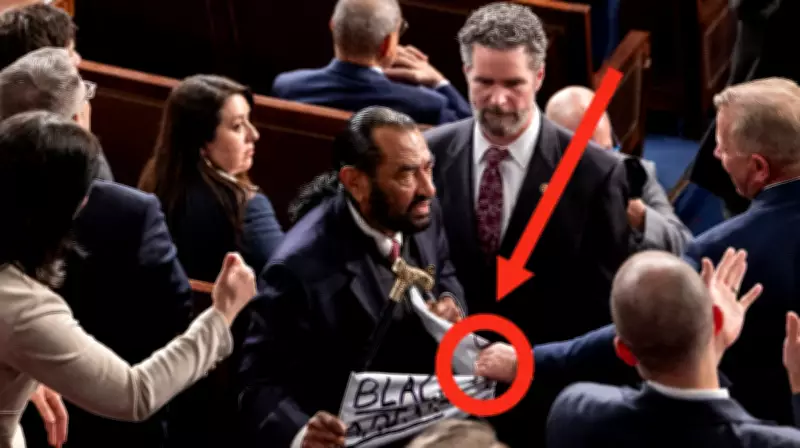
Republican Lawmakers Attempt to Seize Protest Sign at State of the Union Address
During President Donald Trump's State of the Union address on Tuesday night, several Republican lawmakers were captured on camera attempting to physically remove a protest sign from Democratic Representative Al Green's hands. The Texas Democrat had been holding up the sign in silent protest as the president entered the House chamber and began his speech.
The Content of the Sign and Its Context
Green's sign read: "Black people aren't apes!" This statement directly referenced a video that Trump had shared on his Truth Social platform earlier in the month, which featured a racist depiction of former President Barack Obama and former First Lady Michelle Obama as apes. Trump refused to apologize for the video, instead blaming a staffer for posting it in error.
As Trump entered the chamber, Representative Steve Scalise (R-La.), who was walking beside the president, raised his hand to block Green's sign before grabbing it and pulling it downward. Later, as others in the audience stood to applaud the president's arrival at the podium, Green again raised his sign. At this point, Senator Markwayne Mullin (R-Okla.) walked several feet toward Green and attempted to snatch the sign from his hand, though Green managed to dodge the attempt.

Escalation During Removal from Chamber
The situation escalated further as Green was being escorted out of the House chamber by the sergeant-at-arms. Representative Troy Nehls (R-Texas) was seen grabbing and pulling at the sign while the Democrat made his exit. Other Republican officials, including Representatives Pat Fallon (R-Texas) and John McGuire (R-Va.) along with Senator Roger Marshall (R-Kan.), also made efforts to block Green's sign from camera view.
Following the address, Green explained his motivations to reporters. "If you tolerate this level of racism, you perpetuate it," he stated, referencing the racist depiction of the Obamas. "I refuse to tolerate it. I don't want to see it normalized." He emphasized his desire to communicate directly with Trump, saying, "I need him to know that there's some people that have the courage to tell him things that he doesn't want to hear and that nobody else will tell him. On some issues, it's better to stand alone than not stand at all."
Academic Perspectives on the Incident
Kari J. Winter, a professor of American studies at the University at Buffalo whose expertise includes gender, feminism, race, and class, expressed admiration for Green's courage. "I mourn for my country, which has plunged into such a dark abyss that it takes courage to say that Black people are human," she told HuffPost. Winter argued that the sign-snatching attempts demonstrate that Republicans do not support free speech on issues they disagree with, stating, "Since 2016 the Republican mantra has been 'free speech for me, not for thee.' In other words, they are vehemently opposed to freedom of speech."
Tabitha Bonilla, an associate professor of political science and human development and social policy at Northwestern University, highlighted what she sees as a double standard within the Republican Party. "They want the ability to say what they want, post what they want, without challenge or consequence," she explained. "But when people step up to object, Republican leadership is quick to verbally disparage those who disagree and not the disagreement itself. If you want the freedom to post dehumanizing images of people online, then you have to let other people have their reactions to that. Otherwise, you don't believe in free speech."
Historical Context and Broader Implications
This is not the first time Green has been removed from the House chamber during a presidential address. Last year, he was escorted out when he protested the GOP's budget plan by yelling, "You have no mandate to cut Medicaid." Bonilla noted that the physical response to Green's sign is part of a pattern, referencing an incident from the previous year when Representative Lance Gooden (R-Texas) snatched a sign from Representative Melanie Stansbury (D-N.M.) that read "This is NOT normal."

"The behavior is not democratic and is counter to the principles that Americans value about the right to speech and the ability to dissent," Bonilla asserted. Winter added a more critical perspective, stating, "A basic tool of totalitarianism is to cast shame on the victims of state violence while glorifying the perpetrators of state violence. MAGA revels in this topsy-turvy state of moral confusion. I'm guessing that they keep turning up the volume on their outrage to try to drown out the still small voice of their conscience."
Additional Controversy Surrounding Nehls
Representative Troy Nehls faced additional backlash beyond his attempt to grab Green's sign. He arrived at the State of the Union wearing a necktie featuring imagery of Trump's face and was later seen asking the president to sign it as he left the chamber. Social media users criticized these actions as "cringe" and "pathetic." Winter commented on this behavior, saying, "Nehls took his place in a long line of fawning sycophants who prostrate themselves at the feet of tyrannical power. Such abject self-degradation is not only cringe, it's antithetical to the spirit of American democracy."
The incident has sparked a broader conversation about political decorum, free speech, and the state of American democracy, with experts suggesting that such actions reveal deeper issues within the political landscape.