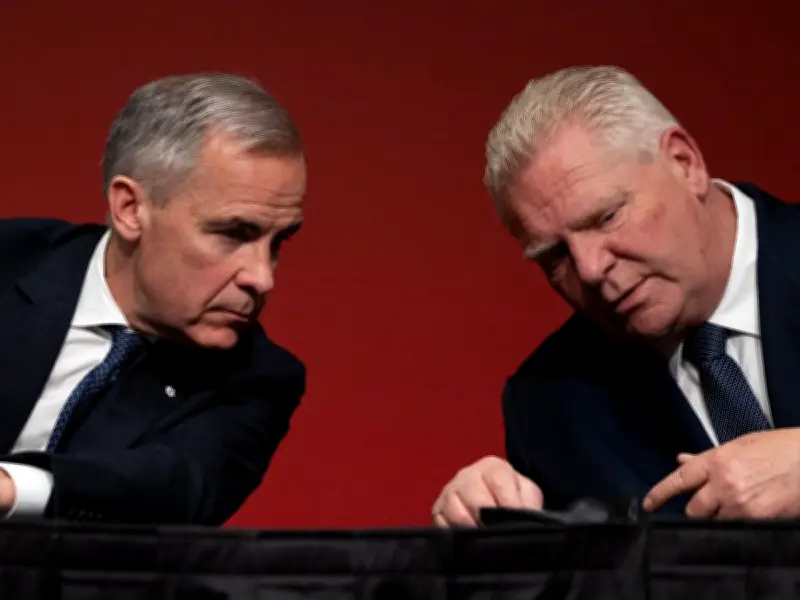
Ontario Premier Doug Ford spent this week promoting his version of free trade in the United States, but he faces a tougher sell back home as two major transportation megaprojects encounter rising public opposition.
Airport Expansion Under Fire
Ford must convince Ontarians that his plan to expand Toronto’s Billy Bishop airport is worthwhile. A coalition of 28 civic and business leaders is calling for a “reality check” on the project’s impacts.
On Wednesday, nearly 1,000 people—including farmers, citizens’ groups, and rural and federal politicians—protested on Parliament Hill against Prime Minister Mark Carney’s Alto high-speed rail project. They fear expropriation of land will devastate their communities.

Same Approach, Different Projects
When it comes to major infrastructure, Ford and Carney share a common philosophy: build big, build fast, and don’t slow down for anyone. Both projects seem driven by the attitude “Sounds great. Let’s do it.”
In their rush, the leaders have largely skipped the step of explaining why the projects make sense after weighing drawbacks against advantages. Ford supports high-speed rail but prefers using existing routes; Carney hasn’t decided whether to back the airport plan. Yet neither project has a publicly released feasibility study or business case.
Lack of Public Consultation
Even allowing for some NIMBYism, the prominent Torontonians questioning the airport plan make a reasonable point: expansion should not proceed until the public has been consulted on a detailed plan.
It is easy to see why people would support easier air access to downtown Toronto, but harder to imagine how Billy Bishop expansion would work. The government envisions an airport serving 10 million passengers annually—five times current capacity—on a 200-acre site. By contrast, Pearson International handles 47 million passengers on 4,613 acres.
Pearson is expanding to handle 65 million passengers, and the province spent $456 million on a direct rail link from Pearson to Union Station. One selling point of Alto is reducing demand for air travel. How many solutions are needed for the same problem?
Cost Considerations
The Billy Bishop plan makes more sense than Carney’s rail plan, though that is a low bar. At least the estimated $5 billion cost of the enlarged airport will be covered by passengers, not taxpayers.