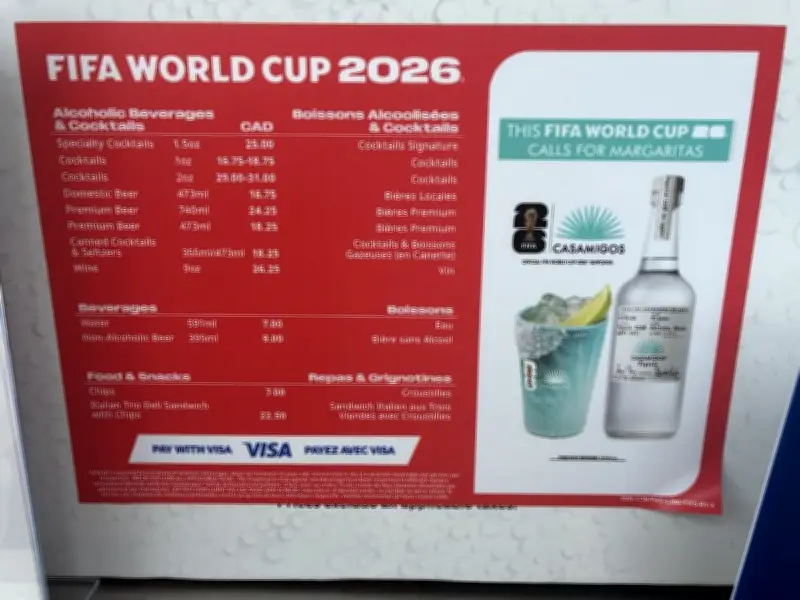
At a tournament already raking in billions, FIFA is maximizing revenue on match days with concession prices that have united the world in disbelief. A $7 bottle of water? A $57.50 hot dog and soft drink combo? Welcome to the 2026 World Cup.
The Price of a Meal
Consider this: a cheap seat for Canada's opening game against Bosnia-Herzegovina in Toronto cost about $1,100. A pair of hot dogs and soft drinks at that game? A mere five per cent of the admission. But that still means $57.50 for the meal.
Readers quick with math will note the other way to think about it: those hot dogs and soft drinks cost $57.50.

Shock and Awe in the Concourses
A week into the World Cup, stadiums across North America have seen jubilation, drama, heartbreak, and joy. But also shock and amazement as visitors discover the cost of anything at FIFA's quadrennial party. Even in Toronto, where high concession prices are routine, these cause a sharp intake of breath. Visitors from other countries find a $17 beer unfathomable.
Seven Canadian dollars for a small bag of chips. $17.75 for fried pickles. $25.25 for chicken tenders and fries. $14.75 for a vegan hot dog. Charging almost $15 for vegan anything should be a crime.
Drinks and More
Fancy a drink? Seven dollars for a bottle of water. Nine for a bottle of Coke. $16.75 for a tall can of beer. A specialty cocktail will run you $25, but you don't get the whole bottle. A nine-ounce glass of wine is $26.25, though the wine is not from Gianni Infantino's private reserve—just run-of-the-mill stuff.
FIFA's Pricing Strategy
FIFA says its concession pricing is in line with local markets, explaining why items are cheaper in Guadalajara than Boston or Toronto. But the prices seem particularly unreasonable given that FIFA has already fleeced fans with incredibly high ticket prices. Four-digit prices are routine for high-profile games, denounced as a betrayal by groups across Europe and South America. FIFA responded late last year by making a small number of tickets available to supporters' groups for less than $100.
While FIFA is a non-profit using the World Cup to fund other activities, reports indicate it is building reserves like never before. The Athletic reported a combined surplus of US$1.1 billion after the four-cycle ending with the 2022 Qatar World Cup. Budgeted revenues for this cycle are US$13 billion, a 72 per cent increase, fueled partly by money extracted from match-going fans.