Democrats Dig In on Immigration Enforcement Reforms as DHS Funding Deadline Looms
Congressional Democrats are maintaining a firm stance in their demands for significant immigration enforcement reform within legislation that funds the Department of Homeland Security. This unwavering position sets the stage for a potential agency shutdown unless a last-minute agreement is reached before a critical Friday deadline. The standoff highlights deep partisan divisions over the operations and accountability of Immigration and Customs Enforcement.
Competing Proposals and Unmet Demands
Democratic leadership on Capitol Hill and the White House under President Donald Trump have exchanged competing proposals aimed at reforming ICE tactics. These discussions follow the tragic deaths of two American citizens in Minnesota last month during enforcement actions. However, Democrats argue that Republican negotiators are not demonstrating genuine commitment to implementing substantive accountability measures and necessary reforms.
House Democratic Leader Hakeem Jeffries of New York revealed to reporters on Tuesday that the White House opposes two key Democratic conditions for supporting DHS funding. These include requiring ICE or Border Patrol agents to obtain judicial warrants for home raids and permitting independent investigations into officer conduct. These are among ten specific demands put forward by Democrats.

"And they're not open to the type of training that is needed in order to ensure that taxpayer dollars are not being used to brutalize American citizens or, in some cases, kill them," Jeffries stated emphatically.
Regarding the issue of ICE agents wearing masks during operations, Jeffries described it as more of an "open question" whether the Trump administration would consider prohibiting the practice. Nevertheless, he expressed little optimism, noting, "They don't appear to be open to masks either or necessarily ensuring that ICE agents are identifiable in a manner consistent with every other law enforcement agency in the country."
Senate Democrats Threaten Legislative Blockade
Senate Democrats successfully insisted that DHS funding be separated from a broader government funding package passed last month, establishing the current Friday deadline. With negotiations showing minimal progress, numerous Democratic senators are now threatening to block the DHS funding bill entirely if their reform demands are not met.
Such a blockade would have limited immediate impact on ICE operations, as the agency maintains its own funding stream established by GOP budget legislation passed the previous year. However, it could precipitate a shutdown of other critical DHS components, including the Federal Emergency Management Agency and the Transportation Security Administration.
Senator Angus King, an independent who aligns with Democrats, indicated broad consensus within the caucus, stating he knew of no Democratic senator willing to support another short-term funding extension without "serious reforms to ICE." King was among those who previously broke with his party to end a full government shutdown in November.
Senator Chris Murphy of Connecticut criticized Republican negotiators, asserting, "They don't seem interested in trading actual offers. I just think they may be betting that the public's attention is going to move somewhere else. I think that's a bad bet. I think people are on our side."
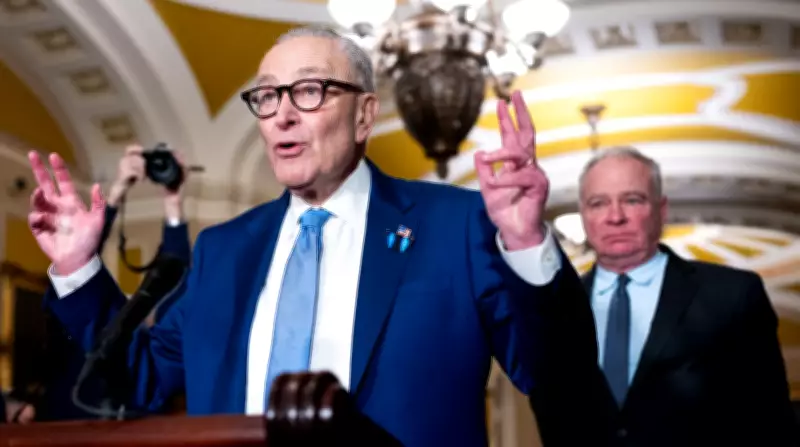
When questioned about potentially blocking a short-term extension, Senate Minority Leader Chuck Schumer of New York did not explicitly rule out the possibility, instead emphasizing, "There's no reason we can't get this done by Thursday."
Funding Stakes and Political Blame Game
The DHS funding legislation in question allocates approximately $10 billion specifically to ICE, alongside billions more for other federal agencies including the Coast Guard, TSA, and FEMA. Republican leaders have warned that Democrats would bear responsibility if these agencies experience a funding lapse.

Senate Majority Leader John Thune of South Dakota cautioned on Tuesday, "A government shutdown ― even one that affects just one agency ― is not in anybody's interest, least of all that of the hardworking Americans who staff these agencies and the American people who depend on their important work."
The White House has indicated continued engagement with Democrats regarding ICE reforms, marking a departure from its approach during the November shutdown when President Trump largely avoided negotiations. That previous shutdown coincided with a decline in the president's approval ratings.
A White House official stated, "We are continuing to have constructive conversations with members of both parties. President Trump wants the government to remain open and for critical services to remain funded."
ICE Leadership Testifies Amid Mounting Tensions
Meanwhile, the heads of ICE and Border Patrol testified before the House Homeland Security Committee. Republican Chairman Andrew Garbarino of New York acknowledged that immigration enforcement has reached an "inflection point" with an opportunity to restore public trust.
Acting ICE Director Todd Lyons adopted a defiant posture, complaining that ICE personnel face excessive threats while performing their duties. Both Lyons and Border Patrol Director Rodney Scott asserted that their agents receive adequate training for dealing with protest situations. The two individuals fatally shot in Minnesota were activists monitoring immigration officers.
Lyons acknowledged that new ICE recruits undergo a shorter training regimen than longer-tenured officers but insisted they complete the same curriculum. He visibly bristled at comparisons between ICE agents and Nazi Germany's secret police. When pressed by Democratic Representative Eric Swalwell of California, Lyons declined to apologize to the families of Rene Good and Alex Pretti, who were killed while protesting immigration enforcement in Minnesota and were subsequently labeled "terrorists" by senior Trump administration officials.
"I'm not going to comment on the investigation, and the president and Secretary Noem are elected officials," Lyons responded.
Chairman Garbarino suggested the hearing could positively influence negotiations, stating, "The answers that we got today from the head of ICE and CBP cleared up a lot of confusion as to training and how officers are armed. So I think it did a lot to calm the public and calm members down with getting us more information."
However, Senator Schumer strongly disagreed with this assessment, arguing that conditions in Minneapolis remain unchanged. "Thousands of agents are still roaming the streets, people are still being assaulted by federal law enforcement, and it's only a matter of time before someone else gets seriously hurt or God forbid killed," Schumer declared in a floor speech. "If the heads of ICE and Border Patrol are genuine about lowering the temperature, they should tell Congress that the only real answer is commonsense bipartisan legislation. Nothing else will suffice."