Carney Government's Conflicting Stance on India's Security Threat to Canada
Prime Minister Mark Carney's administration is under intense scrutiny for its inconsistent and contradictory messaging regarding the threat posed by India to Canada's national security. This confusion within the government raises serious questions about transparency and the prioritization of trade over safety, echoing criticisms from recent foreign interference inquiries.
Inconsistent Security Assessments from Key Agencies
The Royal Canadian Mounted Police (RCMP) and the Canadian Security Intelligence Service (CSIS) have provided conflicting reports on India's activities in Canada. In October 2024, RCMP Commissioner Mike Duheme stated there was "strong evidence" linking a campaign of violence to the highest levels of the Indian government. However, by March 2026, Duheme reversed this position, claiming no current clandestine activities or transnational repression linked to India or any foreign country.
Meanwhile, CSIS has maintained a consistent stance, identifying India as one of the main perpetrators of foreign interference and espionage against Canada. In February 2026, CSIS Director Dan Rogers testified before a parliamentary committee, citing "China, Russia, India and others" as the most active threats. This position was reinforced by a CSIS spokesperson in March 2026, who confirmed that the agency's threat assessment has not changed.

Government Officials at Odds Over Security Threats
The confusion extends to senior government officials, who have made contradictory statements. Prior to Carney's trip to India in February 2026, an unnamed senior official claimed the government believed India no longer posed a security threat, stating, "We're confident that that activity is not continuing." This assertion was quickly contradicted by Public Safety Minister Gary Anandasangaree and Foreign Affairs Minister Anita Anand, who both distanced themselves from the official's comments.
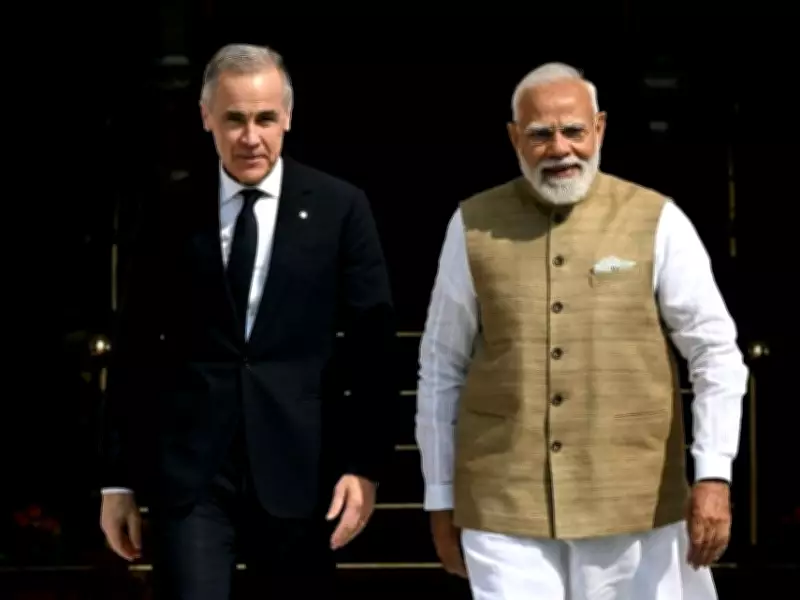
Prime Minister Carney himself echoed this cautious approach, emphasizing vigilance and engagement with India. He stated, "I would not use those words... our approach is one of vigilance and engagement." This backpedaling highlights a lack of cohesive communication within the Liberal government, reminiscent of the foreign interference inquiry's findings that criticized poor transparency.
Historical Context and Trade Implications
The issue stems from the 2023 accusation by former Prime Minister Justin Trudeau that India was involved in the extra-judicial killing of Canadian Sikh leader Hardeep Singh Nijjar. This led to a diplomatic rift, with both countries expelling diplomats. Carney's government appears to be attempting to reset Canada-India relations to expand trade, but this effort has sparked concerns about compromising national security.
India's high commissioner to Canada, Dinesh K. Patnaik, has denied any foreign interference, asserting, "It never happened." Despite this, the foreign interference inquiry's final report identified India as second only to China in attempts to interfere in Canada's electoral process, underscoring the ongoing risk.
Key Points of Contention
- RCMP's shifting stance: From strong evidence of Indian government involvement in violence to no current connections.
- CSIS's consistent warnings: Maintaining that India remains a top threat for foreign interference.
- Government discord: Senior officials and ministers providing conflicting messages on security threats.
- Trade vs. security: Concerns that Carney's push for improved trade relations may overshadow national safety.
The safety of Canadians should never be sacrificed in the name of trade, yet the Carney government's muddled response to India's alleged interference suggests a troubling lack of clarity and coordination. As this situation unfolds, it is imperative for the administration to adopt a unified and transparent approach to protect national interests without compromising security.