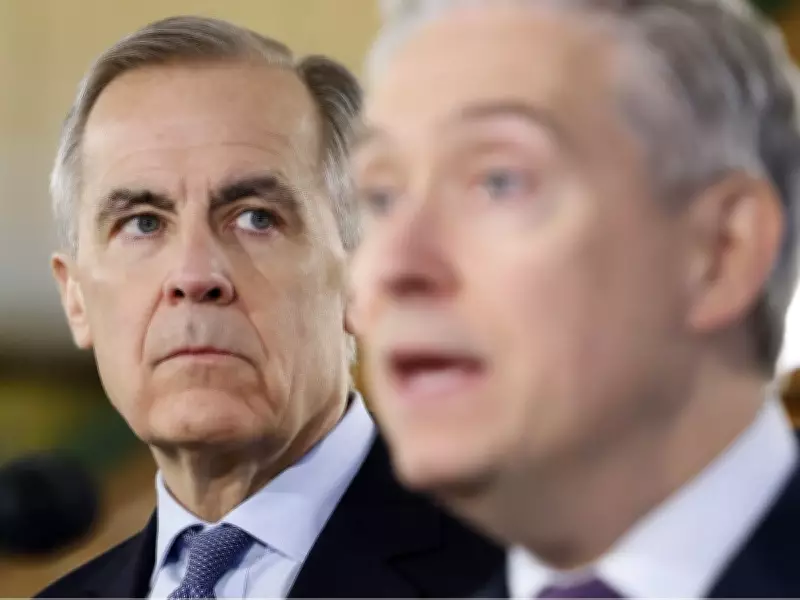
Carney Defends Minister's Connection to Rail Project Amid Tory Calls for Ethics Investigation
Prime Minister Mark Carney has dismissed mounting concerns regarding his finance minister's "personal connection" to the government's ambitious high-speed rail initiative, even as the Conservative opposition formally requested an investigation by Canada's ethics commissioner.
Defending Ministerial Conduct
Speaking at a housing investment announcement event in Brampton, Ontario, Carney asserted that Finance Minister François-Philippe Champagne had followed all established rules when his spouse was hired as a senior executive at Alto. This organization manages the government's plan to construct high-speed rail connecting Toronto and Quebec City.
"This is a good situation, because we have the partner who can pursue her career," Carney told assembled reporters, adding that "the minister of finance can do his responsibilities."

The Prime Minister further emphasized that Canada's ethics framework must accommodate the professional aspirations of spouses and family members of public officials. "So we have to look at them as individuals. We need to have a system that will enable them to have those careers," he stated.
Conflict of Interest Concerns
Carney's comments came in response to media reports revealing a September letter from Champagne to the Prime Minister addressing potential conflicts of interest. The letter disclosed that Champagne's spouse, Anne-Marie Gaudet, had been hired by Alto one month earlier.
Alto operates as a wholly owned subsidiary of the federal government and leads Ottawa's plan to develop a high-speed rail network through Ontario and Quebec. This mega-project carries an estimated price tag reaching up to $90 billion.
In his correspondence, Champagne committed to adding a conflict-of-interest filter to his disclosure and vowed to abstain from participating in any discussions or decisions with government representatives concerning the proposed high-speed rail project.
Budgetary Implications and Disclosure Questions
Two months following this disclosure, Champagne's inaugural budget allocated hundreds of millions of dollars toward the rail initiative, though this funding and governmental support had been announced months prior.
While Champagne's declarations aligned with standard practices for federal cabinet ministers, the specific disclosure regarding his spouse's employment—unlike his other declarations—was not publicly posted on the Ethics Commissioner's website.
John Fragos, Champagne's spokesman, clarified that this omission resulted from the ethics commissioner's decision rather than ministerial action. The ethics commissioner's office confirmed via email that they received a copy of Champagne's September letter to the Prime Minister.
Melanie Rushworth, a spokesperson for the commissioner, explained that family members—defined as spouses and dependents, excluding parents—form part of a public office holder's disclosure requirements but are not typically made public.
Conservative Response and Investigation Request
Fragos emphasized that Champagne's proactive disclosures to both the Prime Minister and ethics commissioner aimed to eliminate any perceived or actual conflicts, asserting that the minister has consistently honored his commitment.
Nevertheless, Conservative MP Michael Barrett took to social media Tuesday afternoon to announce he had formally requested the ethics commissioner investigate whether Champagne violated conflict-of-interest regulations. Barrett contended that Champagne participated in numerous discussions and decisions regarding his own federal budget, which included substantial funding for Alto.
The situation highlights ongoing tensions between governmental transparency, ministerial accountability, and the professional lives of political families, setting the stage for potential ethical scrutiny as the high-speed rail project advances.