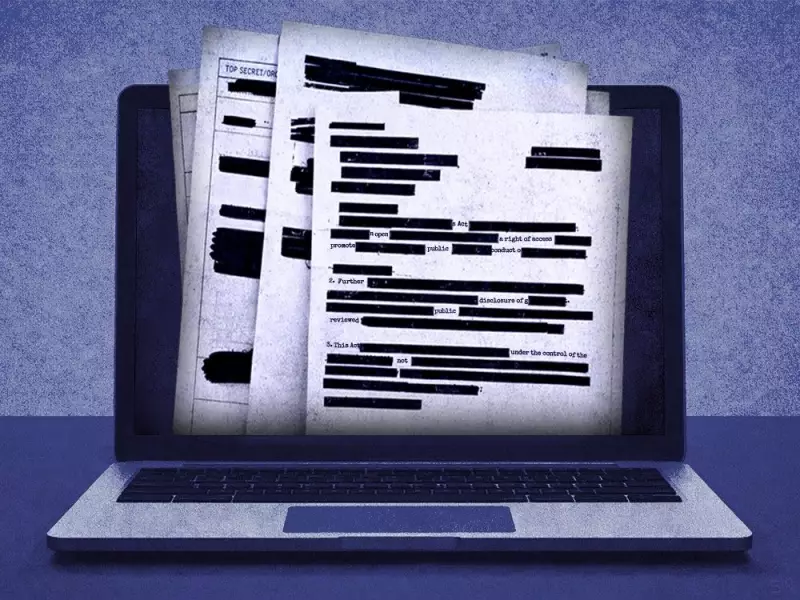
The federal government under Prime Minister Mark Carney is moving forward with the development of artificial intelligence systems designed to automatically redact sensitive information from documents slated for public release. This initiative, involving at least three major departments, emerges against a backdrop of intense scrutiny over government secrecy, highlighted recently by the controversy surrounding redactions in the Jeffrey Epstein files in the United States.
AI Tools in Development Across Key Departments
According to the Treasury Board's official AI register, which outlines the federal strategy for technology expansion through 2027, three specific redaction tools are currently "in development." These projects are being pursued by Transport Canada, the Department of National Defence (DND), and Public Services and Procurement Canada (PSPC).
The register provides limited details on each system. DND's project is described as an AI-based tool to identify and redact sensitive data. PSPC is working on an "AI assistant" that would use historical data to suggest redactions, aiming to improve accuracy and efficiency. Transport Canada's "ATIP Document Inspector" is intended to complement existing case management and redaction software.

None of the named departments provided comments or responses to inquiries by the publication deadline, leaving specific operational details and timelines unclear.
Transparency Advocates Sound the Alarm
The push to integrate AI into the Access to Information and Privacy (ATIP) process has been met with significant concern from transparency activists and experts. They argue that in a system already criticized for excessive secrecy and delays, automating redactions could further erode public accountability.
Ken Rubin, a prominent Ottawa-based researcher and authority on Canada's access laws, issued a stark warning. "It's not a tool of release — it's going to be used as a tool of repression," Rubin stated. He predicts the technology will be leveraged to further "sanitize, exempt and control the flow of information" to the public.
Experts point to several critical risks associated with AI-driven redaction:
- Inaccurate or Overzealous Censorship: The potential for algorithms to make erroneous or overly broad redactions, blacking out information that should legally be public.
- Lack of Human Oversight and Justification: A move towards automation could sideline human ATIP analysts who provide necessary context and justification for exemptions, a process frequent users already find lacking.
- Job Impacts: Concerns about job losses in an ATIP sector already struggling with high workloads and backlogs.
A Broader Push for AI Meets a Skeptical Reality
This development is part of a wider directive from the Carney government to embrace artificial intelligence across the public service. The government's first budget explicitly pointed to the "integration of technology and artificial intelligence" as a key strategy for boosting productivity and improving service delivery.
However, the timing is fraught. The ongoing scandal in the U.S., where heavily redacted court documents related to the Epstein case have fueled public outrage and conspiracy theories, serves as a cautionary tale. It highlights how blacked-out information can damage trust and transparency.
For activists like Rubin, the lesson for Canada is clear: the government should reconsider whether AI is the appropriate tool for making nuanced judgments about what the public has a right to know. The fear is that efficiency gains will come at the direct cost of democratic transparency, turning a tool meant to streamline a legal process into what some experts ominously suggest could "turn out to be a nightmare."