It has only been days since former Supreme Court justice Louise Arbour was named Canada's next governor general, and it will be weeks before she is sworn in and takes up residence at Rideau Hall. However, it is already clear that there will be at least one awkward moment during Arbour's tenure as Canada's 31st viceregal representative and commander-in-chief of the Canadian Armed Forces.
At LeBreton Flats, just a day before Prime Minister Mark Carney announced Arbour would become Canada's next de facto head of state, three federal Liberal cabinet ministers and a host of other dignitaries finally broke ground on the long-anticipated National Monument to Canada's Mission in Afghanistan. When the commemorative site is completed and unveiled sometime in late 2028 or early 2029, it can be expected that the new governor general — in her capacity as the symbolic head of Canada's military — will preside over the dedication of the monument.
The awkward part? In a 2023 interview with the Ottawa Citizen, Arbour said the design of the monument was chosen after federal officials opted to “cheat” her and the other members of a Quebec design team who had won a juried competition for the $3-million project that was later overturned by government fiat. Instead, an Alberta team's design for the monument — the one now being built — was picked after an unscientific online survey showed that it was more popular among respondents than the Quebec team's proposal.

The Quebec Team's Vision
The Quebec team, including strategic adviser Arbour, had designed a conceptual installation featuring two large walls erected at angles that formed a framed view of the Peace Tower to the east and Canadian War Museum to the west. It was Arbour, according to Quebec team leader Renée Daoust, who had helped inspire their design by invoking the famous line from Canadian musician Leonard Cohen's Anthem: “There is a crack, a crack in everything; that’s how the light gets in.” Arbour explained at the time that she had travelled to Afghanistan in her capacity as the UN High Commissioner for Human Rights between 2004 and 2008, was “still in contact with people I met there,” and shared with fellow design team members her knowledge and experience of Canada's mission in the country — “about women’s rights and human rights,” the Canadian presence in Kandahar, and more.
The Winning Design
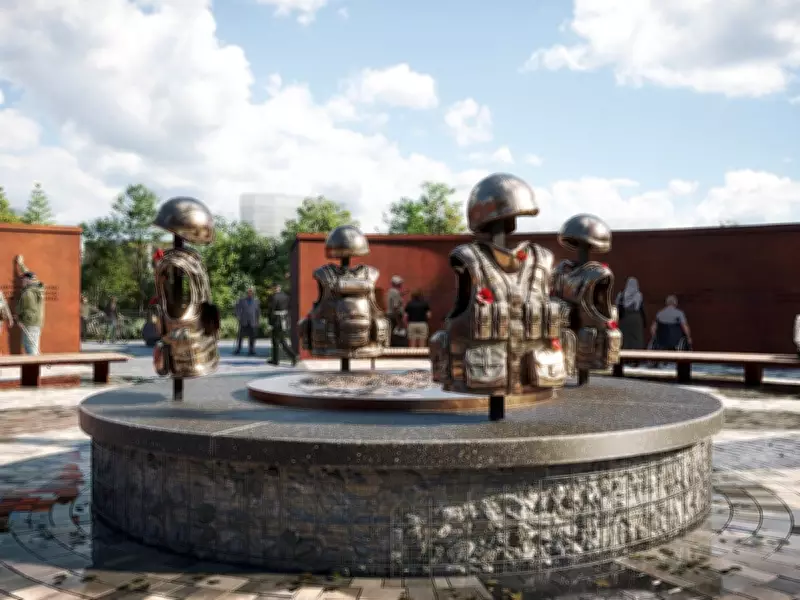
The Alberta team's design, led by Siksika (Blackfoot) Nation artist Adrian Stimson, includes walls inscribed with the names of Canadian military personnel who died in Afghanistan and a “circular, sacred space of safety, a ‘home base’ of reflection, memory and contemplation.” A central stone circle features four bronze flak jackets and helmets draped on crosses. Between 2001 and 2014, more than 40,000 members of the Canadian Armed Forces served in Afghanistan; 158 Canadian soldiers and seven Canadian civilians died there. Thousands of other veterans were wounded physically or left psychologically scarred.
The controversy over the selection process has lingered, with Arbour's comments adding a personal dimension to the debate. As she prepares to assume the role of governor general, her past criticism of the monument's selection process may resurface when she is called upon to officiate its unveiling. The monument, once completed, will serve as a lasting tribute to the sacrifices of Canadian forces in Afghanistan, but the path to its creation has been marked by contention.