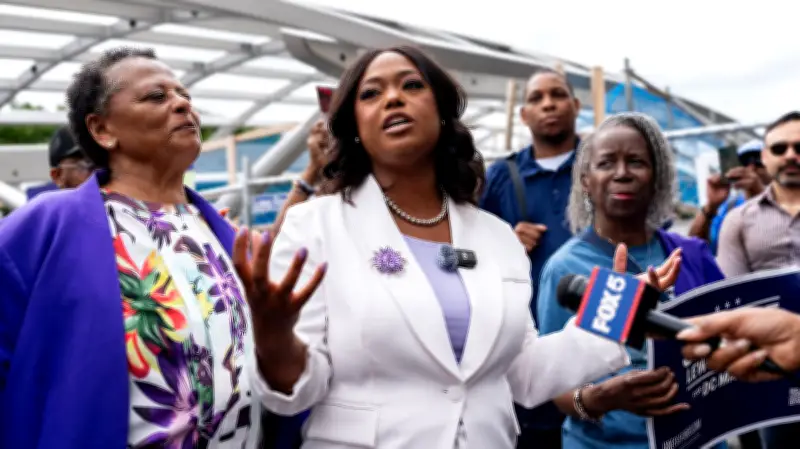
Janeese Lewis George is projected to win the Democratic primary in Washington, D.C.'s mayoral race, setting the stage for a new era of progressive leadership and a potentially more confrontational approach to President Donald Trump's overreach, according to election results.
The final vote had not been certified as of Thursday morning, but Lewis George held a commanding lead, and the other front-runner, former longtime D.C. Council member Kenyan McDuffie, conceded.
“Earlier this morning, I called Councilmember Janeese Lewis George to congratulate her on her victory and wish her success as she prepares for the general election,” McDuffie said in a statement.

Lewis George, a D.C. Council member and former prosecutor, consistently led in the polls against McDuffie. Each candidate courted a distinct base of supporters in their bids to succeed Democratic Mayor Muriel Bowser, who is not seeking reelection after three terms.
A democratic socialist, Lewis George worked closely with organized labor and campaigned on delivering universal childcare and ending the D.C. police department’s cooperation with federal immigration authorities. McDuffie cast himself as a pro-business moderate, following in Bowser's footsteps and securing the D.C. Chamber of Commerce’s endorsement.
Because D.C. skews heavily Democratic — 90% of residents voted for Kamala Harris in the 2024 presidential election — the winner of the Democratic primary is widely expected to win the November general election.
Trump Looms Over the Race
Trump loomed over this race, as he has frequently meddled in D.C.'s affairs and pressured the mayor to bend to his will. Last year, he used executive authority to briefly take over D.C.’s police department and deploy National Guard troops in response to a supposed crime crisis. Many troops are still roaming the city’s streets with little to do.
Bowser has taken a measured approach to managing the president, working with his administration and occasionally earning his praise. Some residents welcomed her skill in appeasing Trump, believing it kept the president from interfering further. Others fumed about her unwillingness to stand up to him.
Trump said last week he “wouldn’t like it” if Lewis George became mayor and suggested he may “take back Washington” if she wins. He does not have the power to “take back” D.C.’s government, and Lewis George has signaled she is ready to confront him.
“We are not going to get ICE off our streets by fearing this president,” she said in a Monday statement to HuffPost. “We are not going to protect our rights or Home Rule by obeying in advance. Threatening Home Rule because you do not like how residents vote is an attack on democracy itself.”
At an event early Wednesday, as she led in the vote count, Lewis George addressed the president directly. “The foundation of public safety is trust. Policies that break trust between our communities and government only make us less safe,” she said to cheers. “As mayor, I will work with anyone who makes D.C. safer. But I will also stand up to Trump and anyone who targets our neighbors.”
Ranked-Choice Voting and a New Chapter
D.C. voters navigated major changes in this election cycle. This is the city’s first mayoral race in two decades without an incumbent, and the first in 12 years without Bowser’s name on the ballot. Lewis George was one of seven candidates in the Democratic primary.
This year also marks the first time Washington voters used a ranked-choice voting system, allowing them to rank up to five candidates for each office in order of preference.
Amid chants of “people power,” Lewis George on Wednesday hailed this “new chapter in D.C.’s history.” “The measure of our city should not be how hard people are willing to fight,” she said. “It should be whether people can count on their government to fight for them.”