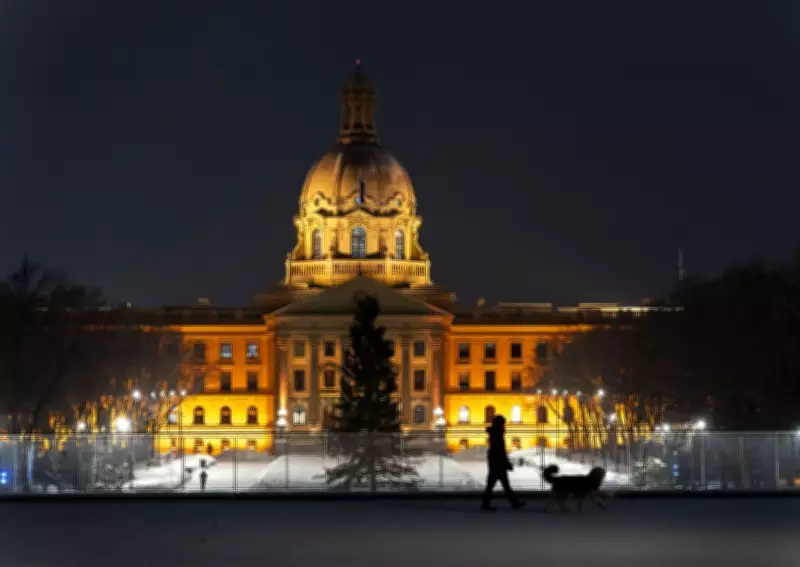
Alberta's newly revised electoral map was officially presented on Thursday morning, introducing significant changes that will reshape the province's political landscape for upcoming elections. The most notable adjustment is the expansion of the Legislative Assembly, with the total number of Members of the Legislative Assembly (MLAs) rising from 87 to 89. This increase addresses Alberta's rapid population growth, though it represents a modest two per cent expansion in legislature size compared to a twenty per cent surge in residents.
Speaker Tables Final Boundaries Report
Speaker Ric McIver formally tabled the conclusive version of the Electoral Boundaries Commission report in the legislature on Thursday. The commission emphasized that its recommendations were meticulously crafted after months of public consultations and deliberations, aiming to reflect demographic shifts accurately. "Our recommendations are made based on the months we have spent hearing from the public and deliberating over our options in light of the population increase," the report's conclusion explicitly states.
Calgary Seats Expand Significantly
The city of Calgary experiences the most substantial gains, acquiring two additional seats. A new constituency will be established in the northern sector, designated as Calgary-Nose Creek, while another emerges in the central area under the name Calgary-Confluence. Furthermore, a third seat is added to the southern part of the city, labeled Calgary-McKenzie. Concurrently, the existing east Calgary riding of Calgary-Peigan will be dissolved and integrated into neighboring constituencies.

Just beyond Calgary's limits, the report transforms two constituencies—Airdrie-East and Airdrie-Cochrane—into three separate ridings. Commission authors highlighted "the astonishing growth" of this region as the primary rationale for this adjustment.
Modest Adjustments in Edmonton Area
Alberta's capital city, Edmonton, will see an overall increase of one seat, though multiple constituencies undergo reorganization. The report cites "the large population growth" in south Edmonton as the basis for creating two new constituencies: Edmonton-Beaumont and Edmonton-Enoch.
In central Edmonton, six electoral divisions are consolidated into five. The former Edmonton-South West constituency is dismantled and its territories redistributed among adjacent ridings, some of which receive new names. Additionally, the Lac St. Anne-Parkland constituency northwest of Edmonton is merged into surrounding electoral divisions.
Central Alberta and Rural Regions Consolidated
Central Alberta witnesses significant consolidation, with the Rimbey-Rocky Mountain House-Sundre riding being merged with Lacombe-Ponoka. This reduction is part of a broader trend where rural and central regions lose seats to accommodate urban growth in Calgary and Edmonton.
Controversial Hybrid Ridings Introduced
A particularly contentious aspect of the new map is the introduction of hybrid ridings that cross municipal boundaries. These constituencies blend urban and rural areas, sparking debates about representation fairness and community cohesion. The commission defended these hybrid ridings as necessary to balance population quotas while acknowledging the complexities they introduce.
Timeline for Implementation
These changes will take effect for the next provincial election, which Alberta's fixed election date legislation mandates must occur on or before October 18, 2027. Voters across the province will encounter altered polling districts and potentially new candidates as political parties adjust their strategies to the reconfigured boundaries.
The Electoral Boundaries Commission's work follows government legislation enacted in November 2024, which authorized the expansion of the assembly to 89 MLAs. While the two-seat increase aims to better represent Alberta's growing populace, critics note that the legislature's growth rate lags far behind the actual population surge, potentially leaving some areas underrepresented.