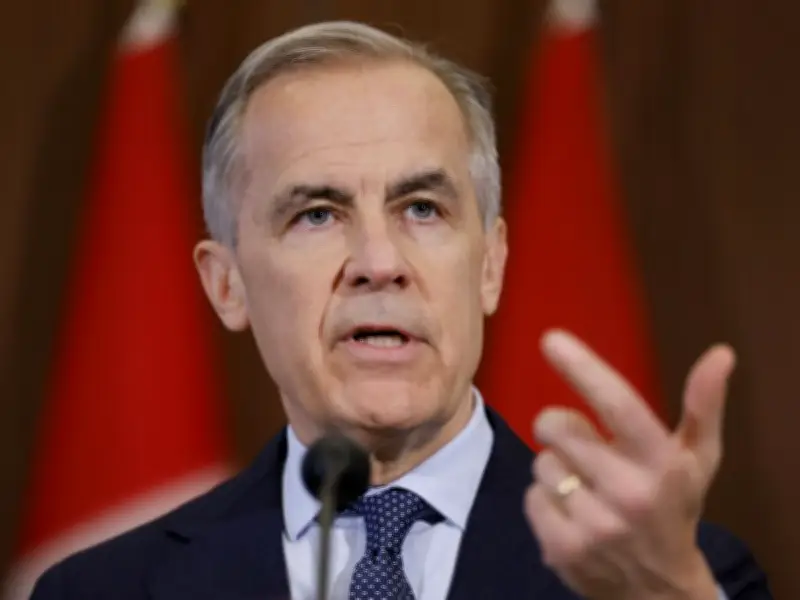
A new report from the Parliamentary Budget Officer (PBO) reveals that Prime Minister Mark Carney's federal deficits will be significantly higher over the next five years than the Liberal government predicted just 37 days ago in its spring mini-budget.
Deficit projections significantly higher
PBO Annette Ryan's economic and fiscal update for June estimates that last year's deficit will reach $72 billion (2.2% of GDP) for the 2025-26 fiscal year. This is double the $36.3 billion deficit reported in 2024-25 and $5.1 billion higher than the $66.9 billion projected by Finance Minister Francois-Philippe Champagne on April 28. The PBO attributes this to modest revenue growth being outpaced by expense growth, largely due to new measures.
For the next five years, the PBO projects federal deficits will average $4.6 billion higher annually than the government's April projections. This reflects lower revenues, particularly from personal income tax, and higher program expenses, partially offset by lower public debt charges.

- 2026-27: $71.8 billion (government projection: $65.3 billion)
- 2027-28: $68.0 billion (government projection: $63.1 billion)
- 2028-29: $60.4 billion (government projection: $57.7 billion)
- 2029-30: $59.7 billion (government projection: $56.2 billion)
- 2030-31: $58.2 billion (government projection: $53.2 billion)
Carney's operating deficit promise under scrutiny
Carney has pledged to separate operational costs from capital spending and balance the operating deficit by 2028-29. However, former interim PBO Jason Jacques warned last November that the Carney government misclassified $94 billion in operating expenses as capital investments in its November budget, contravening standard accounting practices. If reclassified as operating expenses, Carney would fail to meet his balanced budget promise.
Ryan plans to conduct an independent assessment of Carney's capital budgeting framework in an upcoming report to support greater transparency.
Debt-to-GDP ratio rising
The PBO notes that persistent deficits averaging 1.8% of GDP over the projection horizon will increase the federal debt-to-GDP ratio from 41.3% in 2025-26 to 42.5% in 2030-31. The International Monetary Fund recently urged the federal government to reinstate the debt-to-GDP ratio as its primary fiscal anchor to strengthen discipline, transparency, and credibility. Based on her calculations, Ryan states there is only a 39.6% chance the debt-to-GDP ratio will be lower in 2030-31 than in 2025-26.
Interest costs surpass health transfers
Interest payments on the $1.41 trillion federal debt will reach $58.9 billion this year, exceeding the $57.4 billion transferred to provinces for health care. By 2030-31, servicing the projected $1.66 trillion debt will cost $80.2 billion annually, money that cannot be used for public services or tax reduction.
Due to ongoing trade uncertainty with the U.S., Ryan projects Canada's real GDP growth at 1.1% in 2026, down from 1.7% in 2025, and 1.6% in 2027, down from an earlier estimate of 1.8%.