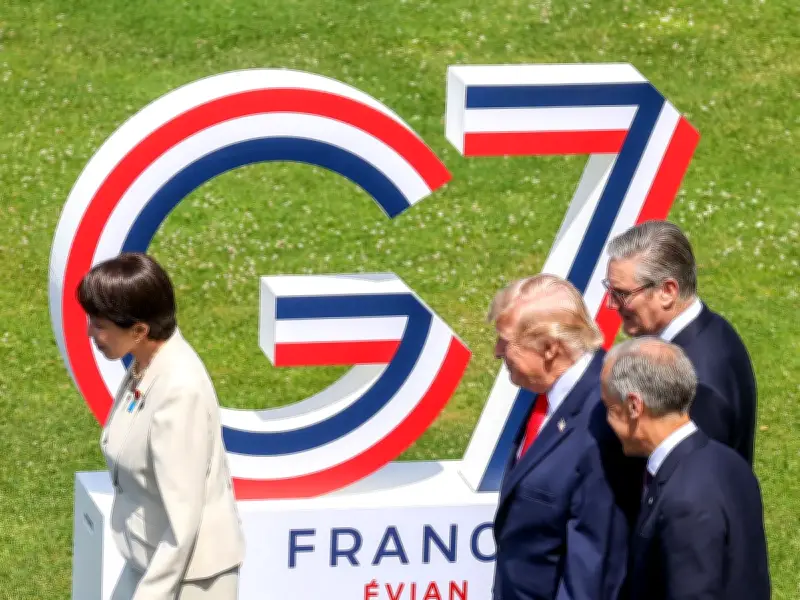
In the 1970s, the G7 countries produced nearly two-thirds of the world's GDP. Today, their share has plummeted, along with their global influence. Unless Europe, Japan, and Canada significantly boost their economic and military capabilities, the G7 may be overshadowed as U.S. President Donald Trump explores alternative global arrangements, such as a potential G2 summit with China.
The G7's Diminishing Role
Before this week's G7 summit in France, Trump irritated fellow leaders by floating the idea of replacing the G7 with a G2 meeting with China. Although China has shown no interest, Trump's comment underscored that China and the U.S. are now the world's dominant economic and military powers.
Since its inception in 1975, the annual G7 summit has allowed major democracies to coordinate economic policies, and later, foreign and security strategies. This year's summit focused on tensions with Iran, but also addressed the Russia-Ukraine war, global trade, critical minerals, energy security, and artificial intelligence. Other nations like Brazil, India, and South Korea are regularly invited. As a forum for discussion, the G7 serves its purpose, but it no longer comprises the world's largest economies.

Historical Context and Shifting Dynamics
In 1975, the six leading countries—the U.S., France, West Germany, Italy, Japan, and the United Kingdom—formed the G6 in response to the 1973 OPEC oil price shock and the collapse of the Bretton Woods monetary system. The U.S. had a GDP of $1.7 trillion (in 1976 dollars), while Italy stood at $228 billion. Canada, with a GDP of $175 billion, joined a year later as a counterweight to Europe. After the Soviet Union's fall, Russia was added in 1997, creating the G8, which lasted until Russia's expulsion in 2014 following its annexation of Crimea.
Fifty years ago, G7 nations produced 62% of global GDP, making them the world's most influential economic powers. They were also major military spenders, though the U.S. alone accounted for over half of NATO spending, with Canada and Italy trailing behind.
Current Economic Realities
According to 2026 IMF projections, the U.S. remains the top economy with a GDP of $32.4 trillion. China is second at $20.9 trillion, and together they represent 42% of the world economy. Trump's assertion about shifting economic power is thus accurate.
Among the middle-tier economies, Germany ($5.5 trillion), Japan ($4.4 trillion), and the U.K. ($4.3 trillion) hold the next three positions, as they did in 1975. However, India ($4.2 trillion) now ranks fifth, followed by France ($3.6 trillion) and Italy ($2.7 trillion). Canada's GDP of $2.5 trillion places it 11th, behind Russia ($2.7 trillion) and Brazil ($2.6 trillion). If the G7 were reconstituted based solely on economic size, India and China would be at the table, while Canada and Italy would be relegated to serving wine.