

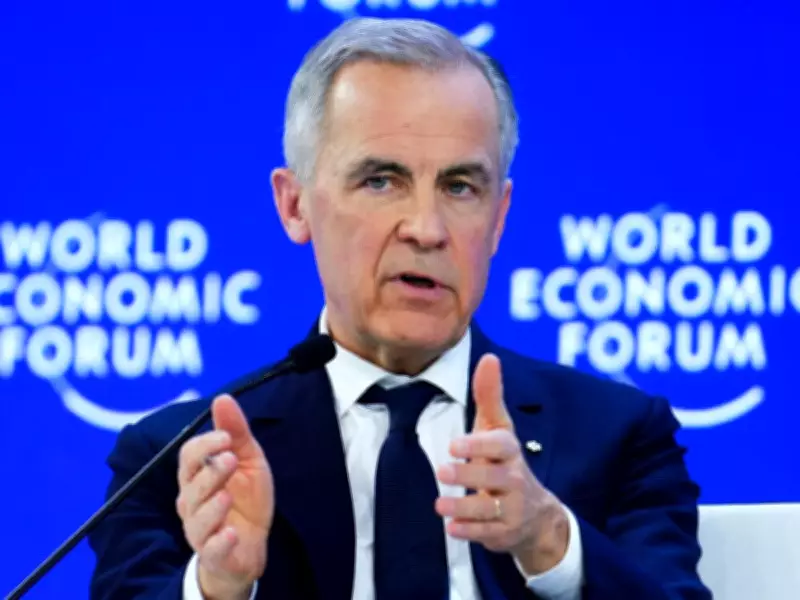
Carney's Davos Declaration of Permanent Geopolitical Shift Meets Newsom's Rebuttal
Prime Minister Mark Carney's address to the World Economic Forum in Davos, initially met with international enthusiasm, has seen its credibility gradually erode in subsequent analysis. The speech's central thesis—that a "new world order" is irreversibly replacing the era of open-market globalization—continues to draw both praise and sharp criticism.
Critics have particularly focused on Carney's characterization of the previous American-led global system, challenging his implied comparisons to the Soviet Union's authoritarian control over Eastern Europe. A recent Wall Street Journal commentary went so far as to label Carney's geopolitical analysis as "muddled and incoherent," highlighting the growing skepticism surrounding his framework.
A Stark Counterpoint from California's Governor
A compelling counter-narrative emerged during the forum through an interview with California Governor Gavin Newsom. While both leaders are recognized as skilled political performers, their assessments of the current global landscape diverge sharply. Newsom's perspective offers a direct challenge to Carney's core assertion of a permanent rupture in international relations.

Initially, Newsom expressed respect for Carney's decision to deliver a speech critical of former U.S. President Donald Trump's foreign policy approach. However, when interviewer Ben Smith raised Carney's key point—that the geopolitical divisions amplified by Trump represent a permanent structural shift with "no going back"—Newsom offered an immediate and firm rebuttal.
"I think these relationships are in dormancy. They are not dead," Newsom stated, cautioning against what he called hyperbolic conclusions. He pointed to Carney's own diplomatic actions, specifically a trip to China to secure a trade deal for importing electric vehicles, as evidence that international engagement continues despite tensions.
Newsom's Defense of Enduring Alliances and American Values
Newsom framed Carney's China deal as symptomatic of a broader "recklessness in American foreign policy" that risks undermining alliances built over eight decades. Throughout the discussion, Newsom launched vigorous attacks on Trump, portraying him as a destructive force betraying the core American values that, in Newsom's view, enabled both national and Californian prosperity.
To bolster his argument, Newsom cited California's formidable economic standing. He highlighted the state's role as home to the most Fortune 500 companies, its contribution of 28% to U.S. economic output, and its position as one of the world's largest economies—noting it was the fourth largest globally in 2024, though it may have recently been overtaken by Japan.
These statistics serve a dual purpose for Newsom: reinforcing his identity as a progressive Democrat capable of managing robust economic growth while defending the enduring strength of the American model he believes Trump jeopardizes.
Diverging from Progressive Orthodoxy on Key Issues
Interestingly, Newsom's positions revealed nuances that sometimes break with progressive activist expectations. While advocating for universal healthcare and progressive taxation, he expressed opposition to a proposed California wealth tax on billionaires, warning it would drive top earners from the state.
On immigration, Newsom aligned himself with the legacy of Republican President Ronald Reagan, quoting Reagan's 1989 farewell address about America's need to remain open to newcomers. Newsom boasted that 28% of California's population is foreign-born, presenting a vision starkly at odds with Trump-era policies and framing open immigration as essential to continued American leadership.
The WEF stage thus framed a fundamental debate: between Carney's vision of an irrevocably shattered old order and Newsom's belief in dormant but recoverable alliances, setting the tone for ongoing discussions about the future of globalization and American power.






