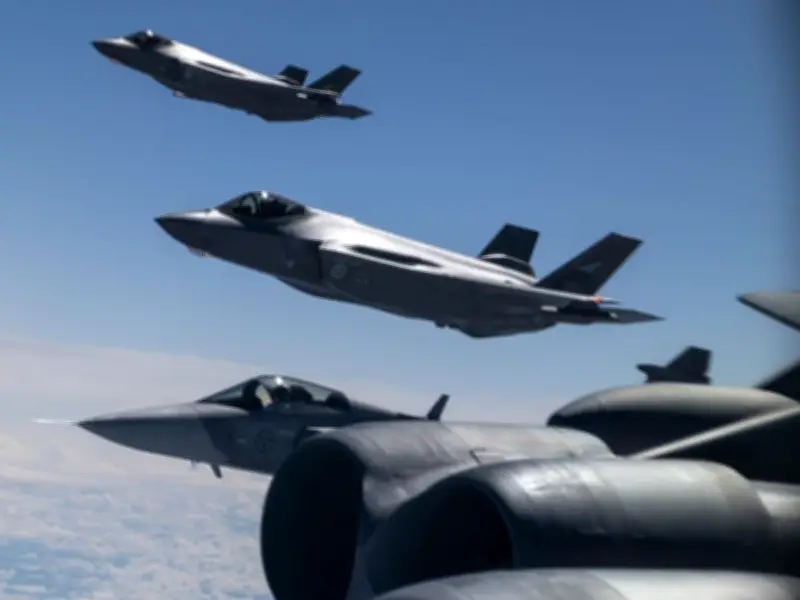
Despite the Gripen fighter jet built by Sweden's Saab losing every open competition against the F-35 held by the Canadian military, the Carney government appears poised to announce a purchase of the Gripen.
Military Leadership Favors F-35
The leadership of the Royal Canadian Air Force, the Department of National Defence, and Defence Minister David McGuinty all support proceeding with the planned purchase of 88 F-35 fighter jets. However, for political rather than military reasons, the Carney government is expected to announce a pivot to the Swedish-made Gripen.
While Minister McGuinty backs the military's preference for the F-35, Industry Minister Melanie Joly and Stephen Fuhr, a former fighter pilot now serving as Carney's point man on defence procurement, support the Gripen. Joly's backing stems from anti-Americanism and a desire to have Saab build the Gripen in Montreal, claiming it would create 10,000 jobs. Yet Brazil's similar effort has yielded barely 200 jobs.

The F-35, by contrast, already sustains thousands of Canadian jobs through parts production for every deployed jet.
Internal Divisions and Exclusion
Fuhr has been described by multiple sources as someone who simply hates the F-35 and has never liked the fifth-generation stealth aircraft. Ottawa insiders say Fuhr currently has Carney's ear and has been going behind McGuinty's back to undermine the F-35. Meanwhile, senior leadership at National Defence has been frozen out of both decision-making and discussions about next steps.
F-35 Scores Far Better
When ranked against the Gripen by Canadian officials, the F-35 has won repeatedly. Late last year, CBC obtained an internal DND document showing the F-35 scored 57 out of 60, while the Gripen scored 19 out of 60. The RCAF is already short of pilots and maintenance technicians; adding a new aircraft type would increase complexity.
The F-35 has no peer in technical or war-fighting capabilities. Opposition to the jet is based solely on politics, as it has been from the start. The jet was developed over decades by Canada, the U.S., and other NATO allies. Canada joined the Joint Strike Fighter Program in 1997.
Political Football
Since 2008, when the Harper Conservatives were in power, the Liberals—who originally committed Canada to the program—turned against it. The F-35 has been a political football for nearly 20 years, with Canada committing to buy, then reviewing, then buying, then reviewing again.
Now, the Carney government appears eager to announce the Gripen purchase ahead of the Farnborough International Airshow in July. At that event, the government is also expected to commit Canada to the Global Combat Air Programme, a British-Italian-Japanese plan for a sixth-generation fighter jet. Given Canada's 29-year record in the fifth-generation program, it's unclear why allies would want Canadian involvement.
What remains unclear is whether the government will stick with the full 88 F-35s or cap the order at 30 currently on order. Either way, there will be consequences Canadians have not been told about.