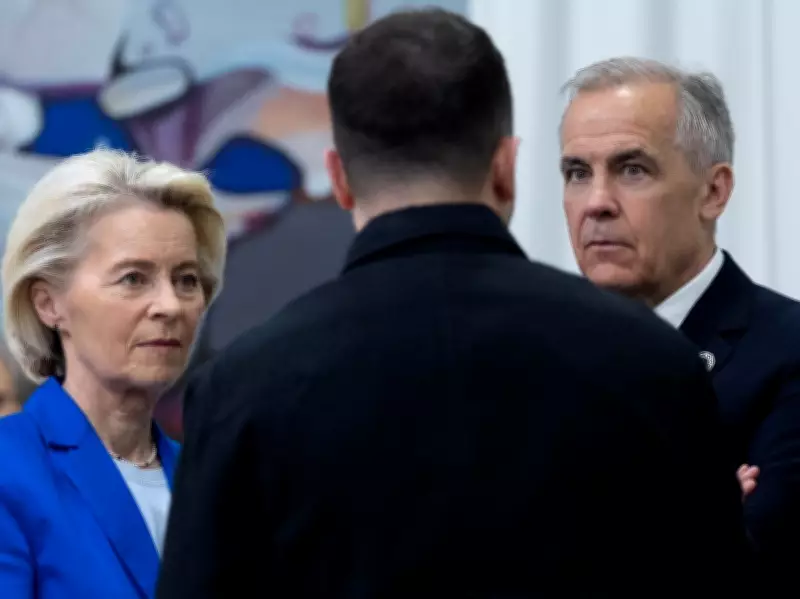
Prime Minister Mark Carney appears to be steering Canada away from the United States and toward Europe, ignoring opportunities to resolve ongoing trade disputes with its southern neighbor. Instead of engaging with Washington to remove tariffs on Canadian steel, aluminum, autos, and lumber, Carney has once again traveled to Europe, where he continues to promote a vision of Canada as a fundamentally European nation.
Carney's European Rhetoric
Speaking at the European Political Community Summit in Armenia, Carney echoed themes from his earlier address at the World Economic Forum in Davos. He stated, "In many ways, we are the most European of non-European countries," a line he first used during a European trip last year. Carney also warned of a global rupture across technology, energy, commerce, and geopolitics, claiming that integration is being weaponized and that rules fail to constrain hegemonic powers.
Criticism of US, Silence on China
Despite acknowledging two hegemonic powers, Carney's criticism is directed solely at the United States while he seeks closer ties with China. This approach seems inconsistent, as China has a history of using trade barriers and tariffs for diplomatic leverage. Recently, China lifted tariffs on Canadian canola, but experts warn this does not signal a lasting change in behavior.

Carney explicitly rejected using Canada's critical minerals or energy sector as leverage in US trade talks. In an interview with The Canadian Press, he stated, "I reject that characterization of it's leverage. It's looking at: Is it in our mutual interest to trade more? Where is it? And if it's not there, we have other options." He questioned whether further integration of energy markets with the US is wise, given their view of such ties as leverage.
Economic Realities
Decoupling from the US would be immensely challenging. In 2025, Canadian goods exports to the EU totaled $34.48 billion US, while imports from the EU reached $54.16 billion US. In contrast, exports to the US were $383 billion US, with imports of $336.5 billion US—more than ten times the EU trade volume. Replacing the US market with European partners is not feasible in the short term.
Carney's vision of rebuilding the international order out of Europe contrasts with the lack of progress on US trade talks. Industry Minister Melanie Joly announced a $1-billion support fund for tariff-impacted industries but admitted uncertainty about whether tariffs will remain permanent. "I don't know," she said, adding that decisions rest with the US.
While Mexico actively negotiates and leverages its position, Carney's approach appears to ignore or even insult the US, as he angles for Canada to join the EU. Critics argue this strategy risks harming average Canadians through job losses and a declining quality of life.