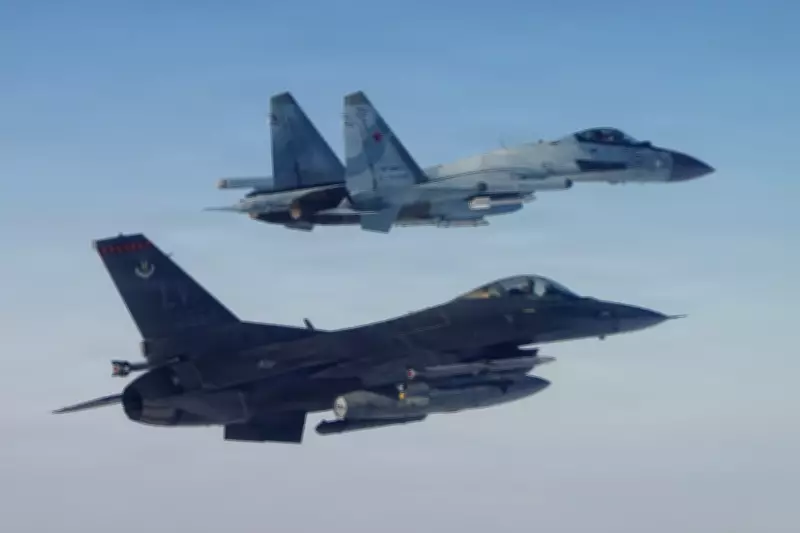
NORAD Confirms Detection of Russian Military Aircraft Near Alaskan Airspace
The North American Aerospace Defense Command (NORAD) has officially reported that both the United States and Canada successfully detected and intercepted multiple Russian military aircraft operating in close proximity to Alaskan airspace. This incident underscores the persistent vigilance required in the Arctic region amid ongoing geopolitical tensions.
Details of the Interception and Regional Security Implications
According to NORAD, the detection occurred in the vicinity of the Bering Strait, west of Alaska, a strategically sensitive area that has historically been a focal point for military activities. U.S. Department of Defense imagery from February 19, 2026, depicts a North American Aerospace Defense Command F-16 fighter aircraft engaging in a standard intercept procedure with a Russian Su-35 military aircraft. Such intercepts are routine protocols designed to monitor and identify potential threats, ensuring the security of North American airspace.
This event highlights the continuous operational readiness of NORAD forces, which maintain a 24/7 watch over the northern approaches to the continent. The command emphasized that all Russian aircraft remained in international airspace and did not enter sovereign territory, adhering to established norms. However, the proximity of these flights near Alaska raises concerns about regional stability and the potential for miscalculation in an increasingly contested Arctic environment.

Broader Context of Arctic Military Activities and Defense Posture
The interception is part of a pattern of increased Russian military presence in the Arctic, where melting ice due to climate change is opening new shipping routes and resource exploration opportunities. NORAD, a binational command jointly operated by the U.S. and Canada, plays a critical role in aerospace warning and control for North America. Its capabilities include radar surveillance, satellite monitoring, and fighter jet deployments to respond to such incidents swiftly.
Experts note that these activities are not uncommon, with similar interceptions reported periodically over the past decade. They serve as a reminder of the strategic importance of the Arctic in global defense calculations. The U.S. and Canada have been bolstering their military infrastructure in the region, including upgrades to early warning systems and enhanced coordination between allied forces, to counter potential adversarial advancements.
In response to the incident, NORAD officials reiterated their commitment to defending North American airspace, stating that such detections are handled professionally and in accordance with international law. The command continues to work closely with Canadian and U.S. authorities to assess threats and maintain a robust defense posture, ensuring the safety and security of both nations amidst evolving challenges in the high north.