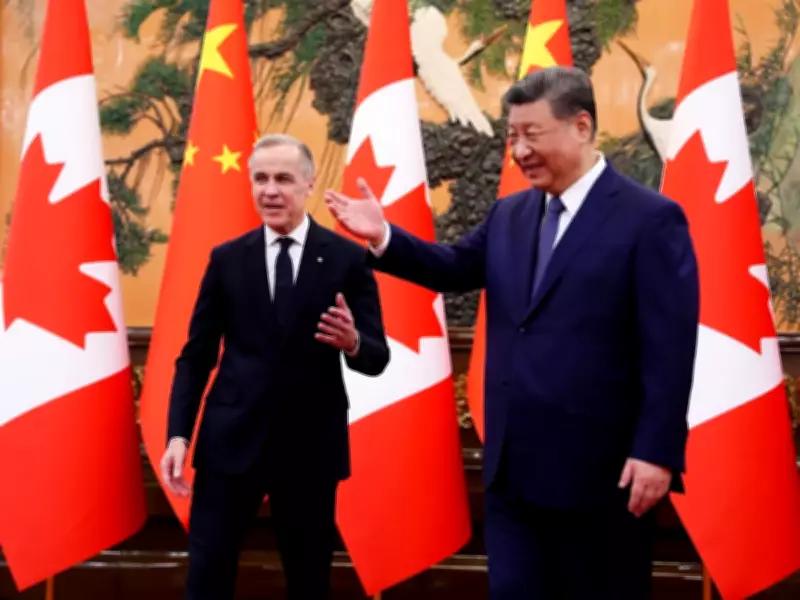
Carney's China Deal Contains Hidden Police and Propaganda Provisions
While public attention has focused on trade components like electric vehicles and canola, Prime Minister Mark Carney's recent strategic partnership with Chinese Supreme Leader Xi Jinping contains several concerning non-trade agreements that critics are calling "Trojan horses" for Beijing's influence operations in Canada.
Beyond Cars and Canola: The Hidden Agreements
The Canada-China concordat signed last month includes multiple provisions that extend far beyond the projected expansion of Chinese electric car imports in exchange for Beijing's promise to ease tariff barriers on Canadian canola products. According to human rights advocates and democracy organizations, these overlooked elements represent significant security and sovereignty concerns for Canada.
"These are all Trojan horses," said Cheuk Kwan, co-chair of the Toronto Association for Democracy and spokesman for the Canadian Coalition on Human Rights in China. Edmund Leung, chair of the Vancouver Society in Support of Democratic Movement, described the dozen or so non-trade deals as "very, very upsetting."

Police Cooperation Agreement Raises Red Flags
One particularly concerning element is the memorandum of understanding between the Royal Canadian Mounted Police and China's Ministry of Public Security. This agreement revives a collaboration from 25 years ago that collapsed following scandals involving tortured witnesses and fabricated corruption charges.
The timing of this renewed police cooperation is especially troubling given recent revelations about China's clandestine police operations in Canada. In 2023, it was discovered that China's Public Security divisions were running several covert police stations under the cover of Beijing-affiliated community organizations in Montreal, Toronto, and Metro Vancouver.
Due to inadequate foreign-interference laws, the RCMP had previously been limited to detecting and disrupting these overseas MPS operations rather than preventing them entirely. Bill C-70, the Countering Foreign Interference Act, was tabled two years ago but only recently emerged from its public consultations stage.
Cultural Exchanges as Soft-Power Vehicles
The proposed collaborations in cultural and educational exchanges might appear benign on the surface, focusing on "people-to-people ties," museum investments, support for digital content creators and visual artists, heritage preservation, education initiatives, travel exchanges, and cooperation in creative industries at sub-national levels.
However, critics argue these are precisely the methods Beijing employs to extend the global reach of its soft-power operations in targeted countries. "This is all about expanding the Communist party's influence and expanding their capabilities in Canada," Leung explained. "These agreements facilitate transnational repression, political interference, and disinformation."
Historical Context of Chinese Interference
The agreements come despite recent national scandals involving Beijing's efforts to influence Canadian politics. Over the past several years, evidence has emerged of the United Front Work Department's attempts to manipulate the 2019 and 2021 federal elections to benefit the Liberal party and to unseat former Conservative party leader Erin O'Toole in 2022.
Canadian intelligence agencies have also documented Beijing's pressure on Canada's Chinese-language media to conform to Xi Jinping's party line. The new agreements appear to disregard this troubling history of foreign interference in Canadian affairs.
The strategic partnership's non-trade components represent a significant shift in Canada-China relations that extends far beyond economic considerations. As these agreements move forward, they raise important questions about sovereignty, security, and Canada's ability to protect its democratic institutions from foreign influence operations disguised as cultural and police cooperation.