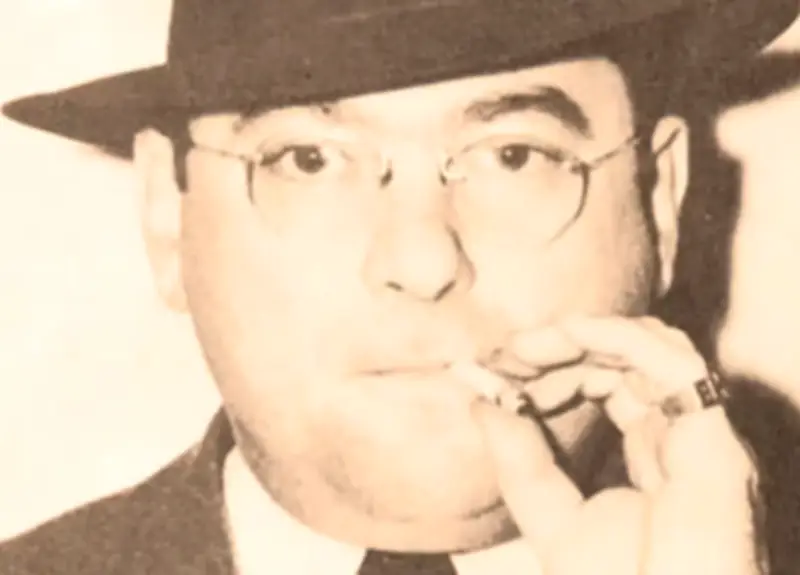
What was left of Willie Bioff was scattered all over the tranquil Phoenix neighbourhood where he lived. Once one of the most powerful men in Hollywood who could bring studios to their knees, Bioff's sordid past had finally caught up with him courtesy of a bomb placed under his pickup truck on Nov. 4, 1955.
To his neighbours, Bioff and his wife were known on Bethany Home Rd. as Bill and Laurie Nelson. They were quiet, and their ranch-style home was well maintained. Inside, the decor boasted Louis XIV-style furniture, a collection of miniature ivory elephants, and a lantana-and-plumbago hedge planted by Bill Nelson himself, as Time magazine reported.
A Long Way from Chicago
Willie Bioff died a long way from the west side of Chicago where he was born in 1900, the child of Russian immigrants who kicked him to the curb when he was eight years old. He started out by peddling newspapers then became a pimp until he was busted in 1922. He said of himself: "I was just an uncouth person, a low-type sort of man. People of my calibre don't do nice things." For a gangster, extorting the Hollywood studios was easy pickings.

By the late 1920s, he had fallen in with Al Capone and the precursor of the Windy City mob, The Outfit. Stock markets were booming and a dry America was still soaking wet thanks to gangsters. For fun, Americans went to the movies by the millions. Seeing an opportunity, Bioff joined forces with corrupt International Alliance of Theatrical State Employees (IATSE) boss George E. Browne, and they started shaking down theatres.
Took Over IATSE
No payoff, no projectionist. But there were bigger fish to fry. Never ones to miss an opportunity, The Outfit sent Jewish labour racketeer Bioff to Tinseltown. At a 1934 Chicago meeting (Browne and Bioff were not invited), gangster Johnny Rosselli explained the profit structure of the movie industry, and a plan was laid for a wholesale extortion operation of the major studios via IATSE, according to the Time story. Rosselli would operate as the puppet master of Browne and Bioff.
In Hollywood, time was money, so Bioff played both sides of the coin. On one hand, he controlled the union, and on the other, he was shaking down the studio moguls to keep the wheels spinning. Everyone from Warner Bros. to poverty row producers were kicking up to the gangsters. And Bioff was loving his Hollywood life. Amusingly, Bioff, a glorified Chicago thug, went Hollywood in a big way with his sudden wealth. But his fancy suits and solid gold business cards made him too high profile – hence the indictment, one source said.
Bioff hoodwinked the usually savvy studio bosses into believing he was a businessman, not a gangster. New York World-Telegram columnist Westbrook Pegler blew up Bioff's facade when he revealed the pimping charge from 1922. But more bad news was on the way.
The Taxman Cometh
In the days prior to RICO, the most terrifying weapon in the feds' arsenal was the taxman. In 1941, Bioff and Browne went on trial for tax evasion and racketeering. Obedience was never one of Bioff's strong points, Alan K. Rode wrote in Noir City Magazine. On the stand, he accused studio bosses of bribing him to maintain labour peace – while remaining mute about the Outfit's orchestration of the scheme.
Found guilty, Browne got eight years, Bioff and the third conspirator, Nick Circella, each got 10 in the slammer. In summation, prosecutor Mathias F. Correa called Bioff a "gangster-racketeer type who could never be rehabilitated to live a useful life in society."
Now, The Outfit had a problem. Willie Bioff could be a loose cannon, a loudmouth. Would he flip to save himself? Bioff and his family were threatened. And those fears became real on Feb. 2, 1943. The victim was model and dice girl Estelle Carey, 34, gal pal of Circella. Carey was discovered bound, beaten and burned in her Windy City apartment. Was it a message or a home invasion? After all, Carey did double duty as her boyfriend's banker.

The End of Frank "The Enforcer" Nitti
Bioff began singing like a canary and there were seismic ramifications in the underworld, particularly in Chicago over the Hollywood shakedown racket. Boss Frank "The Enforcer" Nitti, Paul "The Waiter" Ricca, Louis "Little New York" Campagna, Charles Gioe and Phil D'Andrea were fingered by weasily Willie. For Nitti, a claustrophobe, the idea of prison was unbearable. So on March 19, 1943, he drunkenly walked to the Illinois Central Railroad yard and blew his brains out.
The others served varying stretches in prison and Bioff was marked: R.A.T. Not only that, he broke the mob's Hollywood cash register. His partner Browne "drank himself to death" in the early 1950s.
A New Life in Arizona
Willie Bioff was a marked man when he left prison and moved to Arizona. He and his wife blended in, running in high society Republican circles. He even donated $5,000 to state senator and future presidential candidate Barry Goldwater. But old habits die hard. Bioff hooked up with Outfit associate Gus "Greenie" Greenbaum. He introduced him to the riches that could be had in the Nevada gambling industry and hired Bioff to be entertainment director of the Riviera Hotel.
Didn't Have an Enemy in the World
The outfit caught up to the hyper-cautious Bioff on Nov. 4, 1955. His betrayal had never been forgotten. He stuck his key into the ignition of his truck, triggering the dynamite under his seat, and KABOOM! Bioff never felt a thing. His wife tearfully told a reporter: "He turned to wave. He always waved. I waved back." She was puzzled, she told the reporter, because Willie "didn't have an enemy in the world." Cops did not buy it. Chicago Outfit boss Tony "Big Tuna" Accardo and several other mobsters had been in the Phoenix area recently. No, this was an undoubted mob hit – one that remains unsolved.