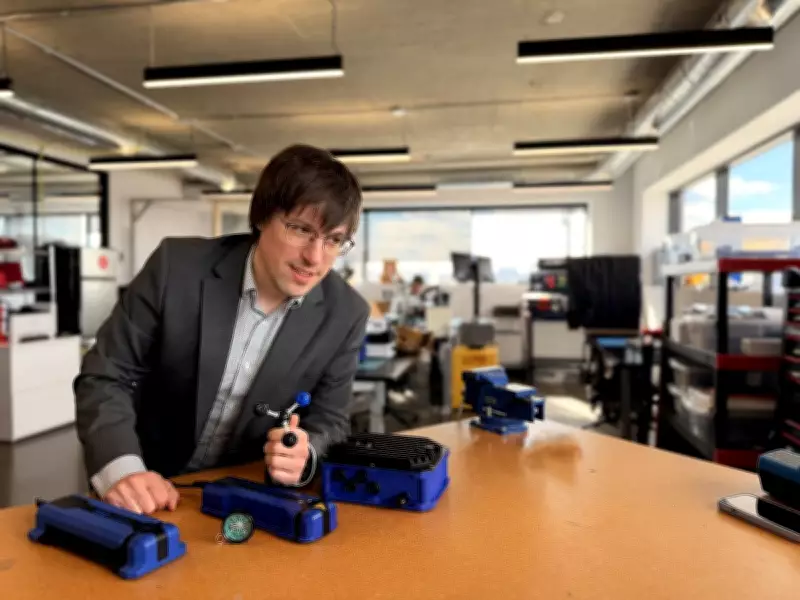
A Sherbrooke, Quebec-based quantum sensor startup that aims to reveal the invisible and provide an alternative to GPS has been awarded two contracts worth approximately $3 million from Canada's Department of National Defence (DND) to test its technology for defence applications.
Quantum Magnetometer Technology
SBQuantum is developing technology to aid navigation and detect objects through fluctuations in magnetic fields, particularly useful in rough or remote areas, conflict zones, and covert operations. The company's quantum magnetometer is a small sensor that mounts on platforms such as drones, vehicles, aircraft, or autonomous underwater vehicles. By picking up fluctuations in the Earth's magnetic field, it detects the size, orientation, material, and distance of objects from the sensor. The system reads and remembers terrain, allowing users to map their location.
Addressing GPS Vulnerabilities
GPS signals are unreliable above 70 degrees north latitude and are vulnerable to jamming and spoofing, while also depending on foreign-controlled infrastructure. Canada requires a navigation alternative to GPS that is resilient, sovereign, and operable in demanding environments, said CEO Eric Giroux in an email. Canada needs sovereign, GPS-independent navigation capability for Arctic and GPS-denied operations.

The sensors use engineered diamonds hit by lasers to excite their electrons so their quantum state can be measured as they interact with magnetic fields. Unlike standard GPS technology, these sensors cannot be jammed or interrupted. Using the Earth's magnetic field also means it is not possible to track where the sensors' transmissions emanate from. This technology does not rely on GPS infrastructure or ground stations, meaning it will work anywhere in the world regardless of latitude, temperature, or network availability.
Defence Applications and Contracts
Magnetic navigation has the potential to provide a new generation of reliable and accurate navigation and positioning systems for aircraft, autonomous platforms, and even ships at sea, offering a unique set of advantages over alternative approaches to navigation, said David Roy-Guay, SBQuantum co-founder and chief technology officer. In the wake of the federal government's defence industrial strategy that prioritizes domestic companies for military spending, SBQuantum's latest DND contracts will see its technology deployed for magnetic navigation, detection of metallic objects, and covert operations. The strategy lists quantum sensors as one of its key sovereign capability priorities.
One contract, worth $1.05 million, was awarded through DND's Innovation for Defence Excellence and Security (IDEaS) program. The funding is intended to test SBQuantum's portable sensor systems in the field.