Israeli Airstrikes Pound Iran and Lebanon as US Targets Drone Carrier
Intense Israeli airstrikes struck the capitals of Iran and Lebanon on Friday, while the United States military targeted an Iranian drone carrier at sea, marking a significant escalation in the ongoing Middle East conflict. The strikes come amid warnings from U.S. Defense Secretary Pete Hegseth that the bombardment is "about to surge dramatically."
Broad-Scale Strikes on Tehran and Beirut
Israel's military announced it had initiated "a broad-scale wave of strikes" on Tehran, Iran's capital, early Friday. Witnesses reported particularly intense airstrikes that shook homes in the area, with additional explosions noted around the city of Kermanshah, home to multiple missile bases. The Israeli military claimed these strikes have already destroyed most of Iran's air defenses and missile launchers.
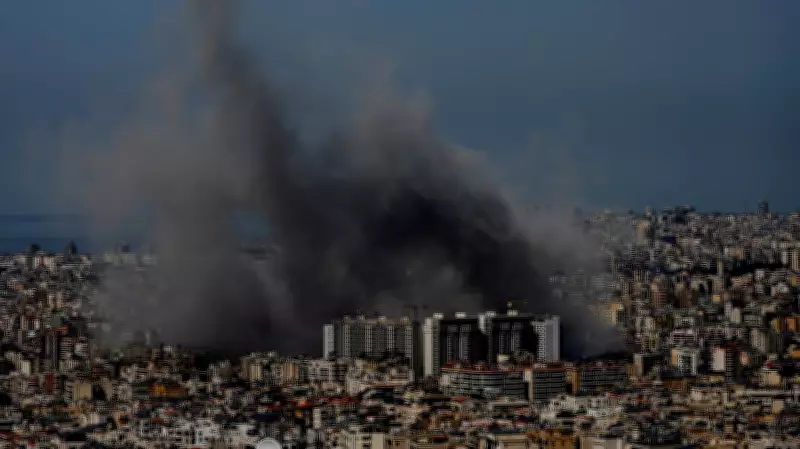
In Lebanon, where fighting has reignited between Israel and Iran-allied Hezbollah militants, Israel launched at least 11 airstrikes late Thursday into Friday targeting the southern suburbs of Beirut and other areas. The attacks caused fires near a gas station and prompted mass evacuations as motorists jammed roads trying to flee or seek shelter. Two hospitals evacuated patients and staff following Israeli warnings urging residents to "save your lives and evacuate your homes immediately."

US Military Action Against Iranian Assets
The U.S. military confirmed early Friday that it struck an Iranian drone carrier, setting it ablaze. U.S. Central Command released black-and-white footage of the burning carrier, identified as the IRIS Shahid Bagheri—a converted container ship with a 180-meter-long runway for drones that can travel up to 22,000 nautical miles without refueling.
Admiral Brad Cooper, head of U.S. Central Command, described the carrier as "roughly the size of a World War II aircraft carrier" and noted, "And as we speak, it's on fire." Earlier in the week, an American submarine sank an Iranian frigate off the coast of Sri Lanka, killing at least 87 sailors. Under cover of darkness Friday morning, B-2 stealth bombers dropped dozens of 2,000-pound "penetrator" bombs on deeply buried ballistic missile launchers inside Iran.
"We've also struck Iran's equivalent of Space Command, which degrades their ability to threaten Americans," Cooper added. Speaking alongside Cooper, Defense Secretary Pete Hegseth promised an upcoming surge involving "more fighter squadrons, more capabilities, more defensive capabilities, and more bomber pulses more frequently."
Iranian Retaliatory Attacks and Regional Impact
Iran launched new retaliatory attacks targeting countries hosting U.S. forces, including Kuwait, Qatar, Saudi Arabia, and Bahrain. Qatar's Defense Ministry reported intercepting a drone attack targeting Al Udeid Air Base, while Saudi Arabia intercepted and destroyed three ballistic missiles fired toward Prince Sultan Air Base south of Riyadh. Air raid sirens sounded in Bahrain, where strikes targeted two hotels and a residential building, and Kuwait activated air defenses when missile and drone attacks breached its airspace.
Cooper stated that Iranian attacks had now hit a dozen countries, who would be welcome to play a more active role in the conflict. "Those 12 countries are none too happy and I look forward to working with all the partners who are willing to join us," he said.
Human Toll and International Concerns
The war has killed at least 1,230 people in Iran, more than 120 in Lebanon, and around a dozen in Israel, according to officials in those countries. Six U.S. troops have been killed. United Nations High Commissioner for Human Rights Volker Türk urged all countries involved to de-escalate, saying "the world urgently needs to see steps to contain and extinguish this blaze." He expressed particular concern about "blanket, massive displacement orders" by Israel to civilians in Lebanon.

Political Developments and Leadership Uncertainty
In brief remarks at the White House, U.S. President Donald Trump again urged the Iranian people to "help take back your country," promising them "immunity" amid the war. "So you'll be perfectly safe with total immunity," Trump said, without providing details. "Or you'll face absolutely guaranteed death." In an interview with Axios, Trump suggested he should be involved in choosing Iran's new supreme leader to replace Ayatollah Ali Khamenei, who was killed in the opening strikes of the war, dismissing Khamenei's son Mojtaba as "a lightweight."
Iranian state television reported Friday that a leadership council had started discussing how to convene the country's Assembly of Experts to select the new supreme leader. The council includes President Masoud Pezeshkian, judiciary chief Gholam Hossein Mohseni Ejehi, and cleric Ayatollah Ali Reza Arafi. Buildings associated with the 88-member Assembly of Experts have been attacked during the Israeli-U.S. airstrike campaign.
Lebanon's Prime Minister Nawaf Salam slammed both Israel and Hezbollah over the current crisis, stating the Lebanese state and people "did not choose this war." As the conflict continues to spiral across the region and beyond, with disruptions to oil supplies and global air travel, the international community watches anxiously for signs of de-escalation.