

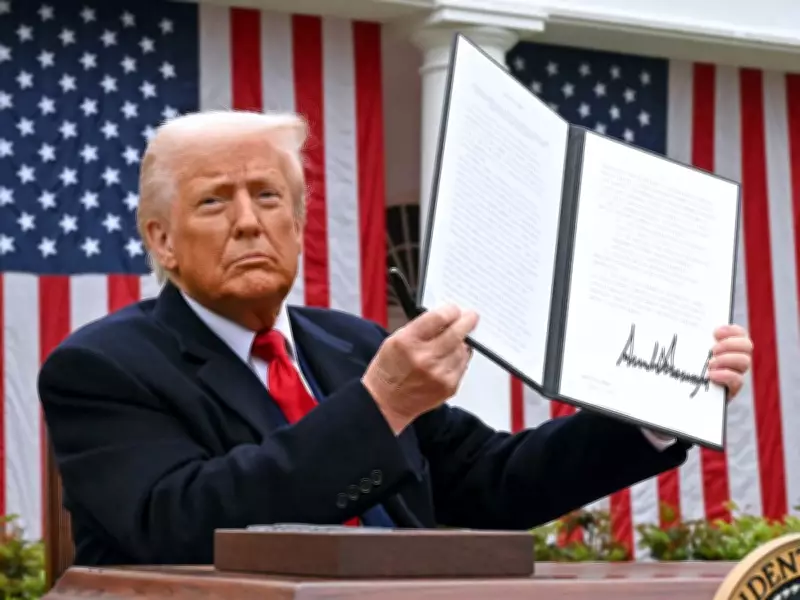
U.S. Supreme Court Strikes Down Trump Tariffs as Unprecedented Overreach
The United States Supreme Court delivered a landmark ruling on Friday, declaring in a 6-3 decision that President Donald Trump's tariffs imposed under the International Emergency Economic Powers Act (IEEPA) exceeded his presidential authority and lacked any historical precedent. This significant judicial rebuke marks a pivotal moment in the ongoing debate over executive power in trade policy.
Majority Opinion Highlights Lack of Precedent
Chief Justice John Roberts, writing for the majority, emphasized the unprecedented nature of Trump's actions. "It is telling that in IEEPA's half century of existence, no President has invoked the statute to impose any tariffs, let alone tariffs of this magnitude and scope," Roberts wrote. The court found that the administration's interpretation would have represented "a transformative expansion of the President's authority over tariff policy" that was never intended by Congress when it passed the 1977 law.
The IEEPA legislation grants sitting U.S. presidents the power to declare national emergencies related to security, foreign policy, or economic matters and impose economic sanctions on other countries. However, the court determined that Trump's application of this authority to impose sweeping tariffs went far beyond the statute's intended scope.

Dissenting Voices and Presidential Response
Justices Clarence Thomas, Brett Kavanaugh, and Samuel Alito dissented from the majority opinion. Thomas argued that there was no constitutional or statutory basis to rule against the president, noting that "The Court has long conveyed to Congress that it may vest the president with large discretion in matters relating to trade and commerce with other nations."
President Trump reportedly responded to the decision during a meeting with state governors at the White House, calling the Supreme Court's ruling "a disgrace." Legal experts do not expect the administration to abandon its tariff agenda despite this judicial setback.
Alternative Pathways for Future Tariff Actions
According to Tim Brightbill, an international trade lawyer and partner at Wiley Rein LLP in Washington, D.C., the Trump administration retains several tools to potentially reimpose tariffs quickly. Section 301 of the Trade Act of 1974 represents one of the most viable alternatives already within the president's arsenal.
This provision allows the U.S. Trade Representative to investigate and take action against foreign countries engaging in "unjustifiable, unreasonable, or discriminatory" economic practices that burden American commerce. During Trump's first term, his administration successfully utilized Section 301 to impose tariffs on China over concerns regarding technology transfer, intellectual property, and innovation practices.
Brightbill noted that the USTR maintains an annual list of foreign trade barriers that could serve as justification for moving forward with country-specific tariffs under Section 301 authority. This mechanism provides a more established legal framework than the emergency powers approach rejected by the Supreme Court.
Background and Context of the Tariff Dispute
President Trump first invoked IEEPA in February to justify levying tariffs on Canada and Mexico, claiming these countries weren't doing enough to address cross-border flows of fentanyl and illegal immigrants. The administration later expanded this order to include dozens of other U.S. trading partners as part of an April 2 announcement dubbed "Liberation Day" by the White House.
The Supreme Court's decision represents a significant check on executive power that will likely influence future presidential actions in international trade matters. Legal scholars anticipate that this ruling will establish important boundaries for how emergency economic powers can be applied to tariff policy moving forward.






