

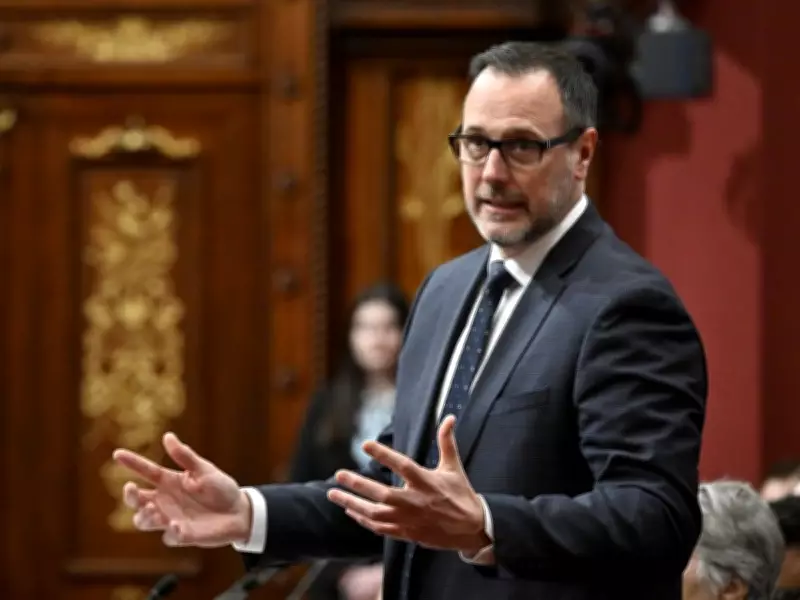
Quebec Secularism Minister Defends Bill 9 Provisions on Public Religious Practices
During public hearings on Quebec's proposed secularism legislation, Minister Jean-François Roberge provided crucial clarifications about the scope and intent of Bill 9, officially titled An Act Respecting the Reinforcement of Laicity in Quebec. The minister specifically addressed concerns that the bill would prohibit traditional funeral processions and charitable activities conducted by religious groups in public spaces.
Clarifications on Funeral Processions and Charity Collections
Roberge emphasized that Bill 9 does not target funeral processions, which he described as longstanding cultural traditions that would remain unaffected by the proposed legislation. Similarly, he clarified that church members collecting donations for charitable purposes, such as the annual "guignolées" campaigns that raise funds for Christmas baskets for the poor, would not be prohibited from identifying themselves as religious group members while conducting these activities in public places.
"No article in this bill says that on the street or in public places it is forbidden to wear a religious symbol, or if you do wear a religious symbol you can't collect donations," Roberge stated during the parliamentary committee hearings in Quebec City. "Nothing like that in this bill."

Municipal Concerns and Religious Group Perspectives
The minister's clarifications came in response to questions from Raymond Poisson, president of the church and society council of the Assembly of Quebec Catholic Bishops, who expressed concern that the bill might prevent religious identification during charitable activities. Poisson cited the example of Knights of Columbus members who proudly identify as part of a religious group while collecting donations that raised over $20,000 for Christmas baskets in St-Jérôme last year.
Quebec municipalities had previously raised similar concerns during Tuesday's hearings, suggesting that Bill 9 might inadvertently outlaw funeral processions or prayers at burial sites if these activities were interpreted as collective religious practice requiring municipal authorization.
Support for Regulating Spontaneous Public Prayer
While some religious practices would remain protected, other groups expressed support for the bill's provisions regarding spontaneous public prayer, particularly in the context of political protests. Eta Yudin, senior Quebec vice-president for the Centre for Israel and Jewish Affairs, described an "unprecedented wave of antisemitism in the West" since the October 2023 Hamas attacks on Israel, including incidents in Montreal.
"Beyond that, we frequently saw prayers in the streets that were used as excuses to call for the death of members of our community and attacks on our common Québécois values," Yudin testified. "Many of the measures in this law are necessary after the events of the last two years."
Conditions for Approved Public Religious Practices
Under Bill 9, municipalities could approve collective religious practices in public spaces if they meet four specific conditions: public safety is not endangered, the activities are short-term, they are open to all participants, and they do not obstruct roads. Yannis Harrouche, director of government relations for CIJA, suggested adding a fifth condition that activities cannot promote terrorist or criminal groups or display their symbols.
Harrouche distinguished between traditional religious celebrations that "have never bothered anybody"—such as Good Friday processions and Simchat Torah celebrations—and spontaneous prayer events that disrupt traffic and sometimes include hate speech.
Criticism from Rights Organizations
Not all groups supported the bill's approach to public religious expression. The Ligue des droits et libertés described Bill 9 as "a state attack on secularism" and argued that its provisions would create "a tool for state surveillance that facilitates censorship, including the suppression of religious expression."

The organization's brief noted that the bill would prohibit spontaneous religious practices during political demonstrations and give municipal councils broad discretion to refuse requests for public religious activities. "Public collective prayers have their place in a free and democratic society," the league argued, suggesting that existing laws already provide authorities with means to address public order concerns.
Daycare Sector Concerns
Separately, the Association des garderies privées du Québec criticized the bill's provisions affecting subsidized private daycares. The association accused Roberge of trying to muzzle dissent by not inviting them to address the public hearings, despite Bill 9's potential impact on their operations.
The legislation would prevent educators who wear religious symbols from working in subsidized private daycares, which the association argues would worsen existing staff shortages. In a survey of parents using their services, 65% of respondents opposed prohibiting educators who wear religious garb, while nearly 70% expressed concern that Bill 9 would exacerbate daycare staffing challenges.
The parliamentary committee hearings on Bill 9 continue as Quebec lawmakers examine the complex balance between secularism principles and religious freedom protections in public spaces.





