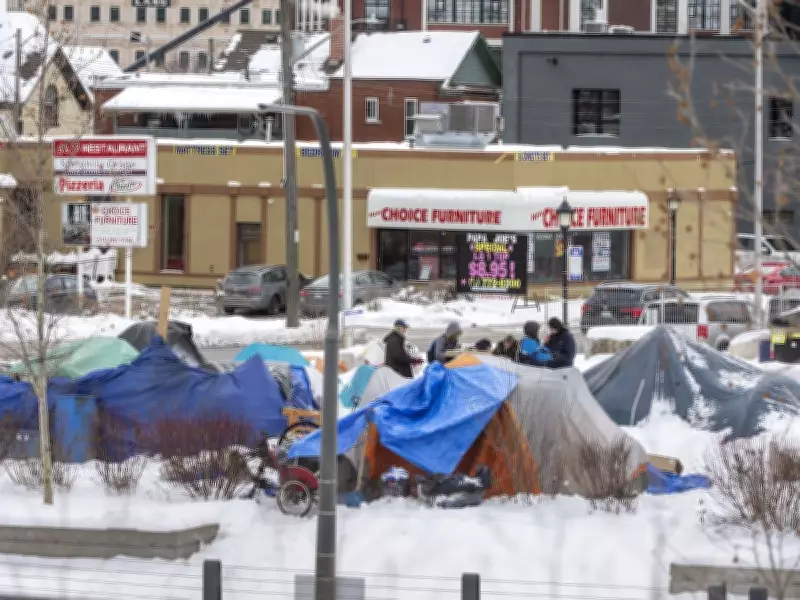
Last week, an Ontario Superior Court judge ruled that the Region of Waterloo cannot clear a 30-person tent encampment from a parking lot in downtown Kitchener, even though the region owns the lot. The municipality has been trying to do so as part of its plans to build the Kitchener Central Transit Hub, which will eventually connect local and regional bus and light rail services, along with VIA Rail. This integrated transit infrastructure is precisely what Canadian cities are constantly told they need more of.
The Background of the Encampment
People have been living in tents on the site since 2021. The region has spent three years trying to clear them through the courts. It passed a bylaw. When the bylaw was challenged, it amended it. It removed the $5,000 fines for people who refused to leave. It created a transition policy to help residents find alternative housing. It offered individualized housing plans to every resident. None of it was enough. To use its own land, the judge ruled, the region must first provide an alternative legal encampment site or a formal tenting protocol with equivalent services.
The Absurdity of the Decision
The absurdity of the decision is obvious to any sensible observer, but the case is just the latest in a disturbing trend in how this country is governed. Buried in the 88-page decision is yet another instance of an Ontario court overturning settled law to invent a new constitutional right, and in the process imposing a policy outcome that no elected government has voted for and no majority of Canadians has ever endorsed. The number of cases where courts use the Charter to invent new rights and impose the policy fever dreams of out-of-touch progressive activists has become impossible to ignore.

Legal Reasoning Under Scrutiny
The crux of the decision begins at paragraph 204 of the ruling. There, Ontario Superior Court Justice Michael R. Gibson declares that homelessness should be recognized as an analogous ground under Section 15 of the Charter, meaning a protected characteristic alongside race, sex, religion, and disability. Homeless people, Gibson writes, possess a constructively immutable characteristic and constitute a discrete and insular minority. Faced with the awkward fact that homelessness, unlike race or sex, is not actually permanent, he concedes (he has to) that homelessness is transitory. He then asserts this does not matter, because such characteristics are, while they last, beyond an individual’s conscious control.
Read that twice. Homelessness is immutable, except that it isn't, but it should be treated as though it is. The judge has redefined immutable to mean its opposite. The reasoning would not survive a first-year constitutional law tutorial, and yet there it sits, in a published Superior Court ruling, as the basis for a substantial expansion of equality rights in Canadian law.
Implications for Urban Governance
Canada's cities will become ungovernable if this ruling stands. The decision effectively ties the hands of municipalities trying to manage public spaces and develop critical infrastructure. By equating homelessness with protected characteristics like race or sex, the court has opened the door to endless legal challenges against any attempt to clear encampments, regardless of the circumstances. This not only hinders transit projects but also undermines the ability of local governments to address homelessness through balanced policies that respect both the rights of the homeless and the needs of the broader community.
Broader Constitutional Concerns
This ruling is part of a broader pattern of judicial activism in Canada. Courts have increasingly used the Charter to create new rights that have no basis in the text or original intent of the Constitution. The result is a shift in power from elected legislatures to appointed judges, who are not accountable to the public. If this trend continues, Canadians may find themselves living under a system where policy decisions are made by judges, not by their elected representatives.