

The Imperial Boomerang: How Colonial Control Methods Return Home
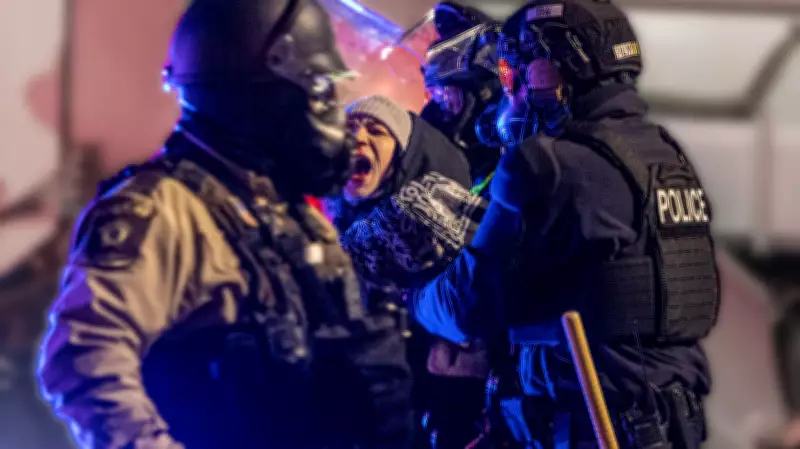
If the hyper-militarized presence of Immigration and Customs Enforcement agents in American cities like Minneapolis evokes imagery reminiscent of war zones such as Iraq in the early 2000s, this perception is not far from reality. A concept gaining traction online, known as the "imperial boomerang" or "colonial boomerang," describes a troubling historical pattern where superpowers develop violent systems of control and surveillance in colonial territories, only to later deploy those same tactics against their own citizens.
Historical Roots in Anti-Colonial Thought
The phrase was first coined in 1950 by Aimé Césaire, an influential anti-colonial thinker from Martinique, who used it to illustrate how the brutality of empire eventually "boomeranged" back to Europe in the form of fascism. Césaire argued that Hitler's invasion and domination of neighboring European countries essentially replicated what European powers had long practiced in the Caribbean, Asia, and Africa—only this time directed at Europeans themselves. Mass surveillance, forced labor, and genocide, once tools of colonial rule, became normalized within Europe.
A similar dynamic is now evident in the United States, where ICE agents and surveillance tactics originally developed for foreign operations are being deployed within domestic borders. In urban centers including Minneapolis, Chicago, and Los Angeles, ICE operations have involved:

- Deploying chemical irritants early in confrontations with protesters
- Using so-called less-lethal munitions that have caused injuries including blindness
- Utilizing facial recognition apps, databases, cell phone trackers, and drones to monitor immigrants and protesters
This pattern mirrors what occurred during efforts to suppress Black Lives Matter protests in 2020, and federal agencies have reportedly drawn on counterterrorism strategies used by the Israel Defense Forces when deploying tactics in Democratic-leaning cities.
Understanding the Boomerang Mechanism
Julian Go, a professor of sociology at the University of Chicago and author of "Policing Empires: Race, Militarization and the Imperial Boomerang," explains that the concept refers to "the process by which imperialism abroad comes home to impact the imperializers themselves." These imperial tools and tactics are first innovated and perfected in colonial peripheries—in colonies, at imperial borders, and in zones of violent conquest like Vietnam or Iraq—primarily for use against peoples racialized as nonwhite and perceived as inherently dangerous.
While U.S. Border Patrol and ICE operate separately from local police departments, they too reflect the boomerang effect. Border Patrol emerged in the late 19th and early 20th centuries along the U.S.-Mexico border, borrowing tactics from America's military conquest of the West, with many early agents coming from the Texas Rangers.
ICE, created in 2002, demonstrates more recent manifestations of this phenomenon. Research by Jewish Voice for Peace reveals that ICE agents have traveled to Israel to learn how Israeli police and military handle Palestinians. Furthermore, Greg Bovino, former head of ICE operations in Los Angeles, Chicago, and Minneapolis, previously served in foreign assignments in Honduras, Egypt, and Africa, and cut his teeth with Border Patrol in the southwest where militarized methods for locating undocumented migrants were developed.
The Racialized Foundation of Imported Tactics
Go emphasizes that racism functions as the Trojan horse through which militarized policing enters domestic spaces. Historically, police import tools and technologies from imperial peripheries when they perceive threats from nonwhite populations—whether Chinese immigrants in early 20th century California, Black Americans in 1960s urban centers, or Muslim communities post-9/11. These populations are constructed as inherently criminal or radical threats, justifying the use of imported violent methods.

While initially targeted at nonwhite people or noncitizens, these tactics inevitably become available for use against any population. Militarized policing has been directed at white striking industrial workers in the early 20th century, white college student protesters in the 1960s, and more recently at protesters of all backgrounds in Minneapolis.
The entire ICE campaign is premised on a racialized threat narrative that exaggerates or fabricates dangers posed by undocumented immigrants, portraying American cities as chaotic spaces requiring militarized responses imported from imperial border zones.
Historical Continuities in Policing Methods
The boomerang effect has deep historical roots in policing itself. The first police department in England, the London Metropolitan Police created in 1829, drew inspiration from colonial policing in Ireland and slave patrols in the British Caribbean. Early U.S. police departments copied this model while incorporating elements from America's westward expansion.
- In the early 20th century, modern police departments imported tools and tactics from America's colonial war in the Philippines, including pin-mapping (precursor to predictive policing) and mounted police units.
- During and after the Vietnam War, police imported counterinsurgency and torture methods, with SWAT units inspired by military units from Southeast Asian theaters of war.
- In the early 1970s, British and U.S. police adopted crowd control methods from Northern Ireland.
- Today, police use surveillance technologies developed during the "war on terror" in the Middle East, including gang databases created by Palantir for the U.S. Army.
Resistance and Potential for Change
The Minnesota protests following ICE operations demonstrate that citizen opposition can potentially halt the boomerang effect. Historically, resistance to police militarization often emerged only after these tactics had already become entrenched. The current situation in Minneapolis shows that public mobilization remains crucial for challenging the growing militarization of immigration infrastructure.
As Go notes, while racist perceptions about threats to law and order motivate bringing these tactics home, and while they are primarily deployed against nonwhite populations, they ultimately become tools that can be directed at anyone. The killings of Renee Good and Alex Pretti by ICE agents serve as tragic examples of how imported tactics impact everyday citizens regardless of background.
This complex interplay between colonial history, racialized policing, and domestic enforcement reveals how America's imperial past continues to shape its present, with the streets of Minneapolis and other cities becoming the latest theaters for tactics originally developed for foreign conquest.





