Cracker Barrel has frequently made headlines over the past year. The chain faced backlash after a disastrous logo redesign, prompting President Trump to declare, “Make Cracker Barrel a WINNER again,” eventually leading the company to revert to its original branding. An internal memo about employee dining rules leaked and went viral, adding to the challenges for the beloved Southern restaurant chain. However, when I saw “Cracker Barrel” trending, none of that came to mind. Instead, I thought of my mother—and imagined the sound of her flip phone crackling to life in the woods of Ohio as she opened a Styrofoam clamshell of fried apples.
Ordering Cracker Barrel for my mom became our unlikely connection. I remember my phone buzzing with a message: “Your DoorDash order has been delivered.” But the meal hadn’t arrived at my home in Brooklyn. It was delivered 700 miles away. Each time I placed an order, I tracked the driver’s progress on my phone in real time, watching the little car icon wind along the roads of Middletown, Ohio, roads my mother had driven for decades. Her driver’s license had finally been revoked after her stroke, when she almost ran over a neighbor and hit a parked police car.
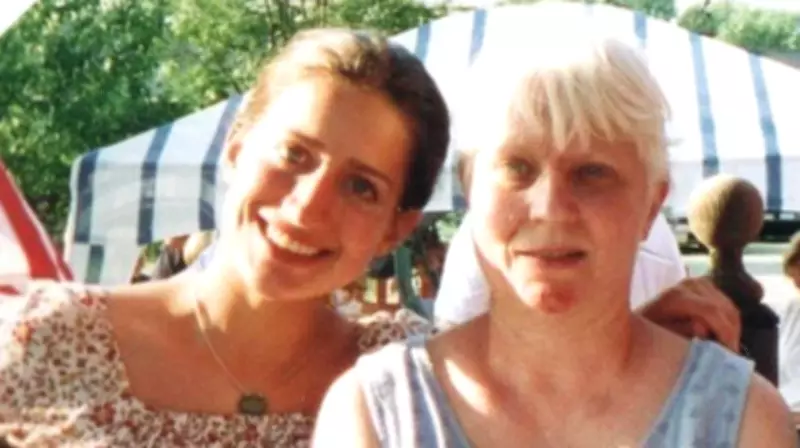
Neighbors sometimes brought my 84-year-old mother food, but she grew tired of their leftovers. After living alone for most of her life, she suddenly needed me. “Order double... the... more fish, cat,” she insisted. Her speech was a jumble of broken sentences. The nurses called it word salad, a symptom of her aphasia—a condition shared by Bruce Willis and millions of others—that she experienced after her stroke.

I had spent years hesitating to pick up my phone when I saw a 513-area code, and I often didn’t answer her calls. Now, receiving her requests for meat loaf or biscuits spoke to me in an incredibly primal way. I had known what it was like to be hungry. When my fraternal twin and I were young, we relied on soup kitchens for food. We were homeless in New York City and home-schooled by our single mother. She had told us that our father died in Denmark while she was pregnant with us. From ages 8 to 16, I played my violin outside Trump Tower on Fifth Avenue in hopes of earning tips and thereby keeping our family of three from starving.
When I was 44, I took a DNA test, which revealed that my father had been alive throughout my childhood. My mom had lied to me—about almost everything. I was stunned, and even more so when not long after that I discovered a stash of her letters and records from when she spent time in a psychiatric institution in 1963. I realized I had been in denial for decades. Despite understanding that her reality was fragmented and unstable, and that she wasn’t to blame for it, I couldn’t help but be angry at her for what she’d kept from me and how my life was affected by it.
I cried every day and barely ate for months. I lost eight pounds and developed severe heart palpitations. It was only when a cardiologist said I needed an ablation—a procedure in which doctors go up through the groin to blast away parts of the heart—that I finally told my mom what I knew. She continued to deny the truth, and I realized she’d told so many untrue stories to me—and herself—for so long that she’d never confess. Maybe she didn’t even understand that they were true. The only way forward was to move forward.

I played my fiddle in a Brooklyn band and raised my two daughters with my husband while my mother lived deep in the woods of Ohio. The distance between us was more than geography—it was decades of hurt, mistrust, and the kind of damage that made me question whether blood really meant anything at all. Despite everything, I still loved her and couldn’t imagine her not being in my life. However, I made my boundaries clear, and I limited my visits, but we talked on the phone almost every day. During our chats, my mother mixed up pronouns, claimed my twin sister was listening in on her cell, and said a killer was lurking in the attic and on her lawn. She insisted the neighbor had poisoned her, strangled her dog, and killed her alpacas. She was tested by a neurologist, and after she didn’t pass the “clock-drawing” test, she was diagnosed with Lewy Body Dementia. Adult Protective Services acknowledged she might have mental health issues, but essentially said “we’ve seen worse,” and deemed her capable of still living independently. Without her consent, they’d need a court order to remove her. She sometimes forgot how to dial my number, but she never forgot to ask me to order extra helpings of Cracker Barrel, which she ate over several days.
I was desperate to do better than my mother had, and to bring her whatever pleasure I could afford, so I had meals delivered to her twice a week. Cracker Barrel provided an idyllic sense of home that my mother never offered me: rocking chairs on the porch, mason jars filled with sweet tea, and the promise that someone’s grandmother is in the kitchen making sure you don’t leave hungry. My mother grew up in the same hometown as Vice President JD Vance, and I knew the chain’s food was the closest she could get to her dear mother’s cooking. Each time I saw a delivery had successfully arrived at her door, I felt like I was sending a bit of comfort and healing through the internet to the woman I’d once sworn I’d never forgive.
“Apple… sweet… the…” she’d suddenly sing in a soprano voice. “Mother, do you mean fried apples?” “Yes! Apple… fried… good!” Then came the drinks: “Cold… peach… drink… big one.” The peach iced tea. 16 ounces. Always. DoorDash drivers would text me, “Can’t find the house,” from the end of her long driveway, and I’d reply frantically with directions: “Pass the mailbox wrapped in duct tape, go through the gate, and turn right at the American flag.” They’d often call me anyway, lost amongst her maze of traffic cones and signs that read Trespassers Will Be Shot, Trump Forever, and My Mother’s Not Here to Clean Your Mess. I’d guide them until I heard the crunch of tires on gravel, and I knew they were almost there. Then came my favorite part: calling mom’s flip phone. “Greasy… cold, but… yum! Yum!” she’d say, her excitement spilling into a jumble of words and laughter.
Then one day she told me she didn’t need me to order food for her anymore. She could do it all by herself. “I’m big girl,” Mother said, defiantly. “But I like sending you food.” Her phone beeped as if she were pushing buttons, trying to figure out how to hang up. “You’re not the mom,” she said. My breath caught in the silence. I wondered if her agitation was due to dementia. I called her back, but she wouldn’t pick up. I called a day later. Her voicemail answered, and the recording said, “Phone broken. Write letter.” I knew her phone wasn’t broken, just parts of her heart.
A week later, a manila envelope arrived with my custom return address label slapped on the front. Mother had drawn hearts all around it. I imagined Mother wearing her pink cowboy hat, hobbling down her long gravel road, and flagging down the mail carrier. Inside the package were crayons and a Cracker Barrel takeout menu with her order circled: fried apples, steak, soup, and peach tea. I ordered double portions. When the food arrived, she answered her phone with that familiar glee. I didn’t know it would be the last time I’d hear her unwrap my love from its Styrofoam packaging.
Not long after, she left me a voicemail: I love you. I love you. I really love you. Her voice brought me to tears. I called her back multiple times, but I didn’t get a response. The next day, a neighbor found her lying on her kitchen floor. Tomato soup and grits were splattered against the walls. The police told me they had no idea how long she had been fighting for her life on the floor after suffering another stroke. After a week in the hospital, she passed away as the moon eclipsed.
I’ve spent a lot of time thinking about that final act of care—how the last thing I did for my mother was make sure she had her favorite meal. I realize now that love is complicated, and sometimes loving someone means navigating DoorDash’s delivery system because it’s the only way to bridge decades of hurt and say, “You are not forgotten. You are forgiven. You are not alone.”
My daughters sometimes ask me what I miss the most about my mother. I tell them I miss the version of her I finally got to know—not the mother who left us homeless and lied about my father, but the woman who had been fighting a losing battle with reality her entire life and simply needed nourishment.
Heather Kristin has written for The Washington Post, Glamour, The Independent, Salon, Slate, and has been interviewed on Latino NPR and by Oprah. She’s worked many jobs, including Park Avenue nanny, extra on films, subway busker, cocktail waitress, but she’s most proud of being a Girls Write Now mentor, mommy, and violinist. She’s currently writing a memoir, “The Stand-In.”