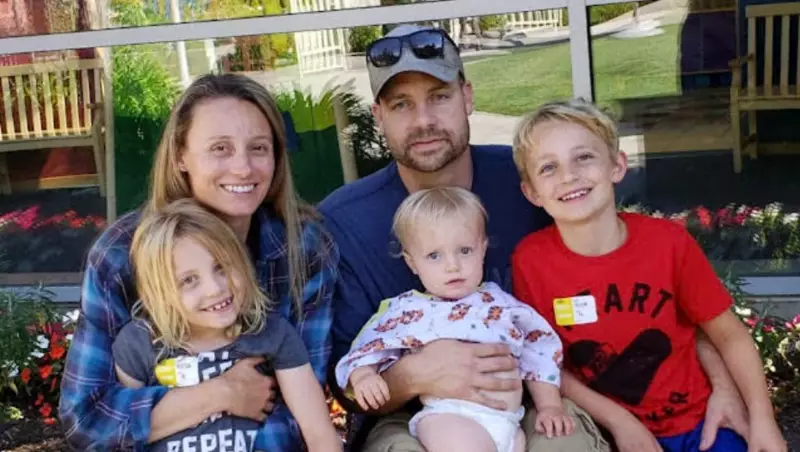
For Emily Henderson and her husband Nick, Christmas will forever be marked by the absence of their son, Aiden. The toddler died unexpectedly at just 20 months old during surgery to remove a brain tumour. Two Christmases later, as Emily sat amidst wrapping paper and her two older children, a simple gift in her stocking would become a profound tool for navigating the family's enduring grief.
A Gift That Captured a Lost Laugh
During that holiday, Emily's husband Nick prompted her to open her stocking. Inside, she found a plain white Easy Button, a common novelty item. At his urging, she pressed it. The room filled with the sound of muffled voices, then a distinctive high-pitched squeal that blossomed into a full, belly laugh. It was the voice of Aiden, captured in a 15-second recording of him playing with his siblings, Peyton and Owen.
"The room blurred," Emily writes. Gravity pulled tears down her cheeks as she recognized her son's joyful noise, followed by her daughter's "Hello" and her older son's playful "Oh no, oh no." The recording ended abruptly, leaving a heavy silence that Nick broke by offering to change it. "It's perfect," Emily replied. The button, a seemingly trivial object, became a cherished portal to a lost moment of pure family joy.

A Test of Heart and Healing
The family's journey with grief took another poignant turn when Emily's best friend, Ashley, asked them to care for her toddler, Will, while she recovered from having a new baby. Will was the same age Aiden had been when diagnosed. Accepting him into their home was both a challenge and a conscious choice in their healing process.
To prepare, Emily had to clear Aiden's crib, which had remained as a shrine in her bedroom. She carefully moved the plaster mold of his hand and the bag with his hair clippings. Watching Will, who babbled and took halting steps just as Aiden had before his illness, was emotionally complex. Her older son noted the similarities, his voice often trailing off. When asked if it was hard, the boy gave a wise reply: "No, I mean, it's hard—but in a good way."
A pivotal moment came when Will found the Easy Button on the living room pile and began pressing it repeatedly. The stops and starts of Aiden's laughter filled the air, and Nick and Emily shared a smile across the room. Aiden was, for a moment, part of the family's new reality.
The Evolution of Grief and Memory
The week with Will was exhausting but fulfilling, proving to the family they could still engage with life and joy. However, his departure brought back the familiar, aching quiet of the house. Emily contrasts her approach to grief with that of her grandparents' generation, who lost a young son and rarely spoke of him. She chooses to keep her grief "front and center," surrounding herself with reminders like photos, Aiden's socks, and the funeral poster.
Yet, she acknowledges that grief evolves. The crib that was once untouchable is now disassembled in the garage. She knows the time will come to donate his toys. The family plans to remodel their house, a process she sees as a Marie Kondo-style curation of memory—deciding what to display, pack away, or let go, never rushed or forced.
The Easy Button remains a central, comforting artifact. "I use it when I need a smile or a cry or when I want to wallow in anger," Emily shares. It is a tangible reminder not just of Aiden, but of the enduring love that surrounded him. By pressing it, she reminds herself that their journey is not easy—but in a good way. The love, she affirms, hasn't gone anywhere; by celebrating Aiden's life, they keep it vibrantly alive.