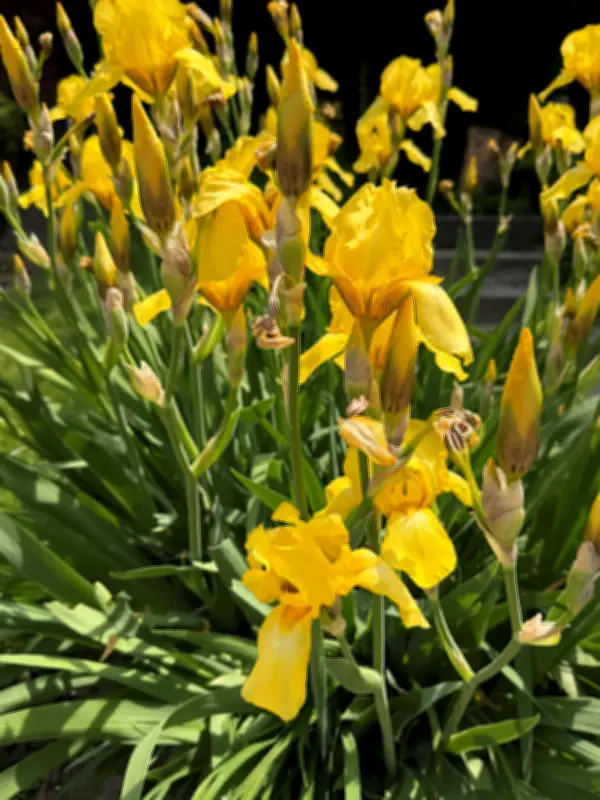
A riot of yellow bearded irises blooms on a neighbor's front lawn, heralding the peak of iris season in mid-June.
We independently select everything we recommend. Buying through us may earn us a commission, which supports our work.
I'm not sure if the recent cool, wet spring held things back a bit, but 2026 is turning out to be a banner year for irises. All through my neighborhood, there are bright explosions of these regal flowers. My own irises are going pretty crazy too.

The Name and Symbolism
Irises take their name from the Greek goddess of the rainbow. Sweet-natured Iris was a handmaiden of Hera and a messenger between the gods and mortals. Iris also symbolized hope and optimism.
Species and Varieties
There are about 300 different species of irises, most originating in Europe, the Mediterranean, and Asia. The most familiar to Canadian gardeners is the bearded iris (Iris germanica), with tall, sword-like leaves and heavy, frilly blossoms. Each flower has six petals: three upright standards and three downward-facing falls, with a fuzzy tongue in the center that resembles a little goatee. Some even have a delicious, licorice-tinged scent.
Bearded irises come in almost every color of the rainbow, from snow white to deep purple, almost black. The only color not seen is true red, but growers are still trying.
Other popular garden irises include:
- Iris reticulata (dwarf iris): smaller, grows from bulbs, blooms early in spring. Lovely with crocuses and early tulips.
- Siberian irises (Iris siberica): immortalized by Van Gogh, with smaller blossoms and finer leaves. They form thick clumps but hollow out after a few years. Dig them up, cut off spent inner rhizomes, and replant healthy outer sections.
- Yellow flag iris (Iris pseudocorus): grows in marshlands, considered invasive. If you keep them, prevent spreading.
Growing Tips
Irises thrive in full sun and well-drained soil on the dry side; they hate wet feet and will rot in standing water. With these conditions, they bloom happily for years, even decades.
The time to plant new irises is late summer. Dig a shallow hole about six inches wide and two to three inches deep, mound up a reverse V in the middle. Place the rhizome lengthwise on this, drape roots down either side, cover roots with soil, but only bury the rhizome enough to stabilize it, keeping the top half exposed.
Be patient; they often don't bloom the first summer but reward you the following year with multiple blooms. Some varieties even do an encore in September.