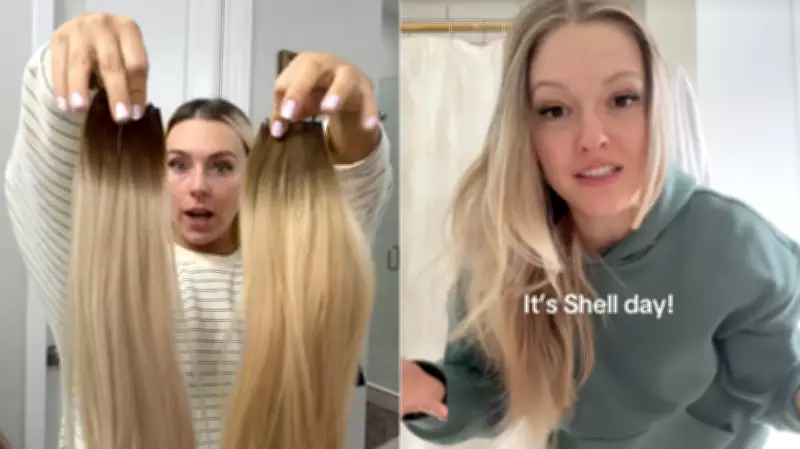
TikTok's 'Shell Day' Trend: Women Embrace Glam as Occasional Self-Care
On TikTok, a new trend called "shell day" is gaining traction, where women document their elaborate makeup and beauty routines on days they choose to get fully glammed up. This phenomenon highlights how Generation Z is redefining beauty practices, with makeup becoming less of an everyday necessity and more of a fun, occasional ritual.
The 'Shell Day' Phenomenon Explained
Content creator Serena Neel, based in Las Vegas, popularized the trend with her viral TikTok series that has garnered millions of views. In her videos, Neel compares herself to Mr. Krabs from "SpongeBob SquarePants" without his shell when she's in her natural state - without hair extensions, eyelash extensions, or a tan.
"I once again feel like Mr. Krabs without his shell," Neel says in one clip before beginning her transformation process. "I don't have my hair extensions, or my lash extensions or a tan - I'm real," she explains, before adding humorously, "Actually, I'm not because I just bleached my hair and I have very dark brown hair. I'm almost real."

Her "shell day" routine involves applying hair extensions, self-tanner, brow gel, eyelash extensions, and curling her hair while enjoying what she calls "the nectar of the baddie gods" - Diet Coke. When complete, she joyfully declares: "This is my shell. Happy shell day!"
Gen Z's Changing Relationship with Beauty
Neel told HuffPost she created the series to promote transparency in the beauty space and share economical beauty hacks. "Clean girl makeup is really popular right now, which is using a little makeup to enhance your natural beauty, and I think my 'shell day' is an extension of that," she explained.
According to a 2024 YouGov poll, only 6% of Gen Z wears makeup daily - the lowest percentage among all age groups. This represents a significant shift from previous generations' beauty practices.
"Most days I'm just in pajamas or comfy clothes, so it's definitely not about looking the most - I even went six months without getting my roots done because my time and energy was going into my craft videos," Neel said. "Life, including makeup application, is meant to be unserious and fun."
The 'Shell Day' Community Grows
Other women have embraced the trend, creating their own "shell day" content. Tracy, a Rhode Island TikToker known as @tracytellsit, describes her routine as "an 'everything shower' day on steroids."
"It's the reset of your image for that week: Think a full blowout, self tanner, eyelashes - a true self care 'me time' day," Tracy explained. She sets aside time for high-maintenance beauty practices to be low-maintenance throughout the week, embracing what she calls working smarter, not harder.
"I'm all about authenticity and realness on my TikTok," Tracy said. "I wanted to show the world that it's OK to be exactly who you are - shell or not."
Academic Perspectives on the Trend
Becki Nash, a senior teaching fellow and sociologist at the University of Southampton who researches beauty norms, notes that TikTok enables greater transparency. "There's a sense of the 'everyday' beauty routine that differs from filtered, edited photos or highly polished pictures we see of celebrities," she said.
Marjolein de Boer, an assistant professor of health humanities at Tilburg University in the Netherlands, observes that Gen Z appears to be renegotiating feminine beauty norms. "These creators implicitly frame beauty routines as a 'choice' and as more 'self-directed' and not as something that is heavily influenced and shaped by feminine beauty aesthetics," she explained.
De Boer suggests this aligns with postfeminist thought: femininity and beauty norms have become something one can opt for rather than something required daily. However, she notes the trend still operates within strict beauty norms, offering flexibility only after completing hours of beautification on "shell day."
The 'Catfishing' Controversy
Interestingly, the "shell day" trend emerges alongside online debates where some men criticize women's use of makeup as "catfishing." Social media has seen complaints about women allegedly deceiving men with their makeup-enhanced appearances.

Even celebrities like Sydney Sweeney and Margot Robbie have faced accusations of "catfishing" when no-makeup photos surfaced online. One Twitter user commented alongside photos of Sweeney: "All women are catfishes. The question is, to what degree."
Rebekah Burroway, an associate professor of sociology at Stony Brook University and a freelance makeup artist, views this criticism as part of broader societal policing of women's bodies. "It's not actually about makeup," she said. "It's about conforming to narrow ideals of what is acceptable femininity."
Tracy, the "shell day" TikToker, finds this criticism absurd. "It's absolutely wild that men think they can dictate women's worth based on what they look like with or without makeup," she said. "Makeup isn't for making myself more appealing to men: It's a tool to help you feel your best."
Redefining Beauty Standards
Burroway notes that younger women are prioritizing skincare and "natural beauty" through trends like clean girl beauty, no-makeup makeup, and the "glass skin" phenomenon. While this might appear healthier, she cautions that it may represent shifting rather than disappearing beauty norms.
"Young women are still subjected to social pressures to look a certain way," Burroway explained. "The trend now is 'effortless' beauty, which actually requires a lot of effort! We can see this effort plainly in 'shell day' videos."
She appreciates that "shell day" content reveals the labor behind beauty practices that often remains hidden. As women continue to navigate evolving beauty standards, trends like "shell day" offer both self-expression and transparency in an increasingly visual digital landscape.