Last winter, a distraught message arrived from an unfamiliar voice. It was her brother, calling from Washington state where he and their father lived together near the Canadian border. “Daddy’s dying, can you come?” The author had not seen or spoken to either of them in 30 years.
A Childhood of Disruption
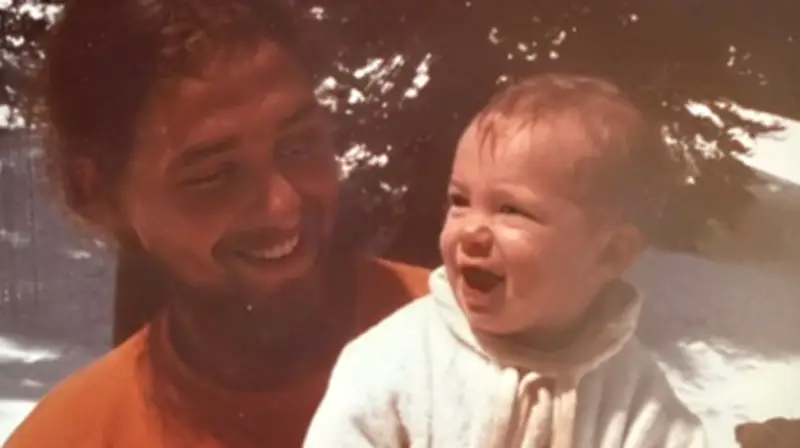
As children, the author and her younger brother were inseparable. She was known as Daddy’s girl, and for a brief time, her father was her entire world. Her parents divorced when she was 3, and her father took her and her brother from Alaska to California, leaving their mother behind. They saw her only during holidays and summers, while their father became the center of their lives.
When she was 6, her father remarried. The new stepmother seemed like a second mother, and the children imprinted on her like baby birds. The family moved to an A-frame house in a small Northern California mountain town, a place where people go to disappear. Despite the constant disruption, that time held glimpses of normalcy: coloring books at the kitchen table, rounds of Clue in the living room, and vines heavy with ripe cherry tomatoes in the garden.

Her father traded handyman tasks for low rent, spending his days hammering door frames and floorboards while wearing a tattered T-shirt, leather tool belt, and cut-off jeans. Under the open-rise stairs was his workshop, where the children were not allowed without permission. Amid X-ACTO knives and Zig-Zag papers, he stood at a high table, woodworking, a joint dangling from his lips. Between carpentry jobs, he made jewelry boxes with intricate hinged tops, mosaics of cedar and pine depicting redwood groves, sunsets, or meadows of lupines. The one he made for her featured a hummingbird drinking nectar from a hibiscus, only visible clearly when she relaxed her gaze and looked from a distance.
She hasn’t seen that jewelry box or her father in over three decades. But in memory, she can still smell the earthy scent of freshly cut wood, hear the soft tone of his voice, and see his shy eyes light up when he called her “Babydoll,” telling her she had her mother’s smile.
Loss and Fracture
During their second year in the mountain house, her mother died of sudden, widespread cancer in an Alaskan hospital. The children did not get to see her or say goodbye. Not long after, in their third year, her father’s violent temper and infidelity drove the stepmother away nearly as quickly as cancer had claimed their mother. The family left that house in a wake of damaged things: picture frames, wedding vows, unharvested vines heavy with rotting fruit.
What followed were years of bouncing from the father’s girlfriend’s house to campgrounds to grandparents’ country home. Until one morning at the school bus stop, she said goodbye to her brother, unwinding his scrawny arms from her waist so he could go one way and she another. At 11, she couldn’t picture life without her sibling, but she couldn’t live another minute with the erratic man who had upended her universe. The choice broke her in two. While her brother orbited their father in off-grid corners of the continent, she tried to find belonging with their ex-stepmother, wearing her thin with grief and anger. Neither orphaned nor adopted, she spent middle and high school feeling adrift. By 17, she was living on her own—miles and years from being a Daddy’s girl.
The last time she saw her father, he drove down from Washington to Northern California in a camper van to see her graduate from high school. He arrived days after the ceremony and parked on the street outside the converted garage where she exchanged babysitting for rent. They spent evenings on lawn chairs in the backyard, talking under starry skies as he smoked hand-rolled tobacco and drank Rainier beer. She studied this bearded man with hair as long as hers and wondered if he’d ever felt familiar.

Her father oscillated between pride and regret over the distance between the girl she once was and the almost-woman she had become. But any remorse was not enough to make him recommit to the role of dad. When she told him she needed consistency and an end to his disappearances, he said, “You know I can’t do that, Babydoll.” Within a week, he returned to the top of Washington, where he lived with his girlfriend, her kids, and her brother, whose loyalty had long outlasted hers. They only spoke a handful of times afterward. Her husband and two sons never met her father.
The Final Chapter
Despite her brother’s pleas last January, she did not rush to the hospital. This time, it was she who couldn’t recommit to the role of daughter after not being one for so long. Instead, she wrote down addresses, title companies, and phone numbers of probate lawyers. She spoke to doctors and arranged for hospice—all from her home in California, two states away.
She learned of her father’s passing in a three-word text from a gruff uncle she barely remembers. The message echoed a truth she already knew: her dad is gone. Was he ever here? Now, his mobile home waits in the Pacific Northwest to be dismantled by her estranged brother and her, as their childhood and chance at growing up together once was. She wonders if she’ll uncover any remnants from their brief shared life.
Since his death, she has tried to understand this man who was once her whole world—who made her a jewelry box that was, like him, loved and lost in time. The mosaic of her dad portrays a complicated man who left behind ripples of pain, but also beauty: knotty pine boards with twisted burls that made faces on her ceiling, a hummingbird forever frozen in a wooden landscape, a plot of verdant land for his only children. All of it is proof that her father—who could not really be a father—was still capable of providing something enduring. She can see it now, but only from a distance.
Do you have a compelling personal story you’d like to see published on HuffPost? Find out what we’re looking for here and send us a pitch at pitch@huffpost.com.
Related: grief, estranged family, death of a parent