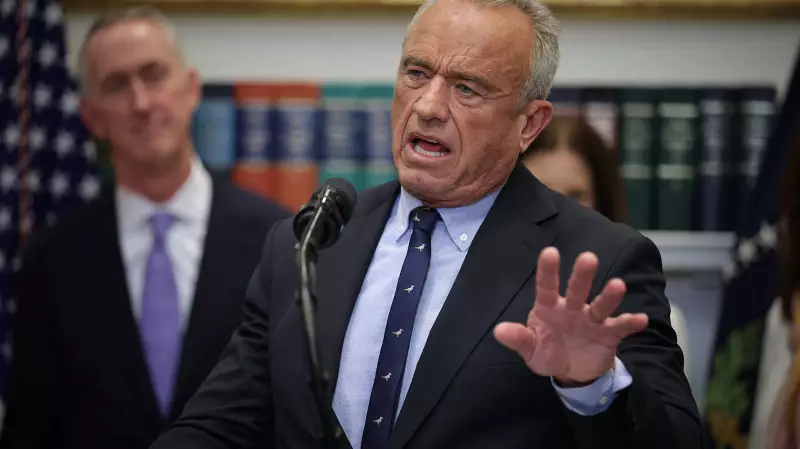
The first year of President Donald Trump's second term has seen seismic shifts within the U.S. Department of Health and Human Services, driven by Secretary Robert F. Kennedy Jr. and his "Make America Healthy Again" (MAHA) movement. Since taking office in February 2025, Kennedy has initiated a sweeping transformation, rebuffing established medical consensus and converting his campaign ideas into public policy, a move that has polarized the nation.
Staffing Cuts and a New Policy Direction
Within two months of his appointment, Kennedy announced a major restructuring of the sprawling $1.7 trillion department. The plan involved shutting down entire agencies, consolidating others into a new entity focused on chronic disease, and eliminating approximately 10,000 jobs through layoffs, on top of another 10,000 voluntary buyouts. While some aspects are contested in court, thousands of the mass layoffs have proceeded.
This significant downsizing has been accompanied by a purge of leadership. Kennedy has fired or forced out several top officials, including four directors at the National Institutes of Health, the former vaccine chief at the Food and Drug Administration, and a director of the Centers for Disease Control and Prevention whom he had hired less than a month prior.

Beyond personnel, Kennedy has overseen deep cuts to scientific research. The NIH slashed billions in research projects, and the department terminated $500 million in contracts aimed at developing vaccines using mRNA technology.
Vaccine Policy Reversals Raise Alarm
Despite assurances during his confirmation hearings, Kennedy's tenure has been marked by dramatic reversals in vaccine policy that have alarmed the medical community. In May 2025, he announced the CDC would no longer recommend COVID-19 vaccines for healthy children and pregnant women, a decision experts said lacked new supporting data.
In June, he dismissed an entire 17-member CDC vaccine advisory committee, later replacing it with a panel that includes several vaccine skeptics. This new group has made controversial decisions, including:
- Declining to recommend COVID-19 shots for anyone.
- Adding new restrictions on the combined MMRV (measles, mumps, rubella, chickenpox) vaccine.
- Reversing the long-standing recommendation that all newborns receive a hepatitis B vaccine at birth.
Most strikingly, in November, Kennedy personally directed the CDC to abandon its official position that vaccines do not cause autism, despite providing no new scientific evidence. While old language remains on the website due to a promise to Republican Senator Bill Cassidy, a disclaimer was added noting its presence was due to that agreement. Public health experts universally reject this change, citing decades of rigorous research.
The Rise of MAHA and Broader Consequences
The "Make America Healthy Again" movement has become the central theme of Kennedy's agenda. He has used it to campaign against ultra-processed foods, artificial food dyes, fluoride in drinking water, and to push for banning junk food from federal nutrition assistance programs. The concept has gained traction beyond HHS, with officials from the Defense, Transportation, and Environmental Protection agencies incorporating MAHA-related initiatives.
However, the overhaul occurs amid broader instability in the American health system. Congress passed Medicaid cuts this year, and expiring Affordable Care Act subsidies threaten the insurance coverage of millions. Critics like Georgetown University's Lawrence Gostin, who was removed from an NIH advisory board, warn the changes are hollowing out U.S. scientific leadership. "I think it will be extraordinarily difficult to reverse all the damage," Gostin stated.
HHS spokesperson Andrew Nixon defended the department's work, stating in 2025 it confronted challenges with "transparency, courage, and gold-standard science." Supporters of MAHA praise the disruption of an agency they long viewed as corrupt. Yet, as Kennedy's policies—from promoting distrust in vaccines to advocating for raw milk—continue to diverge from established science, the debate over the future of American public health intensifies.