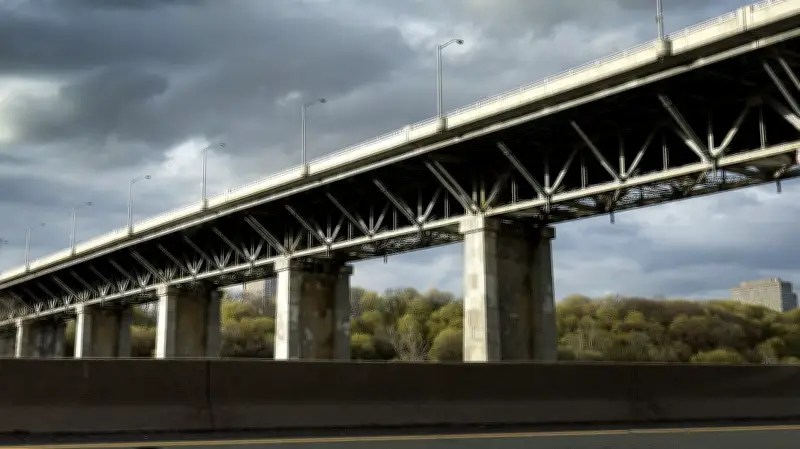
Harold Lusthouse's family still cannot comprehend the tragedy of Father's Day in 2024, when someone plunged from Toronto's Leaside Bridge to the roadway below, killing the father of three.
A Fatal Father's Day
TORONTO — A 2007 Lexus was coursing up the Don Valley Parkway en route to the suburb of Thornhill. It was noon on a sunny Sunday, June 16, 2024. Father's Day.
The driver was a woman named Cheryl G., wife of front-seat passenger Harold "Hushy" Lusthouse, a 76-year-old retired accountant, avid golfer, and collector of rare Scotch bottles. They were on their way to visit Harold's daughter, Tali, for a holiday brunch.

Lusthouse, who had a slight cold, had spent the morning with his son, Landon, at an exhibition of art by Banksy. Now the son, trying to avoid contracting his father's virus, was scurrying to join them in a separate car after picking up his dog, Lola.
What happened in the next few seconds as the Lexus crossed under the century-old, 12-storey-tall Leaside Bridge was so chilling and ghastly that most people to whom I have told the story say it must be a writer's invention. But if this were fiction, there would be no suddenly fatherless children in this city, and no father suddenly without a son.
As best as it can be reconstructed, a person on the bridge went over the shoulder-high railing — whether as an intentional act of self-destruction or accidentally, perhaps slipping while taking a selfie or pranking atop the fence for a TikTok video — and plummeted toward the six-lane roadway just as the Lexus passed below.
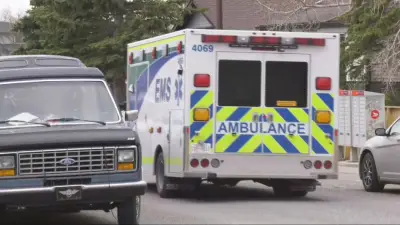
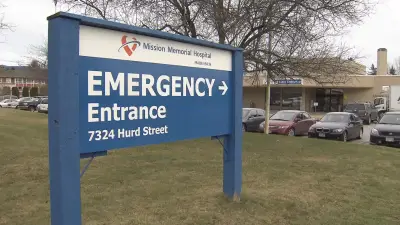
The falling pedestrian impacted the right side of the windshield and was killed instantly. In the front seat, Lusthouse took the force of the impact. Somehow, Cheryl was able to stop the vehicle. Except for a few scratches, she was physically uninjured. A nurse in a passing car witnessed the impact, pulled over, rushed to the Lexus, tugged Lusthouse out of the wreckage and restored his respiration and pulse. But his injuries were too severe. Two days later, Lusthouse died in hospital.
Search for Answers
I have spent the past year seeking to learn more about the man in the Lexus and about the person who jumped, or was thrown, or fell from the overpass like a meteor. The official police and coroner's records are sealed from public view for privacy reasons.
Two of Harold's three children — Tali Uditsky and Landon Lusthouse — have spoken passionately at Toronto City Hall about the need for a barricade at the Leaside Bridge that might prevent future tragedies.
One publicly available document from the Ontario Superior Court of Justice identifies the pedestrian on the bridge as a male with a name common to the Tamil populations of Sri Lanka and southern India. No age, occupation, address, marital, immigration, educational status or medical history is included. Search the man's name online and there is nothing.
The Office of the Chief Coroner of Ontario will tell me only that the incident was not a case of an "unclaimed deceased person." So there must have been a family member, a friend or a charity that claimed the body. But this is guesswork. The prominent Tamil funeral homes in the Toronto region have no record of this particular deceased. The editor of the Tamil Times says he vaguely recalls the incident but adds, "We do not report suicides."
A Family Stricken
"I can't find an explanation for this," Joodi Pollock, Harold Lusthouse's first wife, says. "I feel sorry for the person who jumps 150 feet from a bridge. He's not trying to hurt someone else."
Pollock worries about Cheryl, who was driving the Lexus on that fateful Father's Day. "How can she even close her eyes at night, I don't know," Pollock says.
Then she tells a story that her own children have never heard before. When she was six months pregnant with Tali, Harold had a car accident. The front end of his car was T-boned by another vehicle with such force that the hood and engine were sheared away. Harold was left sitting in the driver's seat with his legs dangling into space. He would live another half century. "He was unharmed," Pollock says. "The car was split in half. It was a miracle. He escaped something that maybe he shouldn't have. He was a ghost who came out of that car."

Landon Lusthouse recalls the day: "We usually always travelled together. But he had a little cold, so we went separate. And then I was coming home to get Lola. I was zigzagging through the city to get here, to get the dog. I didn't even make it halfway home from the exhibit. And then Tali called me. The first call was just, 'Dad was in an accident.' Neither one of us knew the level. We didn't understand. I was just like, 'Oh, he's going to be delayed.'"
Tali Uditsky adds: "The second call was totally different. The wife of one of Cheryl's sons called me and said, 'They are not going to be coming to you for brunch.' And then she told me that a man, a person, jumped off of the bridge and landed on their car. I didn't quite register that this was what it was. How do you absorb that you're never going to see your father again?"
Organ Donation a Silver Lining
"When we realized that Dad was not getting better," Tali says, "and when we realized that he was going to go, the only thing that gave me and my brother strength is thinking that potentially somebody could benefit from his tissues and his organs. It's a silver lining. It's the only thing we had left."
Uditsky has become a passionate advocate for organ donation, dismayed by Canada's standing in the middle of the pack of prosperous nations. In 2024, Canada ranked 12th in the world for organ donation by percentage of population, with a rate of living donors more than 25 per cent lower than the United States.
"It's kind of a crazy thing to say and to hear, but some people feel that if they sign that, 'Yes, I'm willing to be an organ donor,' perhaps the doctors won't work as hard for them," Uditsky says. "One of the reasons that I think Canada has one of the lowest success rates for people saying that they're willing to be a donor is that we live in a very big melting pot of cultures. The best solution to this problem is that families need to have conversations with each other. What is your comfort level with this? Have the conversation. That's all I'm asking for moving forward, that people talk."
Deaths of Despair
Dr. Mark Sinyor of Sunnybrook Health Sciences Centre, with 20 years of research into what he calls "deaths of despair," says: "The majority of suicides are relatively impulsive. When we are talking about lower-lethality methods, people do survive. One of the terrible tragedies that we know from talking to survivors is that people who attempt suicide often immediately regret it."
Two years ago, Sinyor and a team of six specialists produced an academic paper examining all suicides in Toronto from 1998 through 2023. Hanging (1,721 cases), jumping from height (1,280) and poisoning (955) were the most prevalent methods. "People who died by jumping from height were the youngest group and more likely to be female. They were least likely to have past suicide attempts and leave suicide notes."
"There is a myth that has been around for decades, if not hundreds of years, that suicide is not preventable," Sinyor says. "But strong interventions — not just clinical, but public health messages and barriers — they prevent suicide. They save lives."
Returning to Leaside Bridge
"What happens when you pass by Millwood Road and you go under the Leaside Bridge?" I ask Harold Lusthouse's children. "The first time," Tali says, "I had to be on the phone with my husband. I phoned him and I said, 'I'm about to go. I need to be on the phone with you,' and he stayed on the phone with me. And it was … it took my breath away."
Last October, the City of Toronto prepared a report examining a safety barrier on the Leaside Bridge, a quarter-century after the Luminous Veil on the Bloor Street Viaduct virtually eliminated that structure as a suicide destination. The panel recommended the immediate installation of a curved fence as a temporary measure at a cost of $2.4 million, and permanent barrier design as part of the next major project for the bridge, currently programmed for 2037. Construction of the interim barrier will soon begin, with completion expected in December.
A Grieving Father
After months of searching for the person who fell to earth that awful Father's Day, I found a father in Etobicoke. A slender man, brown-skinned, about 60 years old, opened the door. I asked if the person was his son. He nodded. "No newspapers," he said. "No talking." "We have had enough of tragedy," the father said. And, firmly, he closed the door.
If you're thinking about suicide or are worried about a friend or loved one, please contact 988: Suicide Crisis Helpline by calling or texting 988 toll-free. The service is available 24/7. If you or someone you know is in immediate danger, call 911.