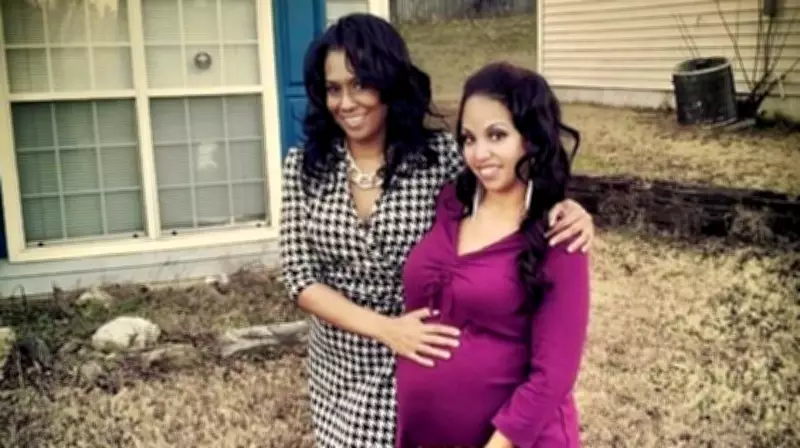
Janice Robinson-Celeste almost died giving birth 42 years ago. As a college freshman, she discovered she was pregnant during a military physical. When she arrived at the hospital to deliver, the attending physician examined her with visible disgust, shouting that her baby would be "too small," as if her young Black body had already failed. As labor progressed, she repeatedly said something was wrong, but her concerns were dismissed. She was left alone in a barren room.
Her husband entered the dimly lit room and later described it as resembling "a murder scene." Blood had pooled on the floor beneath her, yet no one checked on her. She was abandoned until he arrived. Two days later, she delivered a healthy baby girl weighing almost eight pounds. She left the hospital in severe pain, later diagnosed with an undiagnosed broken coccyx—an injury overlooked because her symptoms were not taken seriously.
That was 42 years ago, and her experience remains vivid and relevant. Today, she understands her experience was not isolated. Black mothers are still too often ignored, questioned, and placed at unnecessary risk.

She was reminded of these moments when the White House announced its action plan to address maternal health issues. The government website, moms.gov, is supposed to provide resources for new and expecting mothers, yet there is no mention of addressing the mortality crisis faced by millions of women who look like her.
Recently, Rep. Summer Lee (D-Penn.) challenged Health and Human Services Secretary Robert F. Kennedy Jr. on how anti-DEI policies could set back critical research into Black maternal mortality. She argued that the crisis will continue if policymakers refuse to acknowledge the specific disparities Black mothers face. Kennedy responded by placing a broad "everybody is included" blanket over the issue instead of directly addressing how his department will specifically protect Black women, who remain at greater risk than any other race.
Black women in the United States remain far more likely to die from pregnancy-related causes, even though most of those deaths are preventable. Even as maternal death rates began to decline nationwide in 2023, Black women were still more than three times as likely to die from pregnancy-related causes as white women, revealing how little has changed in the unequal realities of maternal healthcare.
High-profile stories have drawn attention to this crisis. Serena Williams shared her life-threatening complications after medical staff initially dismissed her concerns. Earlier this year, Kashena Manuel delivered her son in a Texas hospital bathroom after reportedly being ignored while in active labor. More recently, Janell Green Smith, a nurse-midwife dedicated to maternal health, died less than a week after giving birth. Their stories reflect what many Black women experience without headlines or national attention.
What is discussed far less often is that these experiences do not end with one generation. Robinson-Celeste's eldest daughter, the child she nearly lost her life bringing into the world, is now an adult. When it came time for her to give birth, she chose to have both of her children at home with a doula's support. Her decision was rooted in fear that a hospital would not listen to or protect her. Her youngest daughter could have died after childbirth when she developed a spinal headache caused by an epidural puncture that was overlooked as she was sent home from the hospital. She later fainted at home before being rushed back to the emergency room.
Now, as another daughter hopes to become pregnant soon, Robinson-Celeste finds herself carrying that fear forward. She worries about her safety in a biased and racist system that continues to produce unequal outcomes. At times, she has even wished that she could give birth in another country, where the risks are lower.
Some will argue that hospitals are safe places. But laws such as the WELLS Act, named after a Black mother who was repeatedly refused care, and the Momnibus Act, a package of bills designed to address maternal health disparities, exist because hospitals have not consistently protected Black mothers. Legislation matters, but it does not erase human bias or the lived fear many Black women carry into childbirth.

No mother intends to pass her fears down to her daughters, yet for many Black moms, the fear of maternal mortality is grounded in real life and supported by data that cannot be ignored. Robinson-Celeste's hope is that future generations will inherit something different: a protective healthcare system that, without question, listens, responds, and values Black women's lives and their infants' lives.