Father's Day offers a chance to ask not just what our children need from us, but what we as dads might need ourselves.
A Father's Day Reflection
If we want children to spend less time online, where do we want them to be instead? Most parents can answer immediately: outside, with friends, playing soccer in a park, learning guitar, helping at a community event, walking in the woods, or sitting around a dinner table.
Over the past few years, that question has taken on new urgency. Concerns about youth mental health have moved from the margins of public discussion to the centre of it. The conversation has been especially focused on boys and young men, with growing attention to loneliness, declining participation in community life and the challenge of finding connection.

The proposed solutions are surprisingly familiar: Move your body. Spend time with other people. Help someone. Join something larger than yourself.
Looking Inward
The more I think about it, the more I wonder whether this conversation belongs only to children. We spend a lot of time worrying about whether our children will make friends, find their people and feel accepted. We spend less time talking about how many parents are asking the same questions. Where do we belong? Where do we find friendship?
We have been discussing how to help children grow up with smartphones, social media and a constant stream of notifications competing for their attention. Those concerns are real. But they can also become a way of avoiding a harder question. Father’s Day offers a chance to ask it. Not what our children need from us, but what we as dads might need ourselves.
The Evidence on Loneliness
A national Canadian survey found that nearly one in three men reported severe loneliness. When researchers followed men over time, the single strongest predictor of whether loneliness led to depression was not how many people a man knew. It was whether he felt deeply understood by the people around him.
The evidence on what helps is consistent and simple. A study of nearly 20,000 people found that two hours a week in nature, however you split it up, was the threshold associated with better health and well being. A walk around the block after dinner counts, family meals, too. Research on parents found that eating together regularly was associated with stronger family relationships and lower stress, and the benefits were equally strong for fathers and mothers.
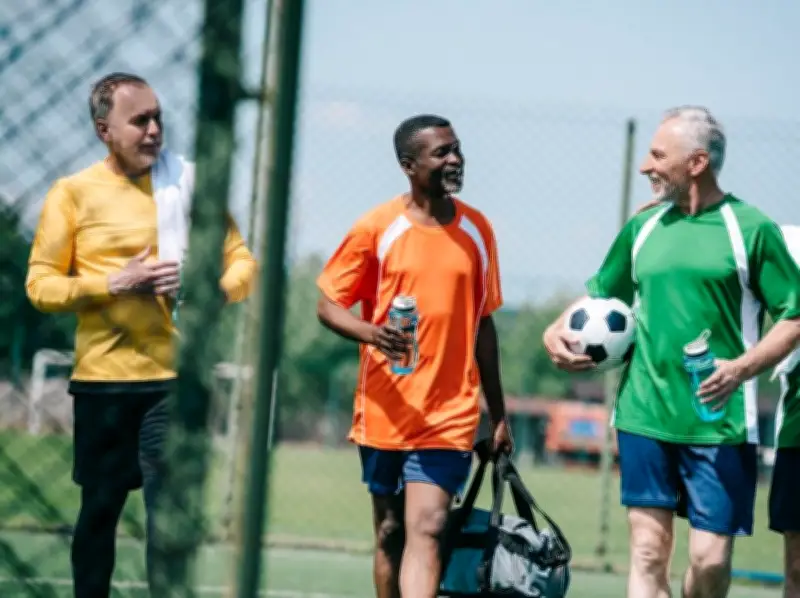
Movement helps, too, especially when it comes with a team. A population study found that depression rates were nearly twice as high among adults who did not belong to a group sport, and the protective effect came less from the exercise than from belonging.
Joining a Team
Last fall, I joined an adult basketball league. I am not very good. Learning a new sport as an adult is humbling in ways no one warns you about. Some younger players move faster, older players somehow move smarter, and there are plenty of evenings when my contribution to the game is mostly enthusiasm.
I need to psyche myself up to get out the door every Tuesday. But I am glad I do. I remind myself that the point was never to become a great player. The point was to have somewhere to connect with other adults. To see familiar faces, laugh, sweat, and be part of something.
After games, we linger and joke around, sometimes grab food. The conversation is usually about basketball, other sports that I don’t follow, work, kids, parents, and whatever happened that week. Nothing profound and no life lessons. Just chatting with other adults.
When I think about what I want for my children, it looks surprisingly similar. Not a perfect life and not constant happiness. A community. People who notice when they show up and when they don’t.
Dr. Jamil Jivraj is a child and adolescent psychiatrist and clinical assistant professor at the University of Calgary.