Finding Echoes of Self: A Trans Woman's Appalachian Journey of Resilience
The morning air carries the scent of damp rust and lingering cigarette smoke. Balancing coffee on the porch railing, I watch a woodpecker rhythmically hammer against a dead tree while an ATV roars to life down the road. A tardy rooster finally announces the day. In this holler, noise serves as a reminder to the world that you're still here, still breathing.
They call it a holler, but most days it feels more like an echo. Sound travels through these ancient hills and returns diminished, thinner, as if the mountains themselves have grown weary of carrying difficult messages. The creek maintains its constant chatter unless drought silences it. The frogs remain indifferent to presidential politics. The trees whisper secrets older than human prayer. And I continue learning how to truly listen.
A Place That Remembers Everything
I live at the bottom of a hollow in Dickenson County, Virginia, where morning mist clings low to the ground and history never fully departs. The dirt road winds downward like a poorly healed scar that still holds memory. Here, everyone knows your business before you do. They remember what your mother said in 1986 and who you dated in high school, preserving both with scriptural reverence. Appalachia can love you fiercely, but it never forgets what it believes you to be.

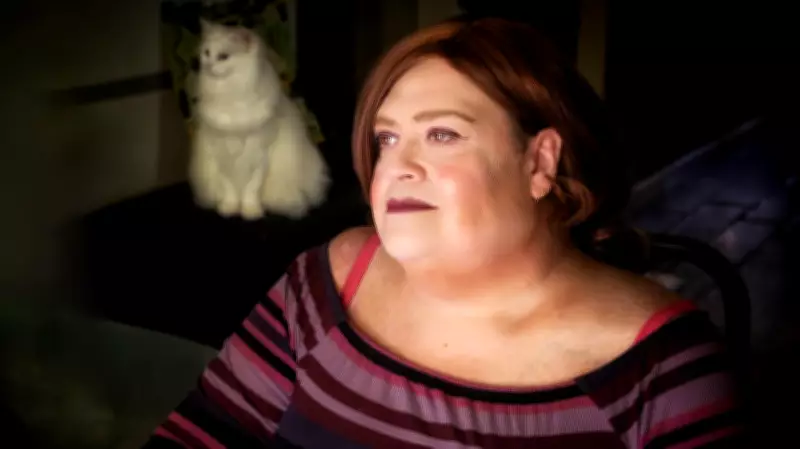
These days, people call me Maya. This still surprises some folks, even though it's been over five years. I imagine gossip spreading like kudzu through convenience stores and shuttered diners. I came out as a transgender woman at age 44 during the pandemic, in one of Virginia's most conservative counties. While the world seemed to unravel on television screens, I was finally coming together within the walls of my home.
When I spoke my truth, there were no fireworks or parades—just a profound quiet that pressed against my ribs. For decades, I had pretended to be someone who could navigate this place more easily than my authentic self could. I was the funny one, the dependable one, the man who never looked quite right in his own reflection. Then the world shut down. Masks covered faces, streets fell silent, and time thickened like syrup. For the first time in my life, there was nowhere to escape from the mirror.
The Quiet Revolution
It happened simply: one morning, looking at my unshaven, exhausted reflection, I decided I would rather be hated for my truth than praised for a lie. I told my daughter first. She smiled, said she understood, and hugged me so tightly I wept. Next came a few close friends. Not all remained, but those who did became the foundation of my new existence.
Coming out here wasn't an act of rebellion but one of survival. The hollow possesses long memory and short mercy. I understood what I risked—my safety, my social connections, my sense of belonging—but I also knew the alternative was dying quietly, piece by piece, in plain sight.
Then there's my leg. Below the knee, gone for over seven years. I still dream about its weight sometimes—the phantom ache, the unscratchable itch. Losing it taught me what the physical body can endure. Coming out taught me what the soul can survive. I joke about being part machine now, but the truth is my prosthetic feels more authentic than the man I once pretended to be.
The hormones didn't just soften my skin; they softened my perception of the world. Everything I had been numb to began to register again: grief, joy, even boredom. Especially boredom. I once feared it; now it feels like breathing. Rebirth isn't a single moment but a process of continuous combustion. Each time I share my story, a little more of my old self burns away.
Navigating Complicated Terrain
Living as a leftist trans woman in MAGA country resembles speaking a language nobody wants to admit they understand. People here are complex—God-fearing and gun-loving, kind and cruel within the same breath. They'll pray for your soul on Sunday and vote against your existence on Tuesday. You learn to read body language quickly: the prolonged stare at the grocery store, the clerk avoiding eye contact, the neighbor's wife suddenly fascinated by the ground as you pass.

There's the maintenance person who charges a reasonable rate for work on my house but won't speak my name aloud. The cashier who whispers "You look nice today" as if offering contraband. The estranged family member who secretly follows my author page. Here, every kindness arrives wrapped in camouflage.
I recall one afternoon at Food City. A man in a camo jacket looked me up and down, muttering about "men in dresses." His wife smacked his arm without glancing at him, simply saying, "Don't you start." I'll never know whether she meant it as protection or embarrassment, but it worked. I kept both my groceries and my dignity.
That's how it unfolds here—precarious kindnesses, accidental mercies. The same person who once used a slur might still pull your car from a snowy ditch. Nobody discusses it afterward. Reciprocity speaks a language older than politics.
Struggle and Survival
People are struggling here. Coal has practically vanished, jobs have disappeared, and hope seems discounted at Family Dollar. Yet every yard displays a flag—larger than the porch, brighter than the future it pretends to promise. Riding past "TRUMP 2024" signs, I think: you can't eat patriotism. The same people who cannot afford insulin cheer billionaires who would step over their bodies for a tax cut.
Still, I love them. Or perhaps I love the version of them that existed before fear became the dominant religion. I want to believe we can find each other again somewhere between wreckage and redemption.
Creating New Worlds
When the world feels small, I build new ones. I paint. I write. I construct tiny battlefields for my Warhammer armies, applying lava and smoke to plastic that will never breathe yet somehow feels alive. My Tyranids emerge as volcanic nightmares with obsidian claws and molten sinew. My Salamanders wield flamethrowers, glowing like the forge itself. I'm not religiously affiliated. Creation is how I pray. Paint, glue, story—all represent resurrection in different forms.
I belong to a small mutual-aid art collective called Patchwork Kinfolx. We create art, exchange food, and share warmth. We don't possess much, but we have each other. We raise funds for queer individuals who cannot pay rent, organize pop-up art shows in borrowed spaces, and host what might be the queerest family reunion on the planet, where laughter fills the air like incense. This isn't utopia. It's survival made beautiful.
We sit shoulder-to-shoulder at Pride events, our work displayed while we snack on chips and eat pizza from paper plates. Someone has painted canvases; another, a series of Pride bricks. The radio plays, and everything feels perfect. For a few hours, nobody is afraid. We're just color and noise and belonging.
In a county where library funding gets cut and the arts are viewed as frivolous, we've constructed our own temple from paint-stained tables and folding chairs. Our currency is compassion. Our economy is care. When someone's heater fails, another arrives with blankets. When someone lacks groceries, we share what we have without interrogation.
All of us are queer, trans, or otherwise "other." We're the town's invisible artists, its inconvenient miracles. The collective is where I cease feeling like a curiosity and begin feeling like a person again.
The Weight of Silence
But for every night of laughter, there are ten nights of silence. A particular loneliness accompanies living where your truth feels like a foreign language. You learn to carry your own echo. Scrolling through social media, I observe the vibrant swirl of queer life in cities and wonder what it would feel like to simply exist—to enter a bar without bracing myself, to hold my partner's hand publicly without calculating escape routes.
Isolation here isn't merely physical; it's cultural and spiritual. You begin shrinking your gestures to fit within others' silence. You stop correcting people when they misgender you because exhaustion often defeats hope.
One night, I nearly deleted everything—every page, every painting, every digital trace of myself. I thought: if the world wants silence, I'll provide silence. Then my phone buzzed. A message from a young trans kid I met in Pikeville, Kentucky: "Your book made me feel real." I sat crying in the dark, the holler humming like a lullaby. I didn't quit.
Evolving Together
They claim Appalachia is dying, but I disagree. It's evolving, as I did—slowly, painfully, beautifully. The same stubborn spirit that raised me refuses to release me, regardless of how much it hurts. These hills are harsh, but they hold me. When sunlight strikes them just right, everything turns golden—the rusted trucks, the kudzu, even the broken glass in ditches. Beauty doesn't require permission to exist.
I've learned the hollow isn't empty. It's waiting to be filled—with laughter, with art, with defiance. Each time someone queer or trans or disabled or different decides to stay, we plant our own flag. Not the kind waving on porches, but the kind declaring: I'm here, and I'm not leaving quietly.
I've been called many things: sinner, survivor, miracle, mistake, authentic, abomination. But mostly, I'm a storyteller. Stories are how we outlast silence. Each time I speak my truth, I create space for someone else to do the same. That's what living in the hollow truly means—learning to send your voice through the mountains, hoping it finds another voice to answer back.
When the sun drops behind the ridge, the creek resumes its conversation. I light another cigarette and listen. The echo returns softer, but it always returns. Perhaps that's what survival really is: learning to answer yourself.
I still don't know if I belong here. Maybe belonging isn't the point. Maybe the point is to exist so completely that even those who hate you must acknowledge you're alive. Maybe the hollow is less a place and more a lesson: that life, like sound, doesn't cease when it meets resistance—it simply echoes.
So I stay.
I stay because someone must keep telling the story.
I stay because the creek keeps talking, and the mountains still listen.
I stay because every time I look at this place—scarred, stubborn, and still standing—I see myself.
And that's enough.