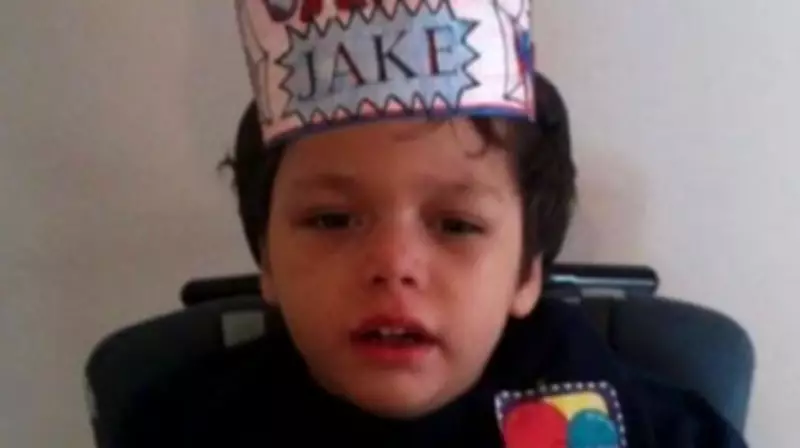
My son Jake died when he was 4 years old. Fifteen years after his death, I still struggle with how to answer the question everyone asks: What happened? It is such a simple question, one I might even ask when I hear about a child's death. Yet, it leaves me tongue-tied every time and instantly makes even the best conversations feel awkward. Why? Because I still do not know what happened. I do not know why Jake first got sick. I do not know why he did not recover. And I do not know why he died.
A Healthy Beginning
Jake was born healthy and remained that way for the first eight months of his life. He was not just healthy; he was thriving. He had high APGAR scores, no weight drops, and met all early milestones ahead of schedule. That is why what happened did not make sense to me. It did not even make sense to some of the world's best doctors. So why should I expect it to make sense to people who unknowingly step into a minefield by asking that question?
That is why it makes me so uncomfortable: I know where the conversation is going, and it is not good for anyone involved. Should I just tell them my life changed in a split second? Should I walk them through all the details from the early morning of Jan. 21, 2007, when I first saw the twitch of Jake's hand when he was 8 months old? Should I say that my husband, Brian, thought it might be a muscle spasm, but my gut told me it was more? How much time does this person have, and do they really want to hear it all?

The Seizure That Changed Everything
I could say that we went to the ER, and much to our surprise, the twitch was quickly identified as a seizure. Back then, Brian and I thought seizures looked like they did on TV: a big, dramatic drop to the ground, full-body convulsions, maybe even foaming at the mouth. We never thought it could be a small, albeit rhythmic, movement of the hand.
At the beginning of that awful night, and even when we were in the emergency room, Jake was completely himself. Cute. Charismatic. He flirted with the nurses. What I did not know then was that those smiles and giggles would be the last ones we would ever see, that the 24 hours before that hand twitch would be the last time we would see Jake sit up, scoot, feed himself, roll, or do any of the things healthy 8-month-olds do. Should I tell them that, too?
That initial seizure led to a 117-day stay at Boston Children's Hospital. Jake was no longer able to sit up or roll over. He could not eat or take a bottle and was put on a feeding tube. He could not even smile or giggle anymore.
The Search for Answers
Every two weeks, we were assigned a new attending doctor. At first, that felt promising. A new set of brilliant eyes. Someone who would finally come up with a diagnosis for Jake, and an answer for us. Because there had to be one, right? Six weeks in, one doctor told us we might never get a diagnosis, and that every time a test came back negative, we should be happy. Happy that Jake did not have the things they were testing for, because those things were so awful, so rare, so fatal. I tried to believe him. I was not happy, but I tried to hold on to hope.
Eventually, we were discharged, but we still did not have any answers. We returned home as a very different family. As parents, our primary job is to keep our kids safe, but we no longer knew how. Jake had lost all of his milestones, and we were immersed in the world of early intervention, physical therapy, occupational therapy, speech/language pathology, and more. You name it, we did it. Every new therapist, doctor, and all our family and friends asked that same question: What happened? Without a diagnosis, I did not know how to give them an answer, and I still do not. All these years later, it is still the thing that keeps me up at night. It is the thing my rational mind cannot make sense of. How did we spend all that time at one of the top pediatric hospitals in the country, yet no one could give us an explanation? How do I make peace with a world where life can change so quickly for no reason at all?

Jake's Fight
Jake fought against this unknown disease for four years. He endured countless procedures, hospital stays, and never-ending therapy sessions, all with the hope that we could turn back the clock and go back to what life was like for those first eight months. There were so many ups and downs, moments when Jake would be getting stronger. With the help of his therapist, Xavier, he could even ride his favorite fire truck. But there were also terrifying moments, like when he broke his femur just by moving in his sleep.
Then came Dec. 8, 2010. It started as an ordinary Wednesday. Nothing happened that would indicate it would turn out to be Jake's last day. He did all his normal things: came with me to walk his big brother Ethan to school, had some therapies, and spent a great afternoon playing. But while I was feeding Jake his ketogenic dinner, he aspirated. Ethan called 911. Although paramedics and firefighters arrived within minutes, it was too late. They could not get him back.
The Unanswerable Question
The death certificate said the cause of death was aspiration. But that is just the headline, and it does not begin to tell the whole story. I understand that it is human nature to want to know why a young child dies, and nobody wants an answer more than I do. However, without that answer, the question not only makes me relive my own confusion, but it also makes me feel judged. How can a mother not know how her own child died? How can I have failed to keep my child alive?
I find myself saying things like, "He had really bad luck" or "There is just so much doctors do not know." When people press for more, I fall back on a stock answer: "He had a seizure out of nowhere when he was 8 months old. No one knows why. We spent 117 days at Boston Children's Hospital. We never got a diagnosis."
A New Perspective
A good friend recently shared a story about one of her longtime friends whose husband died in an accident. The details were irrelevant, but that does not stop people from asking about them. I was shocked when I learned that the widow answered the "What happened?" question with: "It does not matter." It never occurred to me that this was an option. Maybe I was raised to care too much about what others think and therefore to err on the side of politeness. Maybe I worry that this answer would elicit even more judgment. Honestly, I do not care anymore. I think it is a brilliant response. It might also spare me and the person asking the question the awkward conversation that inevitably ensues.
There will never be a diagnosis. There will never be an explanation. So, I think it is time I stop trying to give people one. In my early days of grief, I so desperately wanted to provide people with the answers that I did not have. I did not want them to be as confused as I was. But none of that matters to me now. Hearing about this other loss and the way that the widow answered the question of what happened made me realize I was not alone. This is my story to share or not, just like hers belongs to her. It is not my job to come up with a satisfying answer or a story that will make people feel better about what I have been through. Am still going through.
Remembering Jake's Life
What people do not understand is that I would rather talk about Jake's life than his death. About who he was and what he loved to do. I would love to share that his favorite toy was his red fire truck and that his favorite shirt said, "Believe the hype." In the end, that is what really matters. Those are the kind of questions I will never get tired of answering.
Heather Straughter is the host of "A Place of Yes," a podcast exploring grief, loss, and joy. She is the president of Jake's Help From Heaven, a nonprofit supporting families of children with complex medical needs. Her writing has appeared in Newsweek and Business Insider. She lives in Saratoga Springs, N.Y., with her husband, Brian, and their son, Ethan, who attends Syracuse University.