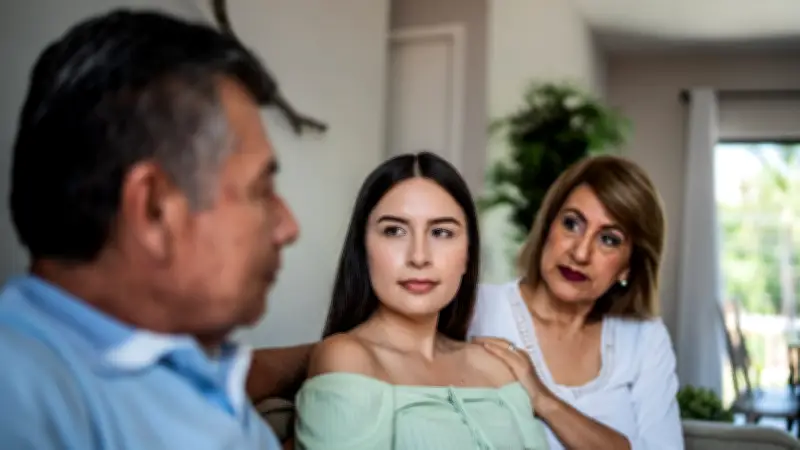
As the eldest daughter in her Nicaraguan family, author Prisca Dorcas Mojica Rodríguez was expected to cook as well as her mom from an early age. Her sister wasn't taught any family recipes, and her brother didn't have to learn them either. For one childhood birthday, her father gifted her a cooking pan. "He was so proud," she recalled. "I was so mad, because I was like, 'I don't want a pan, I want money, I want to go buy press-on nails.' But that was important to them, that I knew how to cook."
Mojica Rodríguez was not just the keeper of her family's recipes; she also served as translator for her mom's doctor visits and college counselor for her younger sister. Later, she learned that her experience had a name: "eldest daughter syndrome," a term popularized online to describe the overwhelmed firstborn daughter who does unrecognized work to keep the household running. For eldest daughters in immigrant families, that pressure is even more intense.
The Unique Burden of Immigrant Eldest Daughters
"As an eldest daughter of Chinese immigrants, you're expected to be honorable and take care of your family before you're even born," said Sherri Lu, a New York City-based content creator who leads an Eldest Daughter Club. Mojica Rodríguez added, "We are the final boss" of eldest daughters. Licensed psychologist Lisette Sanchez, who works with eldest daughters of immigrants and is one herself, explained, "There's not just an expectation to help family, but to serve family." She noted that when you're the firstborn daughter of immigrants, you can often be the emotional anchor of the family—whether you like it or not.

Linda Yoon, a therapist and founder of Yellow Chair Collective, which has a support group for eldest daughters of immigrant families, highlighted the distinction between eldest sons and daughters. "The difference is not that eldest sons have it easy. It is that eldest daughters are often expected to carry responsibility without it being named as responsibility. Their labor is treated like love, duty or personality."
Advisers and Translators—Whether They Like It or Not
Eldest daughters frequently become de facto adults for their parents and younger siblings. Yoon recalled being told she was the "second mom" to her younger sibling. Sanchez explained that emotional parentification—placing children into adult roles before they are developmentally ready—is common. "We feel responsible for the emotions of the people around us," she said, leading to thoughts like, "If I behave a certain way, then mom will be happier." Sanchez shared that her parents would discuss marital problems with her, and it wasn't until she got older that she realized she had to tell them they couldn't talk to her about that.
They also often serve as family translators, handling weighty tasks like preparing documents for parents' U.S. citizenship. "That's a really heavy pressure to place upon a child," Sanchez said. Yoon added, "Some may translate language, but they may also translate culture. They explain American systems to their parents, and then explain their parents' expectations to the outside world." Mojica Rodríguez recalled witnessing people being dismissive and rude to her parents, saying, "Why don't they learn English?" and choosing not to translate that cruelty.
How Moms Perpetuate the Cycle
Many mothers who demand more from their eldest daughter were once eldest daughters themselves. "Often it's coming from a place of survival," Sanchez said. When Lu complained about always being the sister taking out the trash, her mom saw it as natural: "You're older, you should just take it out. It is your responsibility to always do more because you have the privilege of being the oldest." Lu started Eldest Daughter Club because she tried to talk to her mom about it, but her mom didn't see the issue.
There is even a genetic component. A 2024 study found that mothers who experienced high levels of prenatal stress had first-born daughters who went through puberty sooner. One researcher suggested this early maturation might enable the daughter to become a "helper-at-the-nest" sooner for her mother's future offspring.

What Eldest Daughters Can Unlearn as Adults
Breaking free from these expectations is possible. For Mojica Rodríguez, moving out of Miami helped her see the imbalance. When she visited, her dad would have stacks of papers waiting for translation. "That's when I started being like, 'Ask your son who lives 10 minutes away,'" she said. Yoon noted that it's common for eldest daughters to feel guilty for moving away or choosing careers their parents don't understand. This guilt can fester into resentment. "They love their family, but they are tired of being needed. They want closeness, but not obligation," Yoon said. "Underneath many of these experiences, there is often grief. Grief over not having had a carefree childhood. Grief over feeling conditionally loved, and not always protected."
Setting boundaries is crucial. Sanchez advised responding to guilt-inducing comments like "I never see you anymore" with, "Sounds like you miss me and want to spend time with me. Here's how I'm available for that." Yoon emphasized, "Your help is not unlimited. Setting a limit teaches your family that your help is not unlimited. It also teaches your nervous system that setting a limit does not mean you are abandoning people."
Sometimes, talking to family can lead to understanding. Lu said her mother began to unlearn her own eldest daughter experiences through following Lu's content. If closer connections aren't possible, setting limits can provide clarity. After a fight, Mojica Rodríguez set a hard boundary and hasn't spoken to her mother since 2023. "I'm going to text her when I stop being angry," she said. Yoon noted, "Sometimes guilt simply means you are doing something new and stepping out of an old role where your worth came from being endlessly available."
The Strength of Being an Eldest Daughter
Despite the challenges, being an eldest daughter of immigrants can be an advantage. A 2014 study found that eldest daughters are the most likely sibling to go to college, regardless of parents' education and professional achievement. Sanchez said eldest daughters are trained to lead and be "cultural brokers," as they raised themselves to anticipate different needs. "When you are the eldest, you are always going to be more resourceful, and you're going to adapt in the best way you can."
However, being constantly strong can lead to burnout. Mojica Rodríguez said she didn't know how to ask for help because she didn't expect it. "That's not great if you're trying to build real authentic community," she said. Healing can involve finding others who understand. Lu's Eldest Daughter Club hosts virtual journaling meetups with prompts on setting boundaries and healing the inner child. Mojica Rodríguez is writing a modern-day young adult novel about an eldest teen daughter navigating her immigrant family's deportation, taking care of her siblings, and what she will wear to the school dance. "I'm having fun. It's sad, but it's also healing," she said. "There are things I wish I would have said that I'm allowing her to say."